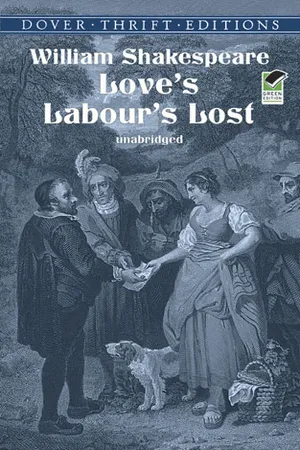
In this charming comedy of manners, one of Shakespeare's earliest efforts in the genre, a well-intentioned king vows to forego all fleshly delights, setting the stage for romantic hijinks. Ferdinand, the king of Navarre, insists that his court join him in a pledge to undertake a strict regimen of study and celibacy. The grudging compliance of three noblemen is sorely tested — as is the king's own resolve — with the arrival of a French princess and a trio of comedy attendants.
First performed in 1594, Love's Labour's Lost features such typical Shakespearean elements as lovers in disguise, a witty clown, and an abundance of sparkling repartee. The play's role as a formative work (the plot is thought to be entirely of Shakespeare's invention) makes it of particular interest to students and scholars, and its merry doings and high spirts recommend it to all.
- 96 pages
- English
- ePUB (mobile friendly)
- Available on iOS & Android
eBook - ePub
Love's Labour's Lost
About this book
Information
ACT V.
SCENE I. The Same.
Enter HOLOFERNES, NATHANIEL, and DULL
HOLOFERNES. Satis Quod Sufficit.
NATH. I praise God for you, sir: your reasons at dinner have been sharp and sententious; pleasant without scurrility, witty without affection, audacious without impudency, learned without opinion, and strange without heresy. I did converse this quondam day with a companion of the king’s, who is intituled, nominated, or called, Don Adriano de Armado.
HOL. Novi hominem tanquam te: his humour is lofty, his discourse peremptory, his tongue filed, his eye ambitious, his gait majestical, and his general behaviour vain, ridiculous, and thrasonical. He is too picked, too spruce, too affected, too odd, as it were, too peregrinate, as I may call it.
NATH. A most singular and choice epithet.
[Draws out his table-book.
HOL. He draweth out the thread of his verbosity finer than the staple of his argument. I abhor such fanatical phantasimes, such insociable and point-devise companions; such rackers of orthography, as to speak dout, fine, when he should say doubt; det, when he should pronounce debt,—d, e, b, t, not d, e, t: he clepeth a calf, cauf; half hauf, neighbour vocatur nebour; neigh abbreviated ne. This is abhominable,—which he would call abbominable: it insinuateth me of insanie: ne intelligis, domine? to make frantic, lunatic.
8 Novi hominem tanquam te] This phrase occurs in Lily’s school grammar (1527), a standard educational manual of the day.
20 abhominable] This was the common orthography in the sixteenth century, probably from the mistaken notion that the word was derived from “ab homine” and not from “ab omine.” Holofernes champions the popular error.
NATH. Laus Deo, bene intelligo.
HOL. Bon, bon, fort bon! Priscian a little scratched; ’t will serve.
NATH. Videsne quis venit?
HOL. Video, et gaudeo.
Enter ARMADO, MOTH, and COSTARD
ARM. Chirrah! [To MOTH.
HOL. Quare chirrah, not sirrah?
ARM. Men of peace, well encountered.
HOL. Most military sir, salutation.
MOTH. [Aside to COSTARD] They have been at a great feast of languages, and stolen the scraps.
COST. O, they have lived long on the alms-basket of words. I marvel thy master hath not eaten thee for a word; for thou art not so long by the head as honorificabilitudinitatibus: thou art easier swallowed than a flap-dragon.
MOTH. Peace! the peal begins.
ARM. [To HOL.] Monsieur, are you not lettered?
MOTH. Yes, yes; he teaches boys the horn-book. What is a, b, spelt backward, with the horn on his head?
HOL. Ba, pueritia, with a horn added.
MOTH. Ba, most silly sheep with a horn. You hear his learning.
HOL. Quis, quis, thou consonant?
MOTH. The third of the five vowels, if you repeat them; or the fifth, if I.
HOL. I will repeat them,—a, e, i,—
MOTH. The sheep: the other two concludes it,—o, u.
ARM. Now, by the salt wave of the Mediterraneum, a sweet touch, a quick venue of wit,—snip, snap, quick and home! it rejoiceth my intellect: true wit!
MOTH. Offered by a child to an old man; which is wit-old.
HOL. What is the figure? what is the figure?
24 Priscian a little scratched] These Latin phrases are derived from conversation books frequently used in Elizabethan schools. Cf. Familiares colloquendi formulae in usum scholarum concinnatae: “He speaks false Latin, diminuit Prisciani caput. ’Tis barbarous Latin, olet barbariem.” The last phrase suggested “I smell false Latin,” V, i, 64, infra.
35 honorificabilitudinitatibus] This long word, which is frequently met with in medieval Latin, is cited by Dante in his De vulgari eloquentia (1300?) as a word difficult to employ in poetry. Elizabethan writers often employ it derisively. Cf. Nashe’s Lenten Stuffe, 1599 (Nashe’s Works, ed. McKerrow, Vol. III, p. 176).
49 venue] a thrust in fencing. In Ben Jonson’s Every Man in his Humour, Act I, Sc. iv, Bobadill uses the word as synonymous with “stoccata,” a more technical term for the fencer’s thrust or lunge.
MOTH. Horns.
HOL. Thou disputest like an infant: go, whip thy gig.
MOTH. Lend me your horn to make one, and I will whip about your infamy circum circa,—a gig of a cuckold’s horn.
COST. An I had but one penny in the world, thou shouldst have it to buy gingerbread: hold, there is the very remuneration I had of thy master, thou halfpenny purse of wit, thou pigeon-egg of discretion. O, an the heavens were so pleased that thou wert but my bastard, what a joyful father wouldst thou make me! Go to; thou hast it ad dunghill, at the fingers’ ends, as they say.
HOL. O, I smell false Latin; dunghill for unguem.
ARM. Arts-man, preambulate, we will be singuled from the barbarous. Do you not educate youth at the charge-house on the top of the mountain?
HOL. Or mons, the hill.
ARM. At your sweet pleasure, for the mountain.
HOL. I do, sans question.
ARM. Sir, it is the king’s most sweet pleasure and affection to congratulate the princess at her pavilion in the posteriors of this day, which the rude multitude call the afternoon.
HOL. The posterior of the day, most generous sir, is liable, congruent and measurable for the afternoon: the word is well culled, chose, sweet and apt, I do assure you, sir, I do assure.
ARM. Sir, the king is a noble gentleman, and my familiar, I do assure ye, very good friend: for what is inward between us, let it pass. I do beseech thee, remember thy courtesy; I beseech thee, apparel thy head: and among other important and most serious designs, and of great import indeed, too, but let that pass: for I must tell thee, it will please his Grace, by the world, sometime to lean upon my poor shoulder, and with his royal finger, thus, dally with my excrement, with my mustachio; but, sweet heart, let that pass. By the world, I
64 I smell false Latin] See note on V, i, 24, supra. ad unguem] Another phrase from Lily’s Grammar. Cf. l. 8, supra. It is classical Latin, and means “to the nail,” “polished.” Cf. Hor. Sat. l. 5. 31–32, “ad unguem factus homo.”
66 charge-house] Affected periphrase for a “school” where the charge of youth is undertaken.
79 remember thy courtesy] Holofernes having removed his hat is bidden by Armado replace it. He reminds the pedant that to replace one’s hat on one’s head after raising it satisfies all requirements of courtesy. Cf. Ben Jonson, Every Man in his Humour, I, ii, 49–51: Knowell (...
Table of contents
- Title Page
- Copyright Page
- Note
- Table of Contents
- Dramatis Personæ
- ACT I.
- ACT II.
- ACT III.
- ACT IV.
- ACT V.
Trusted by 375,005 students
Access to over 1.5 million titles for a fair monthly price.
Study more efficiently using our study tools.
Frequently asked questions
Yes, you can cancel anytime from the Subscription tab in your account settings on the Perlego website. Your subscription will stay active until the end of your current billing period. Learn how to cancel your subscription
No, books cannot be downloaded as external files, such as PDFs, for use outside of Perlego. However, you can download books within the Perlego app for offline reading on mobile or tablet. Learn how to download books offline
Perlego offers two plans: Essential and Complete
- Essential is ideal for learners and professionals who enjoy exploring a wide range of subjects. Access the Essential Library with 800,000+ trusted titles and best-sellers across business, personal growth, and the humanities. Includes unlimited reading time and Standard Read Aloud voice.
- Complete: Perfect for advanced learners and researchers needing full, unrestricted access. Unlock 1.5M+ books across hundreds of subjects, including academic and specialized titles. The Complete Plan also includes advanced features like Premium Read Aloud and Research Assistant.
We are an online textbook subscription service, where you can get access to an entire online library for less than the price of a single book per month. With over 1.5 million books across 990+ topics, we’ve got you covered! Learn about our mission
Look out for the read-aloud symbol on your next book to see if you can listen to it. The read-aloud tool reads text aloud for you, highlighting the text as it is being read. You can pause it, speed it up and slow it down. Learn more about Read Aloud
Yes! You can use the Perlego app on both iOS and Android devices to read anytime, anywhere — even offline. Perfect for commutes or when you’re on the go.
Please note we cannot support devices running on iOS 13 and Android 7 or earlier. Learn more about using the app
Please note we cannot support devices running on iOS 13 and Android 7 or earlier. Learn more about using the app
Yes, you can access Love's Labour's Lost by William Shakespeare in PDF and/or ePUB format, as well as other popular books in Literature & British Drama. We have over 1.5 million books available in our catalogue for you to explore.