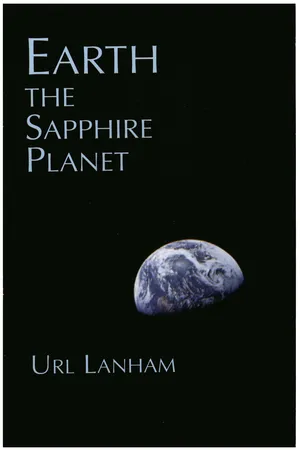
With some 70 percent of its surface covered by water, the Earth presents a picture of a gemlike blue planet when viewed from outer space. This sapphire jewel — the only planet in our solar system to sustain intelligent life — is the subject of this remarkably engaging and concise book by biologist, teacher, and popular science writer Url Lanham. Focusing on the Earth and the life forms that have evolved on it, Mr. Lanham's captivating study covers a wide range of subjects — from the work of Galileo, Copernicus, Herschel, and other scientists who contributed to our knowledge of Earth's position in the universe, to the Earth's internal physiology, intricacies of the biosphere, creation of continents, origins of plant and animal life, the diversity of physical habitats in which these life forms thrive, and much more. Well written and highly readable, this absorbing and optimistic natural history of the planet will take readers on a fantastic journey through time, offering up a host of facts and provocative insights. Easily accessible to advanced high school science students and college undergraduates, Earth, the Sapphire Planet will be warmly received as well by teachers and ecologically aware general readers.
AS WE NOW UNDERSTAND earth’s history, the modern ocean (as a unit, not in details of its shape) formed from a cooling atmosphere early in the third eon B.P. (an eon is 1 billion years, so this would be a little less than 3 billion years ago). Life appeared 100 or 200 million years later, and modern eukaryote organisms appeared at the beginning of the second eon B.P. The seas, perhaps with minor and local exceptions, remained the home of life until about 500 million years ago, when the invasion of the continents by plants and animals began on a large scale. Today the ocean is continuous, occupying mainly the Southern Hemisphere, with the Pacific and Adantic forming two large embayments.
The ocean forms 70 percent of the surface of the earth and is of immense volume, so that if the solid earth were graded flat, it would be “water, water everywhere, nor any drop to drink.” Nevertheless, space available for the primary production of biological materials by plants in the ocean is limited. The volume that is bathed in sunlight is relatively small. Even the superlatively clear waters of the open sea are not transparent. A 3-foot (1 m) layer of seawater filters out a third of the light. At 150 feet (46 m), scarcely 1 percent of the light remains, and this is mainly blue light. Below this depth, the last vestiges of light fade rapidly. Most of the volume of the marine environment is black and icy cold. Only here and there is it lighted by the strange luminous animals that prowl these depths. Near the coastlines turbid river waters and the abundant small animals and plants floating in the water make it relatively opaque, so that the sunlit layer is even thinner. So far as abundance of life is concerned, this disadvantage is more than compensated for by the richness of dissolved mineral nutrients. In shallow seas near the coasts marine life is richer than in the high seas.
Only a minute amount of the sunlight absorbed in the upper layers of the open sea is trapped and used for photosynthesis by plants. The remainder is converted into heat. It is mainly the sunlight absorbed by seawater that keeps the earth warm through the cold seasons, since land reflects most of the light falling on it. The ocean is our solar heat storage system.
Land and sea are alike in that about half their respective areas are biological deserts or semideserts. On the land, there are the vast regions where 15 inches (38 cm) or less of precipitation falls per year. Here, at least in warmer regions where evaporation is high, the vegetation is generally sparse short grass, and in the true deserts that are rainless for months or years at a time plant life may be widely scattered or completely absent for mile after mile.
The open sea—nearly all of the Atlantic and Indian oceans, and the Pacific on either side of a narrow band of luxuriant life along the equator—also is a biological semi-desert. Here the amount of life is restricted chiefly by the scarcity of the element phosphorus. Although it is abundant in seawater near the ocean floor and near the coastlines, there usually is no way for phosphorus to reach the surface waters from the great depths of the open seas. These surface layers generally are isolated by a boundary layer of subsurface horizontal currents. In some localities, as in the equatorial Pacific and along the west coast of South America, strong upwellings do penetrate to the surface, bringing with them the life-giving element.
These deserts or semideserts of the open sea also are poor in nitrates. But this is not, in the long-range view, the limiting factor. There are a number of aquatic microbes, most importantly the blue-greens, that have a set of enzymes capable of combining the nitrogen dissolved in the water (from the atmosphere) with other elements to form biologically usable compounds. If phosphorus were abundant in this upper layer of the sea, it seems unlikely that the nitrogen-fixing, photosynthetic blue-greens or similar organisms would not have invaded this environment and diversified on a massive scale, thus dominating the most spacious habitation on earth. However, the DNA mechanism, based on phosphorus, and the high-energy phosphate mechanism involving ATP are firm requirements for life as we know it. Any alternatives that may have existed in the early history of life were presumably replaced by their phosphorus-equipped rivals.
The heaving mats of brown seaweed that occur on many coasts are watery jungles, with plants stretching 50 or 100 feet (15–30 m) above the sea floor. Coral reefs and the cold waters of the North Atlantic fishing banks teem with life. But despite such local richness, there is more living material, by weight, on land than in the sea.
Of an ineffable blue are the sunny meadows of the high seas. Their plants are invisible, being microscopic and spaced far apart. In the pioneer explorations of marine life during the nineteenth century, these plants were collected by towing cone-shaped nets, made of cloth with very fine mesh, for some miles through the clear water. Such nets gathered an astonishing variety and number of small creatures: a majority consisting of plants, a minority of animals, and a number that were neither or, more accurately, were both plant and animal. Nearly all were of microscopic size. The chances of these relatively small, slow nets catching one of the good-sized animals that roam these waters were rather remote. This assortment of tiny plants and animals is called “plankton,” an assemblage of organisms that floats more or less passively in the sea, carried by currents both horizontally and vertically into different sorts of environments in rhythms that may correspond with or be immensely longer than their life cycles.
Usually the most common of these microscopic plants in the net are the diatoms, often called the “grasses of the sea.” The single cell that makes up one of these plants is enclosed in a jewel box of clear, hard silica (roughly speaking, glass), with a lid that fits down over and encloses the sides of the base. This box is engraved with hundreds or thousands of lines and dots arranged in beautifully symmetric patterns that are admired by students of these algae and are used to classify them. These minute plants probably can control their buoyancy by regulating the droplets of oil that they secrete into their bodies, but not much is known of the world as experienced by the diatom. In some parts of the ocean, dead bodies of diatoms fall slowly to the sea floor in astronomical numbers. In California, near the town of Lompoc, are beds of soft white rock hundreds of feet thick that are composed of diatom shells. These beds are owned by a corporation that sells the rock for a multitude of uses ranging from abrasives to paints to insulation.
We tend to think of the abundant microbes of the sea, such as the diatoms, as ancient and little-changing. But on the contrary the dominant plants of the marine meadows are, like the grasses of the land, of relatively recent origin. Diatoms did not appear in the geological record until the Triassic, a mere 200 million years ago, and did not become reasonably abundant until the Cretaceous, the period that saw the disappearance of the dinosaurs.
Next most abundant after the diatoms, or in some places the most abundant, are actively swimming microbes called dinoflagellates. They have equipment for photosynthesis and have a simple photosensitive spot that orients them to light. When near the surface they are in the domain of the botanists, for they live like a poet on air and sunshine. When they are carried, or swim, to deeper and darker waters they express their animal side and feed on helpless microplants or on other small animals by engulfing them.
During the twentieth century, explorers of the deep came to realize that their plankton nets were not telling the whole story and that many or most of the plants were too small to be caught. New methods using centrifuges or ultrafiltration disclosed a world of very small plants, as small as a micron (0.000039 inches) in diameter. The smallest of these appear to carry the minimum of equipment for a eukaryote (or nucleate) cell that is able to carry out photosynthesis.
Using the array of equipment needed to get a reasonably complete sample of the plankton, scientists determined that in most of the open ocean the concentration of plants was relatively low just at the surface, rapidly increased to a maximum about 80 feet (25 m) below the surface, then fell away to vanishingly small amounts at 500–650 feet (150–200 m). Numbers of organisms varied from place to place. The main large-scale anomaly was the central band of upwelling in the Pacific, which produced unusually high concentrations of microplants. The seaweeds of the Sargasso appear to be mainly a concentration of coastal seaweeds torn away by storms and gathered in a gigantic eddy in the Atlantic. There is some controversy about the degree to which this population is able to reproduce itself in the open sea.
Generally, the abundance of microorganisms is higher at higher latitudes, and falls off toward the equator. One rough estimate characterized the Atlantic plankton at 20° north latitude in this way: A cube of water in the upper 165 feet (50 m), measuring about 3 inches (8 cm) on a side, averaged about 20 million organisms. The number appears high, but it should be remembered that the organisms are very small. Allowing an average size of 2 microns for an organism, its nearest neighbor would be about 8,000 times its own length away. Translating into human dimensions, everyone would have a nearest neighbor something over a mile away.
Animals that graze such sparse meadows have a problem finding food. There are no large animals, analogous to the sometimes gigantic grazers found on the land, that can feed directly on these microscopic and scattered plants. Most of the marine animals that graze on them belong to four groups, ranging in size from a fraction of a millimeter to a few centimeters. These are the radiolarians, the foraminfera, the larvaceans, and the copepods.
Radiolarians are single-celled organisms, although sometimes with many nuclei or aggregated into simple colonies. Like many of the simpler animals, they are careless of their individuality; they sometimes allow other and smaller microscopic creatures, especially plants, to dwell inside their living substance, to what is assumed to be the mutual benefit of host and guest. Some are large enough to be seen without a microscope, being flecks of matter 2 or 3 millimeters (about ⅛ inch) in diameter. They are among the most elegant small animals of the sea, resembling the artist’s conception of stars, or elaborate three-dimensional snowflakes. Basically, they are spheres surrounded by a multitude of long radiating filaments of protoplasm, so that an enormous surface area is presented to their surroundings as they drift through the water. When smaller creatures are touched by the filaments, they are engulfed and devoured.
Often the protoplasm of the radiolarian is supported by an intricate internal skeleton of silica. As with the diatoms, these hard, resistant skeletons accumulate in some regions of the ocean in countless numbers on the sea floor, where they make a radiolarian ooze. This may be brought to the surface by geological processes, to form a radiolarian earth, analogous to diatomaceous earth, or may be transformed into nodules of flint, where the skeletons may still be observed. Radiolarian skeletons have been found in rocks of Paleozoic age.
These animate, three-dimensional plankton sieves were first adequately described as living animals by T. H. Huxley (1825–1895) in the mid nineteenth century. Their chief admirer and explorer was another contemporary disciple of Darwin, Ernst Haeckel (1834–1919), a German who sought temporary refuge from his continuing political and ideological battles with the authorities to study these beautiful creatures. He described 4,000 new species of radiolarians (a name he invented) and celebrated them in two huge illustrated volumes.
Foraminifera, or forams, are single-celled animals that average about a millimeter (
inch) across but they construct a vaguely mollusclike shell that may attain a few centimeters (an inch or two) in length or diameter. Nearly all the species are bottom dwellers, but the minority that float in the upper layers, buoyed by oil droplets or bubbles, occur in large numbers. Nearly 30 percent of the ocean floor is covered with a layer rich in their shells, called Globigerina ooze and named for a common foram of the upper layers of the sea. The shells are abundant fossils, some extending back to Cambrian times. Their close study and identification are essential parts of the science of stratigraphy. On Mount Everest, at 22,000 feet (6,700 m), is a layer 200 feet (60 m) thick of fossil foram shells of Eocene age. Eocene forams called nummulites make up the limestone blocks of which the great pyramids of Egypt were built.
Forams have bristling sunbursts of extended protoplasm, resembling those of the radiolarians, and like them trap microrganisms as their bearers drift passively through the sea.
Our third group, the larvaceans, are small, active, muscular, many-celled animals only a few millimeters long. They are near the most distant ancestry of man, having what might be called a boneless backbone, which gives support for the muscles that move the minute but powerful swimming tail. This supporting rod or notochord gains its strength from cells stretched drum-tight by water that is drawn into and kept in the cell by specialized physicochemical processes. It was some time before biologists realized that the animal itself was the manufacturer, engine, and pilot of a large sieving apparatus that enables it to eat its way through the sparsely inhabited universe of the open sea. The larvacean constructs a streamlined, movable house, resembling a fat submarine, of a gelatinous substance that is mainly water. So economical is its construction that the animal can afford to shed it and construct another every few hours. Without careful observational techniques, this superstructure collapses into an indecipherable glob when the animal is taken out of the water. In it are fine sieves, an external coarser one that filters out large particles, and an inner fine sieve with a mesh size of about 1 micron that can filter out micro-microplankton. This underwater houseboat is furnished with a trapdoor which holds the inflowing water brought in by the swimming tail until a certain amount of pressure is built up, then suddenly releases, driving the structure forward. Some of the very small microbes that make up a large part of the plankton were in fact first seen alive in the sieves of larvaceans, since they had passed through the much coarser mesh of the plankton nets of the early explorers.
If a net, similar to a plankton net, is swept through a grassy meadow on land, it collects a swarm of small, buzzing insects. The marine plankton net can be towed for weeks through the waters of the high seas without catching a single insect. In the open seas there are almost no insects—only a group of small water striders that live on the surface. Their place is taken by a rather similar group of animals, the copepods, whose nearest relatives are the crabs and shrimps; all these are members of a group called crustaceans. Copepods include 2,000 to 3,000 species in the waters of the high seas, and another 8,000 in coastal or fresh waters and other more specialized habitats. Insects, by contrast, have about 800,000 described species, and probably 5 to 10 times this number remain undiscovered. This gives a fair idea of the difference in diversity of habitats on land and in the sea. Although the sea is far less uniform than is generally believed, there is a much greater variety of habitats, often small and well-delimited, on the land.
Copepods are generally a few millimeters long, and those that feed on plankton graze by beating a set of microscopic combs several hundred times a minute in such a way as to drive the microplankton into their mouths.
In Arctic and Antarctic waters there are immense numbers of larger plankton-grazing crustaceans called euphausids. Huge heaps of these animals are tumbled out of the stomachs of slaughtered baleen whales.
There is little doubt that the vast stretches of the Pacific have little to offer man. During a 20-day voyage across the Pacific on a high-decked ship, the only animals I saw were the beautiful blue flying fish, which rose up from the water like the grasshoppers of a western prairie. Nor did we see a fishing boat (or any other kind of boat) or an airplane. A glimpse of a tiny island and a single seabird only reinforced the loneliness. Man’s chief activity in these waters now seems to be to infest them with plutonium-carrying submarines and to sow them with sensing devices that locate these mechanical monsters, friend or foe.
However, the scanty pastures of the open sea, like the short-grass prairies of the American West, support a diverse population of animals, large and small. On the land, insects and mice graze the vegetation. Other insects, birds, foxes, coyotes, and wolves prey on these creatures. There also are large herbivores, such as buffalo and antelope, that feed directly on the vegetation, and these used to be the prey of the relatively rare and large carnivores: the grizzly bear, once king of the western plains, the mountain lion or panther, and the wolf.
It is just so in the sea, although the minutely divided plant life in the open ocean cannot be eaten directly by large herbivores. Man himself has been unable to devise mechanisms efficient enough to make it pay to filter out the microbial plants. This is done by the small radiolarians, larvaceans, and crustaceans already described, as well as some other animals such as the arrow-worms and the free-swimming snails or sea butterflies, and a few of the smaller fishes. All the larger animals are carnivores, feeding on the small animals or tearing chunks off one another. It is these that provide food for human beings.
The blue whale, largest of all animals living on earth, perhaps attaining a weight of 400,000 pounds, feeds on very small animals. So far as is known, only in polar waters that are rich in nutrients and support a rich soup of plankton can the blue whale sieve out crustaceans fast enough to gain weight. There it gorges itself for a ...
Table of contents
Cover
Title page
Copyright
Contents
Introduction
One: The Oasis
Two: Internal Physiology of the Earth
Three: The Biosphere
Four: Life Prevalent
Index
Trusted by 375,005 students
Access to over 1.5 million titles for a fair monthly price.
Study more efficiently using our study tools.
Frequently asked questions
Yes, you can cancel anytime from the Subscription tab in your account settings on the Perlego website. Your subscription will stay active until the end of your current billing period. Learn how to cancel your subscription
No, books cannot be downloaded as external files, such as PDFs, for use outside of Perlego. However, you can download books within the Perlego app for offline reading on mobile or tablet. Learn how to download books offline
Perlego offers two plans: Essential and Complete
Essential is ideal for learners and professionals who enjoy exploring a wide range of subjects. Access the Essential Library with 800,000+ trusted titles and best-sellers across business, personal growth, and the humanities. Includes unlimited reading time and Standard Read Aloud voice.
Complete: Perfect for advanced learners and researchers needing full, unrestricted access. Unlock 1.5M+ books across hundreds of subjects, including academic and specialized titles. The Complete Plan also includes advanced features like Premium Read Aloud and Research Assistant.
Both plans are available with monthly, semester, or annual billing cycles.
We are an online textbook subscription service, where you can get access to an entire online library for less than the price of a single book per month. With over 1.5 million books across 990+ topics, we’ve got you covered! Learn about our mission
Look out for the read-aloud symbol on your next book to see if you can listen to it. The read-aloud tool reads text aloud for you, highlighting the text as it is being read. You can pause it, speed it up and slow it down. Learn more about Read Aloud
Yes! You can use the Perlego app on both iOS and Android devices to read anytime, anywhere — even offline. Perfect for commutes or when you’re on the go. Please note we cannot support devices running on iOS 13 and Android 7 or earlier. Learn more about using the app
Yes, you can access Earth, the Sapphire Planet by Url Lanham in PDF and/or ePUB format, as well as other popular books in Physical Sciences & Geology & Earth Sciences. We have over 1.5 million books available in our catalogue for you to explore.