- 156 pages
- English
- ePUB (mobile friendly)
- Available on iOS & Android
eBook - ePub
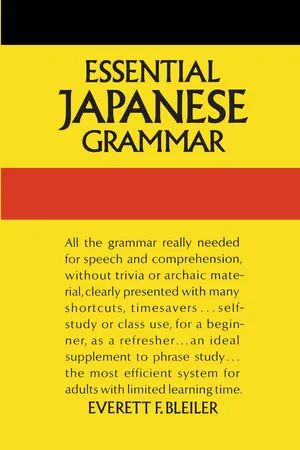
Essential Japanese Grammar
About this book
Although not a member of the Indo-European language family, Japanese is not too difficult grammatically for an English speaker. It is astonishingly regular in its formations — exceptions and irregularities can usually be numbered on one's fingers — and once the student masters a few conventions of linguistic classifications of experience, he will find that he can express most of his wants.
This is the first Japanese grammar written for the adult with a limited objective in studying Japanese: to express oneself orally with reasonable accuracy; to understand simple material addressed to oneself; and to be able to analyze, understand, and enlarge material in a phrase approach.
The author has limited this book to modern colloquial Japanese, and does not overburden the student with literary language, rarely used alternate forms, unnecessary abrupt forms, causatives and direct conditionals, and similar forms that might be required for a full knowledge of the written language. On the other hand, this book is not simplified Japanese, nor baby Japanese, nor kitchen Japanese. It is the full idiomatic language, with thorough treatments of the material you really need: the noun, pronoun, adjective, demonstrative words, adverb, verb, negative forms, Chinese forms, courtesy and honorific forms, idiomatic constructions, word order, relationship of ideas, syntax, etc.
Emphasis has been placed upon clarity of exposition, so that the English-speaking reader can understand what is really happening in Japanese, even if he has never studied any foreign language before. For this reason, explanation rather than brute memory work is stressed, examples are given for all constructions, and both word-for-word and free translations are given, to acquaint the reader with thought processes. Hints are given on avoiding difficult constructions. Japanese is presented in the Romaji transliteration, which can be read at sight. Characters are not used.
This is the first Japanese grammar written for the adult with a limited objective in studying Japanese: to express oneself orally with reasonable accuracy; to understand simple material addressed to oneself; and to be able to analyze, understand, and enlarge material in a phrase approach.
The author has limited this book to modern colloquial Japanese, and does not overburden the student with literary language, rarely used alternate forms, unnecessary abrupt forms, causatives and direct conditionals, and similar forms that might be required for a full knowledge of the written language. On the other hand, this book is not simplified Japanese, nor baby Japanese, nor kitchen Japanese. It is the full idiomatic language, with thorough treatments of the material you really need: the noun, pronoun, adjective, demonstrative words, adverb, verb, negative forms, Chinese forms, courtesy and honorific forms, idiomatic constructions, word order, relationship of ideas, syntax, etc.
Emphasis has been placed upon clarity of exposition, so that the English-speaking reader can understand what is really happening in Japanese, even if he has never studied any foreign language before. For this reason, explanation rather than brute memory work is stressed, examples are given for all constructions, and both word-for-word and free translations are given, to acquaint the reader with thought processes. Hints are given on avoiding difficult constructions. Japanese is presented in the Romaji transliteration, which can be read at sight. Characters are not used.
Frequently asked questions
Yes, you can cancel anytime from the Subscription tab in your account settings on the Perlego website. Your subscription will stay active until the end of your current billing period. Learn how to cancel your subscription.
No, books cannot be downloaded as external files, such as PDFs, for use outside of Perlego. However, you can download books within the Perlego app for offline reading on mobile or tablet. Learn more here.
Perlego offers two plans: Essential and Complete
- Essential is ideal for learners and professionals who enjoy exploring a wide range of subjects. Access the Essential Library with 800,000+ trusted titles and best-sellers across business, personal growth, and the humanities. Includes unlimited reading time and Standard Read Aloud voice.
- Complete: Perfect for advanced learners and researchers needing full, unrestricted access. Unlock 1.4M+ books across hundreds of subjects, including academic and specialized titles. The Complete Plan also includes advanced features like Premium Read Aloud and Research Assistant.
We are an online textbook subscription service, where you can get access to an entire online library for less than the price of a single book per month. With over 1 million books across 1000+ topics, we’ve got you covered! Learn more here.
Look out for the read-aloud symbol on your next book to see if you can listen to it. The read-aloud tool reads text aloud for you, highlighting the text as it is being read. You can pause it, speed it up and slow it down. Learn more here.
Yes! You can use the Perlego app on both iOS or Android devices to read anytime, anywhere — even offline. Perfect for commutes or when you’re on the go.
Please note we cannot support devices running on iOS 13 and Android 7 or earlier. Learn more about using the app.
Yes, you can access Essential Japanese Grammar by E. F. Bleiler in PDF and/or ePUB format, as well as other popular books in Languages & Linguistics & Languages. We have over one million books available in our catalogue for you to explore.
Information
Verbs
Introduction to Japanese Verbs
This section is a brief anticipation of some of the more important features of the Japanese verb that are likely to be strange to you. We urge you to read this section carefully before you move on to the detailed explanation of verb grammar. It will probably help you to understand some of the unfamiliar constructions and features of form and meaning that must necessarily occur in the sentences that have been quoted as examples.
1. Japanese verbs do not have different forms to indicate the number or person or gender of the subject of the sentence. The same forms are used whether the subject is I or you or they or anything else. Thus the verb form kaimasu could mean I buy, you (SING.) buy, he buys, she buys, it buys, we buy, you (PL.) buy, or they buy.
2. Verbs are very often used without a pronoun subject, as in the example above. In such cases you recognize the subject by context. Actually, this is not as difficult as it sounds, and you will very seldom be at a loss about the situation which a verb describes. If there is a question of ambiguity, of course, pronouns may be used.
You will probably find the Japanese pronounless verbs easier to understand if you remember that the verb in Japanese conveys many aspects of meaning which we think of as belonging to nouns. A translation of the form kaimasu, mentioned above, that would catch the spirit of the Japanese form better than our English counterparts, could be simply “act of buying” or “there is an act of buying” or simply “buying.”
Whenever we have given sentences in which the verb is not accompanied by a subject pronoun, we have supplied the English translation with the subject pronoun that a conversational context might require. In most cases, however, other pronouns could fit into a translation equally well. Where we have translated “I,” you could read with equal reason “you” or “he” or “they” or another personal pronoun. (See page 115, the section on honorific forms, however, for instances where the verb forms or other words definitely restrict the meaning to one pronoun-idea.)
3. There are only two real tenses in Japanese, a present and a past. Japanese is not so much interested in the subtleties of time as is English or some of the other Indo-European languages. There is no true future tense; the present is used to express definite future ideas:
Tōkyō e yukimashita. (PAST TENSE)
[Tōkyō to went]
I went to Tōkyō.
Tōkyō e yukimasu. (PRESENT TENSE)
[Tōkyō to go]
I go to Tōkyō. I shall go to Tōkyō.
4. Although tenses are few, Japanese is extremely rich in verb forms that indicate moods or aspects of likeness, or belief on the part of the speaker, or appearances. Most of these are beyond the scope of this manual, but there is one such mood that is important and must be learned. This is a form which is called the probable mood. It indicates that action will probably occur, is probably occurring, may occur, etc. We have described it in more detail on page 47. kaeru deshō, for example, might be translated “he is probably returning,” “he will probably return,” “I think he will return,” and so on.
5. There are several compound verb forms that are frequently used. There is a progressive aspect which corresponds surprisingly closely to the English form in meaning and formation (see page 46). It is made with a participle and a conjugated form of a verb meaning “to be.”
Nani o shite imasu ka?
[what oj doing is qu]
What is he doing?
6. Each Japanese ve...
Table of contents
- Cover
- Title Page
- Copyright Page
- Contents
- How to Use this Booklet
- Introductory Material
- Nouns
- Personal Pronouns
- Using Nouns and Pronouns in Sentences
- Particles Equivalent to Prepositions, Adverbs, Conjunctions
- Words of Demonstration
- Verbs
- Adjectives
- Adverbs
- Verb Constructions and Adjective Constructions
- Clauses and Conjunctions
- The Language of Courtesy
- Word Order
- Forming Questions
- Numbers and Counting Objects
- Idiomatic Expressions
- Appendix: Japanese Pronunciation
- A Glossary of Grammatical Terms
- Index