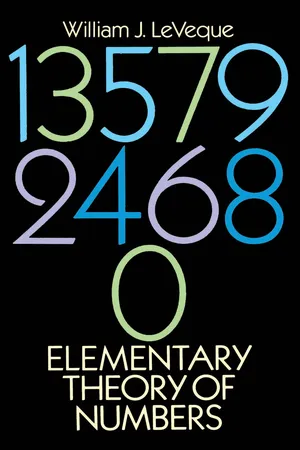
This superb text introduces number theory to readers with limited formal mathematical training. Intended for use in freshman- and sophomore-level courses in arts and science curricula, in teacher-training programs, and in enrichment programs for high-school students, it is filled with simple problems to stimulate readers' interest, challenge their abilities and increase mathematical strength.
Contents:
I. Introduction
II. The Euclidean Algorithm and Its Consequences
III. Congruences
IV. The Powers of an Integer Modulo m
V. Continued Fractions
VI. The Gaussian Integers
VII. Diophantine Equations
Requiring only a sound background in high-school mathematics, this work offers the student an excellent introduction to a branch of mathematics that has been a strong influence in the development of higher pure mathematics, both in stimulating the creation of powerful general methods in the course of solving special problems (such as Fermat conjecture and the prime number theorem) and as a source of ideas and inspiration comparable to geometry and the mathematics of physical phenomena.
- 160 pages
- English
- ePUB (mobile friendly)
- Available on iOS & Android
eBook - ePub
Elementary Theory of Numbers
About this book
Information
CHAPTER 1
INTRODUCTION
1–1 What is number theory? In number theory we are concerned with properties of certain of the integers (whole numbers)
. . . , −3, −2, −1, 0, 1, 2, 3, . . . ,
or sometimes with those properties of real or complex numbers which depend rather directly on the integers. It might be thought that there is little more that can be said about such simple mathematical objects than what has already been said in elementary arithmetic, but if you stop to think for a moment, you will realize that heretofore integers have not been considered as interesting objects in their own right, but simply as useful carriers of information. After totaling a grocery bill, you are interested in the amount of money involved, and not in the number representing that amount of money. In considering sin 31°, you think either of an angular opening of a certain size, and the ratios of some lengths related to that angle, or of a certain position in a table of trigonometric functions, but not of any interesting properties that the number 31 might possess.
The attitude which will govern the treatment of integers in this text is perhaps best exemplified by a story told by G. H. Hardy, an eminent British number theorist who died in 1947. Hardy had a young protégé, an Indian named Srinivasa Ramanujan, who had such a truly remarkable insight into hidden arithmetical relationships that, although he was almost uneducated mathematically, he did a great amount of first-rate original research in mathematics. Ramanujan was ill in a hospital in England, and Hardy went to visit him. When he arrived, he idly remarked that the taxi in which he had ridden had the license number 1729, which, he said, seemed to him a rather uninteresting number. Ramanujan immediately replied that, on the contrary, 1729 was singularly interesting, being the smallest positive integer expressible as a sum of two positive cubes in two different ways, namely 1729 = 103 + 93 = 123 + 13!
It should not be inferred that one needs to know all such little facts to understand number theory, or that one needs to be a lightning calculator; we simply wished to make the point that the question of what the smallest integer is which can be represented as a sum of cubes in two ways is of interest to a number theorist. It is interesting not so much for its own sake (after all, anyone could find the answer after a few minutes of unimaginative computation), but because it raises all sorts of further questions whose answers are by no means simple matters of calculation. For example, if s is any positive integer, about how large is the smallest integer representable as a sum of cubes of positive integers in s different ways? Or, are there infinitely many integers representable as a sum of cubes in two different ways? Or, how can one characterize in a different fashion the integers which can be represented as a sum of two cubes in at least one way? Or, are any cubes representable as a sum of two cubes? That is, has the equation

any solutions in positive integers x, y, and z? These questions, like that discussed by Hardy and Ramanujan, are concerned with integers, but they also have an additional element which somehow makes them more significant: they are concerned not with a particular integer, but with whole classes or collections of integers. It is this feature of generality, perhaps, which distinguishes the theory of numbers from simple arithmetic. Still, there is a gradual shading from one into the other, and number theory is, appropriately enough, sometimes called higher arithmetic.
In view of the apparent simplicity of the subject matter, it is not surprising that number-theoretic questions have been considered throughout almost the entire history of recorded mathematics. One of the earliest such problems must have been that of solving the “Pythagorean” equation

For centuries it was supposed that the classical theorem embodied in (2) concerning the sides of a right triangle was due either to Pythagoras or a member of his school (about 550 B.C). Recently interpreted cuneiform texts give strong evidence, however, that Babylonian mathematicians not only knew the theorem as early as 1600 B.C., but that they knew how to compute all integral solutions x, y, z of (2), and used this knowledge for the construction of crude trigonometric tables. There is no difficulty in finding a large number of integral solutions of (2) by trial and error—just add many different pairs of squares, and some of the sums will turn out to be squares also. Finding all solutions is another matter, requiring understanding rather than patience. We shall treat this question in detail in Chapter 5.
Whatever the Babylonians may have known and understood, it seems clear that we are indebted to the Greeks for their conception of mathematics as a systematic theory founded on axioms or unproved assumptions, developed by logical deduction and supported by strict proofs. It would probably not have occurred to the Babylonians to write out a detailed analysis of the integral solutions of (2), as Euclid did in the tenth book of his Elements. This contribution by Euclid was minor, however, compared with his invention of what is now ca...
Table of contents
- Cover
- Title Page
- Copyright Page
- Preface
- Contents
- Chapter 1. Introduction
- Chapter 2. The Euclidean Algorithm and its Consequences
- Chapter 3. Congruences
- Chapter 4. The Powers of an Integer Modulo m
- Chapter 5. Continued Fractions
- Chapter 6. The Gaussian Integers
- Chapter 7. Diophantine Equations
- Appendix
- Answers to Problems
- Index
Trusted by 375,005 students
Access to over 1.5 million titles for a fair monthly price.
Study more efficiently using our study tools.
Frequently asked questions
Yes, you can cancel anytime from the Subscription tab in your account settings on the Perlego website. Your subscription will stay active until the end of your current billing period. Learn how to cancel your subscription
No, books cannot be downloaded as external files, such as PDFs, for use outside of Perlego. However, you can download books within the Perlego app for offline reading on mobile or tablet. Learn how to download books offline
Perlego offers two plans: Essential and Complete
- Essential is ideal for learners and professionals who enjoy exploring a wide range of subjects. Access the Essential Library with 800,000+ trusted titles and best-sellers across business, personal growth, and the humanities. Includes unlimited reading time and Standard Read Aloud voice.
- Complete: Perfect for advanced learners and researchers needing full, unrestricted access. Unlock 1.5M+ books across hundreds of subjects, including academic and specialized titles. The Complete Plan also includes advanced features like Premium Read Aloud and Research Assistant.
We are an online textbook subscription service, where you can get access to an entire online library for less than the price of a single book per month. With over 1.5 million books across 990+ topics, we’ve got you covered! Learn about our mission
Look out for the read-aloud symbol on your next book to see if you can listen to it. The read-aloud tool reads text aloud for you, highlighting the text as it is being read. You can pause it, speed it up and slow it down. Learn more about Read Aloud
Yes! You can use the Perlego app on both iOS and Android devices to read anytime, anywhere — even offline. Perfect for commutes or when you’re on the go.
Please note we cannot support devices running on iOS 13 and Android 7 or earlier. Learn more about using the app
Please note we cannot support devices running on iOS 13 and Android 7 or earlier. Learn more about using the app
Yes, you can access Elementary Theory of Numbers by William J. LeVeque in PDF and/or ePUB format, as well as other popular books in Mathematics & Number Theory. We have over 1.5 million books available in our catalogue for you to explore.