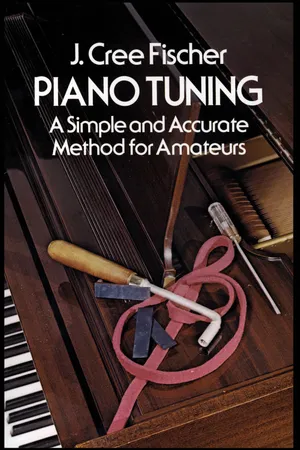
If you have a note that has dropped in pitch, do you have to call in the tuner? A stuck key? Sympathetic rattle? Missing bridles? A broken hammer shank? An unglued ivory? The answer, in each case, is no: you can make all of these repairs yourself!
This is the clearest and most complete book available for beginning tuners and amateur pianists. It explains all the basic processes practically and with model clarity. A non-musician can use this book without too much difficulty.
You will learn how upright, grand, and square actions work, and how to take care of the smallest repairs — repairing stuck keys, poorly adjusted bottoms and capstans, crowded back checks, felts and leather on the hammers, hammer stems; softening damper and hammer felts; installing new bridles; eliminating "sympathetic rattle"; all with a minimum of tools and training.
You will learn a professional method of tuning based on slightly flattened fifths, where only the octave and the upward fifth intervals are used. This is one of the easiest systems to learn, one capable of a great deal of control, and one perfectly suited to adjusting one or two keys. It is a tested method especially right for amateurs working without a teacher, and a method that trains the ear for other recommended systems. The author also explains "beats," the theory of the tempered scale, and useful experiments you can make with harmonic phenomena.
If you want to experiment with tuning a piano, there is no better book to start with. It will help performers and teachers make occasional repairs and learn the structure and scale of the piano. Those who want to know how pianos work will find this book both clear and useful.
- 224 pages
- English
- ePUB (mobile friendly)
- Available on iOS & Android
eBook - ePub
About this book
Information
Subtopic
MusikINDEX.

ACTION, 17
brackets, 24
of grand piano, 37, 38, 62
of square piano, 32, 34
removing, square and grand, 38
replacing, square and grand, 39
requisites of, 17, 18
top, of square piano, 34
trap, of square piano, 19, 34
Advantages of two-octave temperament, 171
Ancient instruments, 13
BACK check, adjustment of, 49
and back catch, 18, 27, 28, 33, 37
wire, 27
Balance pin, 21
rail, 21
Bearing bar, 17
Beats, waves, and pulsations, 73, 150
of unison, octave, and major third, 154
cause of, 77, 150
Black lead, use of, 64
Block rail, 27, 51
Bottom or capstan, adjustment of, 48, 99
or key rocker, 23, 33, 48, 56, 57
Bracket bolts, 25
Bridle, 28
putting in new, 50
wire, 28, 50
Bridges, 16, 17
split, 173
Building of upright piano, 16
Butts, 28
and flanges, repairing of, 59
CAPSTAN, 24, 48
Cause of beats 27, 150
Center-pins, 25
putting in new 52
Clicks at release of key, 51, 52
Compromises, the, 99, 100
Continuous mute, 89
DAMPER lever, 29
felt, softening, 54
Damper, of grand piano, 37
of square piano, 36, 60
rod, 30
rod, squeaking of, 55
spoon, 29
springs broken, 54
Dampers, 18, 29
Damping, defective, 54, 60, 61
Ditonic comma 144
EVOLUTION of the piano, 12
Extension, 23
FALSE waves, 160, 161
Fifths, beats of, 79
not all tempered alike, 105, 106
tempering of, 79, 104
Final inspection, 172
Fischer System...
Table of contents
- Cover
- Title Page
- Copyright Page
- Preface
- Contents
- Lesson I. Introduction
- Lesson II. General Construction of the Piano and Something of its Evolution and History
- Lesson III. Technical Names and Uses of the Parts of the Upright Action
- Lesson IV. Action of the Square Piano. Action of the Grand Piano. Instructions for Removing the Square and Grand Piano Actions
- Lesson V. Regulating and Repairing. Faults in Pianos aside from the Action and their Remedies. Regulating and Repairing the Up- right Action
- Lesson VI. Regulating and Repairing the Square Action. Miscellaneous Repairs
- Lesson VII. The Study and Practice of Piano Tuning
- Lesson VIII. The Temperament. Beats, Waves, Pulsations. The New System of Temperament. The Octave. The Fifth. Pitch. Diagram of the Fischer System of Temperament
- Lesson IX. Specific Instructions in Setting Temperament. The Con- tinuous Mute
- Lesson X. Theory of the Temperament. Equal Temperament. Un- equal Temperament
- Lesson XI. Technique or Modus Operandi in Piano Tuning. Manipulation of the Tuning Hammer. Setting the Mutes or Wedges in the Upright Piano. Setting the Mutes or Wedges in the Square Piano
- Lesson XII. Mathematics of the Tempered Scale. Rationale of the Temper- ament. Proposition I
- Lesson XIII. Rationale of the Temperament, Concluded. Proposition II. Proposition III. Numerical Comparison of the Diatonic with the Tempered Scale. Various Mathematical Tables and Ex- amples
- Lesson XIV. Miscellaneous Topics Pertaining to the Practical Work of Tun- ing. Cause of the Beats. Finishing up the Temperament. Tuning the Treble. Tuning the Bass. False Waves
- Lesson XV. Miscellaneous Items Pertaining to the Practical Work of Tuning, Regulating, and Repairing. Comparison of the Different Systems of Temperament. System A. System B. System C. Final Inspection. Loose Pins. Split Bridges. Stringing. Wire Splicing
- Lesson XVI. Tuning and Repairing the Reed Organ. Cleaning. Stops. Examination. Sticking Keys. Leaks. Pedal Defects. Sym- pathetic Vibrations. Tuning
- Lesson XVII. Concluding Professional Hints. Peculiar Expressions Used in Designating Qualities of Tone. Questions often Asked the Piano Tuner. Seasons for Tuning
- Index
Trusted by 375,005 students
Access to over 1.5 million titles for a fair monthly price.
Study more efficiently using our study tools.
Frequently asked questions
Yes, you can cancel anytime from the Subscription tab in your account settings on the Perlego website. Your subscription will stay active until the end of your current billing period. Learn how to cancel your subscription
No, books cannot be downloaded as external files, such as PDFs, for use outside of Perlego. However, you can download books within the Perlego app for offline reading on mobile or tablet. Learn how to download books offline
Perlego offers two plans: Essential and Complete
- Essential is ideal for learners and professionals who enjoy exploring a wide range of subjects. Access the Essential Library with 800,000+ trusted titles and best-sellers across business, personal growth, and the humanities. Includes unlimited reading time and Standard Read Aloud voice.
- Complete: Perfect for advanced learners and researchers needing full, unrestricted access. Unlock 1.5M+ books across hundreds of subjects, including academic and specialized titles. The Complete Plan also includes advanced features like Premium Read Aloud and Research Assistant.
We are an online textbook subscription service, where you can get access to an entire online library for less than the price of a single book per month. With over 1.5 million books across 990+ topics, we’ve got you covered! Learn about our mission
Look out for the read-aloud symbol on your next book to see if you can listen to it. The read-aloud tool reads text aloud for you, highlighting the text as it is being read. You can pause it, speed it up and slow it down. Learn more about Read Aloud
Yes! You can use the Perlego app on both iOS and Android devices to read anytime, anywhere — even offline. Perfect for commutes or when you’re on the go.
Please note we cannot support devices running on iOS 13 and Android 7 or earlier. Learn more about using the app
Please note we cannot support devices running on iOS 13 and Android 7 or earlier. Learn more about using the app
Yes, you can access Piano Tuning by J. Cree Fischer in PDF and/or ePUB format, as well as other popular books in Medien & darstellende Kunst & Musik. We have over 1.5 million books available in our catalogue for you to explore.