![]()
1. INTRODUCTION
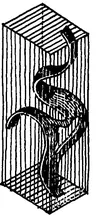
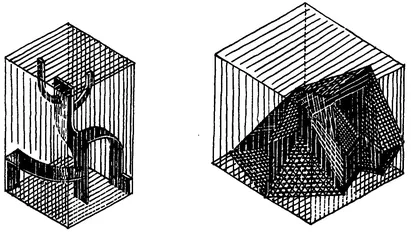
Any object or geometric magnitude that has length, breadth, and thickness is three-dimensional. The three-dimensional or space object has the property of envelopment; that is, it may be incased in a rectangular prism whose faces will be tangent
to the extreme limits of the space object.
There are many different types of three-dimensional objects. The differences for the most part are explained by the geometric properties that characterize each type.
We must realize that when we talk about geometric properties we talk about imaginary conditions. The objects and surfaces with which we deal in real life are our own approximations of the mathematical concepts. It is well to remember that the mathematical line or surface or object is one thing and its counterpart in reality is quite another thing.
From a practical point of view, the closer we try to make an object or surface or line conform to its mathematical equivalent the more exact we must be in both tooling and measuring. As a result the economic factor enters the picture. Strange as it may seem, the economics of the situation may have a very profound effect on the design. Any designer working in industry knows only too well the intimate relationship between design and economics and the challenging problems that must be overcome for a satisfactory solution. As an example, an industrial designer may be called upon to create a design which can be produced by casting or die-stamping. If the concern does not have a foundry and does not wish to parcel out its jobs, the designer is confronted with a problem different from the one which he would otherwise have if casting were feasible.
The question of how to construct the object and what materials to use is ever present when dealing with three-dimensional design. Essential as this is, this book is primarily concerned with an investigation into the properties of surfaces, their modification, adaptation, and transformation into new forms.
In the course of everyday living we see countless objects with the greatest variety of shapes and functions. As a matter of interest and curiosity, count the number of differently shaped objects that you see in your own home. Do the same when you are out-of-doors. I am quite sure that you will be astonished at the large number of space objects that you see, that you live with, that you use—each one in some mysterious way adding to the sum total of your ever-widening experience.
What are the basic shapes or surfaces? How can they best be described for the profitable use of the designer? How can they be combined and modified to serve the purposes of the designer? This book tries to answer these questions. We must bear in mind, however, that design involves much more than an understanding of the basic geometric properties of space objects.
It includes as well:
- An awareness of, and knowledge concerning, the properties of various types of material.
- The availability of tools for manufacture.
- The availability of skilled craftsmen.
- Knowledge of municipal and state codes which impose restrictions affecting design.
- The ability to cultivate a reasonable attitude toward the ideas of others with whom it may be necessary to collaborate on a design project. (This is especially important in production and architectural design.)
- A questioning outlook not easily satisfied by any ready-made solution.
- A healthy disrespect for historic design. (This does not mean that we must deny the greatness of earlier forms in order to proceed with the solutions to our own problems.)
- A healthy curiosity and a desire for continuing inquiry into the essential nature of source material.
Each designer has his own limited capacity for self-expression. At each step of his development he acquires new skills and new emotional outlooks which come from the subtle influences of the works of others and from his own continuing growth. He constantly calls on all of his resources to give fullest expression to his ideas. Only after he is adequately prepared can he bring into play the imagination, the technical skill, the daring that each design must have in order to do justice to its creator.
![]()
2. FUNDAMENTAL DEFINITIONS
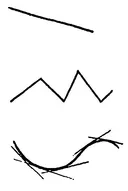
1. A line A line is a geometric figure created by a point moving through successive positions.
Straight line The direction remains the same throughout the length of the line.
Broken line Each successive segment changes direction.
Curved line There is a constant change in direction. The direction at any point in the curve is described by the direction of the tangent line at that point.
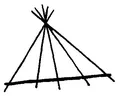
2. Plane surface A plane surface is a geometric magnitude produced by the motion of a straight line. The moving straight line always passes through a fixed point and always intersects a fixed straight line.
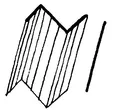
3. Prismatic surface A prismatic surface is a combination of plane surfaces in which the successive planes change direction. It is produced by a straight line moving parallel to a fixed straight line and always touching a fixed broken line.
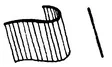
4. Cylindric surface A cylindric surface is generated by a straight line moving parallel to a fixed straight line and always touching a fixed curved line.
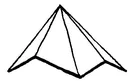
5. Pyramidal surface A pyramidal surface is a combination of plane surfaces having a common point. It is created by a straight line moving through a fixed point and always touching a fixed broken line.
6. Conical surface A conical surface is created by a straight line moving through a fixed point, always touching a fixed curved line.
7. Surface of revolution A surface of revolution is formed by the motion of a line about a straight line axis. Each point of the moving line generates a circle. The moving line may be straight, curved, or a combination of the two.
8. Spherical surface The spherical surface is a surface of revolution. It is formed by the rotating motion of a circle about one of its diameters.
9. Toroidal surface A toroidal surface is a surface of revolution created by the rotating motion of a curve about a straight line lying outside the curve. If...