eBook - ePub
Pictorial Encyclopedia of Historic Ornament
100 Plates, Including 75 in Full Color
- 112 pages
- English
- ePUB (mobile friendly)
- Available on iOS & Android
eBook - ePub
About this book
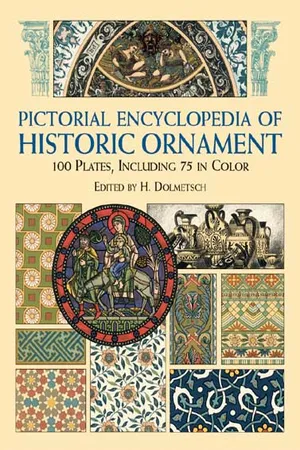
One of the great anthologies of historic ornament and design, on a par with Owen Jones' Grammar of Ornament and Racinet's Historic Ornament, Dolmetsch's dazzling collection of over 1,500 illustrations — most in full color — is a veritable treasure chest of royalty-free images. Artists, designers, and hobbyists will also find design inspiration on every page, with images of artistic ornaments from antiquity through the 19th century, when this volume was originally assembled. Arranged chronologically, coverage begins in the ancient world, with designs from Roman architecture and sculpture, mosaic floors of Pompeii, and Byzantine embroidery. From the Middle Ages come illuminated manuscripts and stained glass decorations. Items dating from the Renaissance and later include Italian glass painting, pottery, and lace; French tapestry and block printing; and German metal work and weaving.
Information
Topic
DesignSubtopic
Decorative ArtsSources of Illustrations
PLATE 1. Egyptian: Painting and Ornament
1. Painting from a column of the temple at Denderah. 2, 3. Paintings from mummy cases. 4, 5. From a mummy case in the Louvre, Paris. 6. Painted border from sarcophagus. 7. Border from a mummy case. British Museum, London. 8. Ornament on a wooden sarcophagus. British Museum. 9. Border on a mummy case. British Museum. 10. Portion of a border. British Museum. 11. Painting on a sarcophagus. British Museum.
PLATE 2. Egyptian: Architecture and Painting
1. Pylon (entrance gate). Louvre, Paris. 2. Painted cornice from the great temple at Philae. 3. Capital from the temple at Luxor (representing papyrus). 1200 B.C. 4. Capital from a temple at Thebes (lotus bud). 5. Capital from a portico at Edfu (palm tree). 6. Capital from Thebes, 12 B.C. (lotus bud). 7. Mummy-case painting. 8, 9. Tile designs. Paintings from tomb chambers. Louvre, Paris.
PLATE 3. Assyrian: Painting, Polychrome Sculpture, and Pottery
1. Portion of a glazed brick from a palace at Khorsabad. 2-4. Painted bas-reliefs from Koyunjik. 5. Painted ornament from Nimroud. 6. Glazed brick from Khorsabad. 7-10. Painted ornaments from Nimroud. 11-12. Sacred trees. Painted bas-reliefs from Nimroud. 13. Painted ornament from Nimroud. 14. Enamelled brick from Khorsabad.
PLATE 4. Greek: Ornamental Architecture and Sculpture
1. Doric capital from Paestum (with painted ornament). 2. Ionic capital from the Erechtheum on the Acropolis, Athens. 3. Corinthian capital from the Choragic Monument of Lysicrates, Athens. 4. Caryatid figure from the Erechtheum. 5, 6. Acroteria from stelae (sepulchral columns), Paris. 7-9. Anthemion decorations. 10, 11. Griffins. Portions of friezes. 12, 13. Trazephoroe in the National Museum at Naples. 15, 16. Trazephorœ in the British Museum, London.
PLATE 5. Greek: Polychrome Architecture
1. Polychrome cyma (ogee) with lion’s head from Selinus. 2. Acroterium form a temple at Athens. 3-6. Painted cornices from the Propylaea, Athens. 7. Ornament from the temple of Theseus, Athens. 8. Ornament from a temple at Selinus. 9. Frieze of the temple of Jupiter, Aegina. 10. Cyma ornament from the Parthenon. 11. Ornament found at Palazzolo. 12, 13. Fret meanders. 14. Decoration of coffers, British Museum, London. 15. Panel of metopes of baked clay, found at Palazzolo. 16. Panel of coffers from the Propylaea.
PLATE 6. Greek: Pottery
1-9. Forms of Greek vases. 1. Amphora, vessel for oil, wine, etc. 2. Cylix, drinking cup. 3. Urn for ashes of the dead. 4. Oenochoe, wine pitcher. 5. Hydria, vessel for carrying water. 6. Deinos, crater, vessel for mixing wine and water. 7. Lecythus, vessel for anointing oil. 8. Cantharus, two-handled drinking cup. 9. Rhyton, drinking vessel. 10. Figure on an amphora in the National Museum at Naples. 11-17. Greek frets. 18. Wave borders. 20, 21. Rosette borders. 22, 23. Ivy buds. 24, 25. Anthemion borders. 26-29, 32. Palmette borders. 30, 31. Olive-leaf borders.
PLATE 7. Roman: Ornamental Architecure and Sculpture
1. Corinthian capital from the Pantheon at Rome. 2. Head of a candelabrum from the Vatican Museum. 3. Composite capital from a temple of Juno at Rome. 4. Fragment of a frieze from the villa of Hadrian at Tivoli, now in the Lateran Museum, Rome. 5, 7. Rosettes from the Vatican Museum. 6. Fragment of a frieze from Rome. 8, 11. Bases of columns from the later Roman period. 9, 10. Members of cornices from the ruins of the imperial palaces on the Palatine.
PLATE 8. Pompeian: Mosaic Floors
1. Mosaic frieze in the house of the Faun at Pompeii. 2, 3. Mosaic floors in the Palatine Museum at Rome. 4, 5. Mosaic floors from the Hunting Villa at Fliessem near Trèves. 6, 7. Mosaic floors from Pompeii. 8-10. Mosaic floor from the Thermae of Caracalla at Rome.
PLATE 9. Pompeian: Wall Paintings and Bas-Reliefs
1. Wall painting, representing a figure of Victory, from Pompeii. 2, 3. Colonnettes, in the Museum at Naples. 4, 5. Borders from Pompeii. 6. Frieze from Pompeii. 7-12. Borders from Herculaneum and Pompeii. 13, 14. Painted dados from Pompeii. 15-20. Painted stucco cornices, Pompeii.
PLATE 10. Pompeian: Bronzes
1. Bronze helmet with embossed figures, in the Museum at Naples. 1a. Accompanying piece of armor. 2, 3. Two lamps (lucerna), in the Museum at Naples. 4, 5. Great candelabra, in the Louvre. 6, 8. Great candelabra, in the Museum at Naples. 7. Side view of top of Fig. 6 (enlarged). 9. Candelabrum head, at Naples. 10. Two-armed small candelabrum with figure of Silenus, at Naples. 11. Bisellium, seat of honor for magistrates, in the Louvre. 12, 13. Tripods from Herculaneum, in the Museum at Naples. 14, 15. Bronze masks (fragments of decorations), at Naples.
PLATE 11. Chinese: Painting
1-5 and 9-13 borders; 6-8 continuous patterns of painted China vases—most in the Victoria and Albert Museum, London. (The yellow in 4, 6, and 10 is gold on the original objects.)
PLATE 12. Chinese: Painting, Weaving, Embroidery, and Enamel
1. Painted porcelain. 2. Painted border from a china vessel. 3. Painting from a small wooden chest. 4-6. Portions of bed curtains embroidered in silk and gold (15th c). 7-9. Patterns from woven stuffs. 10, 11. Enameled designs from an old copper vase. 12-23. Enameled ornaments on vases, bowls, and censers.
PLATE 13. Japanese: Lacquering
1-50. Designs for lacquer ware.
PLATE 14. Japanese: Weaving, Painting, and Enamel
1-7. Borders and patterns from silk stuffs. 8, 9. Paintings from an old porcelain vase. 10. Painting from an old cup-shaped vase. 11, 12. Borders from two faience vases. 13-19. Ornaments from cloisonné enameled vases.
PLATE 15. Indian: Metalwork
1. Vessel with damascened inlays. 2. Battle axe with etched decorations. 3. Battle axe with damascened work. 4. Shield of rhinoceros skin inlaid and mounted with metal. 5-8. Ornaments from damascened hookahs (water pipes). 9. Repousse decoration of a gilt copper can. 10. Repoussé decoration of a copper can. 11. Decoration from a damascened tin vase. 12. Damascened work on steel of a dagger sheath. 13. Neck decoration of a damascened tin cup. 14. From a copper plate in repoussé work. 15. From a tin plate in repoussé work.
PLATE 16. Indian: Embroidery and Weaving
1. Woven carpet of the 16th c. 2-6. Borders from silk embroideries. 7. Pattern embroidered in silk. 8, 9. Cotton carpets. 10. Mat of plaited rushes. 11, 12. Border patterns of Cashmere shawls.
PLATE 17. Indian: Metalwork, Embroidery, Weaving, and Painting
1. Ancus in chiseled iron. 2, 3. Pendants and button embossed in gold and chiseled. 4. Ancus, enameled and adorned with jewels. 5-9. Decorations from enameled arms. 10. State parasol with rich gold e...
Table of contents
- Title Page
- Copyright Page
- Table of Contents
- Sources of Illustrations
Trusted by 375,005 students
Access to over 1.5 million titles for a fair monthly price.
Study more efficiently using our study tools.
Frequently asked questions
Yes, you can cancel anytime from the Subscription tab in your account settings on the Perlego website. Your subscription will stay active until the end of your current billing period. Learn how to cancel your subscription
No, books cannot be downloaded as external files, such as PDFs, for use outside of Perlego. However, you can download books within the Perlego app for offline reading on mobile or tablet. Learn how to download books offline
Perlego offers two plans: Essential and Complete
- Essential is ideal for learners and professionals who enjoy exploring a wide range of subjects. Access the Essential Library with 800,000+ trusted titles and best-sellers across business, personal growth, and the humanities. Includes unlimited reading time and Standard Read Aloud voice.
- Complete: Perfect for advanced learners and researchers needing full, unrestricted access. Unlock 1.5M+ books across hundreds of subjects, including academic and specialized titles. The Complete Plan also includes advanced features like Premium Read Aloud and Research Assistant.
We are an online textbook subscription service, where you can get access to an entire online library for less than the price of a single book per month. With over 1.5 million books across 990+ topics, we’ve got you covered! Learn about our mission
Look out for the read-aloud symbol on your next book to see if you can listen to it. The read-aloud tool reads text aloud for you, highlighting the text as it is being read. You can pause it, speed it up and slow it down. Learn more about Read Aloud
Yes! You can use the Perlego app on both iOS and Android devices to read anytime, anywhere — even offline. Perfect for commutes or when you’re on the go.
Please note we cannot support devices running on iOS 13 and Android 7 or earlier. Learn more about using the app
Please note we cannot support devices running on iOS 13 and Android 7 or earlier. Learn more about using the app
Yes, you can access Pictorial Encyclopedia of Historic Ornament by H. Dolmetsch in PDF and/or ePUB format, as well as other popular books in Design & Decorative Arts. We have over 1.5 million books available in our catalogue for you to explore.