On the Study and Difficulties of Mathematics
eBook - ePub

On the Study and Difficulties of Mathematics

  1. 304 pages
  2. English
  3. ePUB (mobile friendly)
  4. Available on iOS & Android
eBook - ePub

On the Study and Difficulties of Mathematics

About this book

One of the twentieth century's most eminent mathematical writers, Augustus De Morgan enriched his expositions with insights from history and psychology. On the Study and Difficulties of Mathematics represents some of his best work, containing points usually overlooked by elementary treatises, and written in a fresh and natural tone that provides a refreshing contrast to the mechanical character of common textbooks.
Presuming only a knowledge of the rules of algebra and Euclidean theorems, De Morgan begins with some introductory remarks on the nature and objects of mathematics. He discusses the concept of arithmetical notion and its elementary rules, including arithmetical reactions and decimal fractions. Moving on to algebra, he reviews the elementary principles, examines equations of the first and second degree, and surveys roots and logarithms. De Morgan's book concludes with an exploration of geometrical reasoning that encompasses the formulation and use of axioms, the role of proportion, and the application of algebra to the measurement of lines, angles, the proportion of figures, and surfaces.

Frequently asked questions

Yes, you can cancel anytime from the Subscription tab in your account settings on the Perlego website. Your subscription will stay active until the end of your current billing period. Learn how to cancel your subscription.
No, books cannot be downloaded as external files, such as PDFs, for use outside of Perlego. However, you can download books within the Perlego app for offline reading on mobile or tablet. Learn more here.
Perlego offers two plans: Essential and Complete
  • Essential is ideal for learners and professionals who enjoy exploring a wide range of subjects. Access the Essential Library with 800,000+ trusted titles and best-sellers across business, personal growth, and the humanities. Includes unlimited reading time and Standard Read Aloud voice.
  • Complete: Perfect for advanced learners and researchers needing full, unrestricted access. Unlock 1.4M+ books across hundreds of subjects, including academic and specialized titles. The Complete Plan also includes advanced features like Premium Read Aloud and Research Assistant.
Both plans are available with monthly, semester, or annual billing cycles.
We are an online textbook subscription service, where you can get access to an entire online library for less than the price of a single book per month. With over 1 million books across 1000+ topics, weโ€™ve got you covered! Learn more here.
Look out for the read-aloud symbol on your next book to see if you can listen to it. The read-aloud tool reads text aloud for you, highlighting the text as it is being read. You can pause it, speed it up and slow it down. Learn more here.
Yes! You can use the Perlego app on both iOS or Android devices to read anytime, anywhere โ€” even offline. Perfect for commutes or when youโ€™re on the go.
Please note we cannot support devices running on iOS 13 and Android 7 or earlier. Learn more about using the app.
Yes, you can access On the Study and Difficulties of Mathematics by Augustus De Morgan in PDF and/or ePUB format, as well as other popular books in Mathematics & Logic in Mathematics. We have over one million books available in our catalogue for you to explore.

Information

CHAPTER X.

EQUATIONS OF THE SECOND DEGREE.

EVERY operation of algebra is connected with ant other which is exactly opposite to it in its effects. Thus addition and subtraction, multiplication and division, are reverse operations, that is, what is done by the one is undone by the other. Thus a + b โ€” b is a, and
images
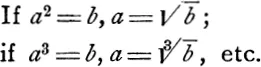
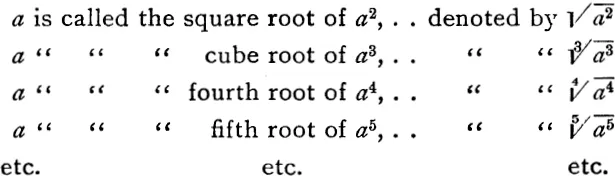
is a. Now in connexion with the raising of powers is a contrary operation called the extraction of roots. The term root is thus explained: We have seen that a a, or a2, is called the square of a; from which a is called the square root of a2. As 169 is called the square of 13, 13 is called the square root of 169. The following table will show how this phraseology is carried on.
images
If b stand for a5,
images
stands for a, and the foregoing table may be represented thus:
images
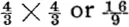
The usual method of proceeding is to teach the student to extract the square root of any algebraical quantity immediately after the solution of equations of the first degree. We would rather recommend him to omit this rule until he is acquainted with the solution of equations of the second degree, except in the cases to which we now proceed. In arithmetic, it must be observed that there are comparatively very few numbers of which the square root can be extracted. For example, 7 is not made by the multiplication either of any whole number or fraction by itself. The first is evident; the second cannot be readily proved to the beginner, but he may, by taking a number of instances, satisfy himself of this, that no fraction which is really such, that is whose numerator is not measured by its denominator, will give a whole number when multiplied by itself, thus
images
is not a whole number, and so on. The number 7, therefore, is neither the square of a whole number, nor of a fraction, and, properly speaking, has no square root. Nevertheless, fractions can be found extremely near to 7, which have square roots, and this degree of nearness may be carried to any extent we please. Thus, if required, between 7 and 7
images
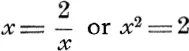
could be found a fraction which has a square root, and the fraction in the last might be decreased to any extent whatever, so that though we cannot find a fraction whose square is 7, we may nevertheless find one whose square is as near to 7 as we please. To take another example, if we multiply 1.4142 by itself the product is 1.99996164, which only differs from 2 by the very small fraction .00003836, so that the square of 1.4142 is very nearly 2, and fractions might be found whose squares are still nearer to 2. Let us now suppose the following problem. A man buys a certain number of yards of stuff for two shillings, and the number of yards which he gets is exactly the number of shillings which he gives for a yard. How many yards does he 2 buy? Let x be this number, then
images
is the price of one yard, and
images
. This, from what we have said, is impossible, that is, there is no exact number of yards, or parts of yards, which will satisfy the conditions ; nevertheless, 1.4142 yards will nearly do it, 1.4142136 still more nearly, and if the problem were ever proposed in practice, there would be no difficulty in solving it with sufficient nearness for any purpose. A problem, therefore, whose solution contains a square root which cannot be extracted, may be rendered useful by approximation to the square root.
Equations of the second degree, commonly called quadratic equations, are those in which there is the second power, or square of an unknown quantity: such as x2 โ€” 3...

Table of contents

  1. Cover
  2. Contents
  3. I. Introductory Remarks on the Nature and Objects of Mathematics
  4. II. On Arithmetical Notation
  5. III. Elementary Rules of Arithmetic
  6. IV. Arithmetical Fractions
  7. V. Decimal Fractions
  8. VI. Algebraical Notation and Principles
  9. VII. Elementary Rules of Algebra
  10. VIII. Equations of the First Degree
  11. IX. On the Negative Sign, etc.
  12. X. Equations of the Second Degree
  13. XI. On Roots in General, and Logarithms
  14. XII. On the Study of Algebra
  15. XIII. On the Definitions of Geometry
  16. XIV. On Geometrical Reasoning
  17. XV. On Axioms231
  18. XVI. On Proportion240
  19. XVII. Application of Algebra to the Measurement of Lines, Angles, Proportion of Figures, and Surfaces
  20. Index