- 128 pages
- English
- ePUB (mobile friendly)
- Available on iOS & Android
eBook - ePub
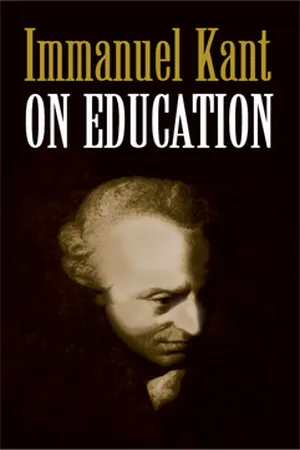
On Education
About this book
"One of the greatest problems of education," Kant observes, "is how to unite submission to the necessary restraint with the child's capability of exercising his free will." He explores potential solutions to this dilemma, stressing the necessity of treating children as children and not as miniature adults. His positive outlook on the effects of education include a conviction that human nature could be continually improved; to achieve this end, he advocated that pedagogy, the science of education, be raised to academic status and studied at a university level — an innovative notion for the 18th century.
Information
Topic
PhilosophySubtopic
Education Theory & PracticeEDUCATION
CHAPTER I
INTRODUCTION
1. MAN is the only being who needs education. For by education we must understand nurture (the tending and feeding of the child), discipline (Zucht), and teaching, together with culture.1 According to this, man is in succession infant (requiring nursing), child (requiring discipline), and scholar (requiring teaching).
2. Animals use their powers, as soon as they are possessed of them, according to a regular plan—that is, in a way not harmful to themselves.
It is indeed wonderful, for instance, that young swallows, when newly hatched and still blind, are careful not to defile their nests.
Animals therefore need no nurture, but at the most, food, warmth, and guidance, or a kind of protection. It is true, most animals need feeding, but they do not require nurture. For by nurture we mean the tender care and attention which parents must bestow upon their children, so as to prevent them from using their powers in a way which would be harmful to themselves. For instance, should an animal cry when it comes into the world, as children do, it would surely become a prey to wolves and other wild animals, which would gather round, attracted by its cry.
3. Discipline changes animal nature into human nature. Animals are by their instinct all that they ever can be; some other reason has provided everything for them at the outset. But man needs a reason of his own. Having no instinct, he has to work out a plan of conduct for himself. Since, however, he is not able to do this all at once, but comes into the world undeveloped, others have to do it for him.
4. All the natural endowments of mankind must be developed little by little out of man himself, through his own effort.
One generation educates the next. The first beginnings of this process of educating may be looked for either in a rude and unformed, or in a fully developed condition of man. If we assume the latter to have come first, man must at all events afterwards have degenerated and lapsed into barbarism.
It is discipline, which prevents man from being turned aside by his animal impulses from humanity, his appointed end. Discipline, for instance, must restrain him from venturing wildly and rashly into danger. Discipline, thus, is merely negative, its action being to counteract man’s natural unruliness. The positive part of education is instruction.
Unruliness consists in independence of law. By discipline men are placed in subjection to the laws of mankind, and brought to feel their constraint. This, however, must be accomplished early. Children, for instance, are first sent to school, not so much with the object of their learning something, but rather that they may become used to sitting still and doing exactly as they are told. And this to the end that in later life they should not wish to put actually and instantly into practice anything that strikes them.
5. The love of freedom is naturally so strong in man, that when once he has grown accustomed to freedom, he will sacrifice everything for its sake. For this very reason discipline must be brought into play very early; for when this has not been done, it is difficult to alter character later in life. Undisciplined men are apt to follow every caprice.
We see this also among savage nations, who, though they may discharge functions for some time like Europeans, yet can never become accustomed to European manners. With them, however, it is not the noble love of freedom which Rousseau and others imagine, but a kind of barbarism—the animal, so to speak, not having yet developed its human nature. Men should therefore accustom themselves early to yield to the commands of reason, for if a man be allowed to follow his own will in his youth, without opposition, a certain lawlessness will cling to him throughout his life. And it is no advantage to such a man that in his youth he has been spared through an over-abundance of motherly tenderness, for later on all the more will he have to face opposition from all sides, and constantly receive rebuffs, as soon as he enters into the business of the world.
It is a common mistake made in the education of those of high rank, that because they are hereafter to become rulers they must on that account receive no opposition in their youth. Owing to his natural love of freedom it is necessary that man should have his natural roughness smoothed down ; with animals, their instinct renders this unnecessary.
6. Man needs nurture and culture. Culture includes discipline and instruction. These, as far as we know, no animal needs, for none of them learn anything from their elders, except birds, who are taught by them to sing; and it is a touching sight to watch the mother bird singing with all her might to her young ones, who, like children at school, stand round and try to produce the same tones out of their tiny throats. In order to convince ourselves that birds do not sing by instinct, but that they are actually taught to sing, it is worth while to make an experiment. Suppose we take away half the eggs from a canary, and put sparrow’s eggs in their place, or exchange young sparrows for young canaries; if the young birds are then brought into a room where they cannot hear the sparrows outside, they will learn the canary’s song, and we thus get singing sparrows. It is, indeed, very wonderful that each species of bird has its own peculiar song, which is preserved unchanged through all its generations; and the tradition of the song is probably the most faithful in the world.
7. Man can only become man by education. He is merely what education makes of him. It is noticeable that man is only educated by man —that is, by men who have themselves been educated. Hence with some people it is want of discipline and instruction on their own part, which makes them in turn unfit educators of their pupils. Were some being of higher nature than man to undertake our education, we should then be able to see what man might become. It is, however, difficult for us accurately to estimate man’s natural capabilities, since some things are imparted to man by education, while other things are only developed by education. Were it possible, by the help of those in high rank, and through the united forces of many people, to make an experiment on this question, we might even by this means be able to gain some information as to the degree of eminence which it is possible for man to attain. But it is as important to the speculative mind, as it is sad to one who loves his fellow-men, to see how those in high rank generally care only for their own concerns, and take no part in the important experiments of education, which bring our nature one step nearer to perfection.
There is no one who, having been neglected in his youth, can come to years of discretion without knowing whether the defect lies in discipline or culture (for so we may call instruction). The uncultivated man is crude, the undisciplined is unruly. Neglect of discipline is a greater evil than neglect of culture, for this last can be remedied later in life, but unruliness cannot be done away with, and a mistake in discipline can never be repaired. It may be that education will be constantly improved, and that each succeeding generation will advance one step towards the perfecting of mankind; for with education is involved the great secret of the perfection of human nature. It is only now that something may be done in this direction, since for the first time people have begun to judge rightly, and understand clearly, what actually belongs to a good education. It is delightful to realise that through education human nature will be continually improved, and brought to such a condition as is worthy of the nature of man. This opens out to us the prospect of a happier human race in the future.
8. The prospect of a theory of education is a glorious ideal, and it matters little if we are not able to realise it at once. Only we must not look upon the idea as chimerical, nor decry it as a beautiful dream, notwithstanding the difficulties that stand in the way of its realisation.
An idea is nothing else than the conception of a perfection which has not yet been experienced. For instance, the idea of a perfect republic governed by principles of justice—is such an idea impossible, because it has not yet been experienced ?
Our idea must in the first place be correct, and then, notwithstanding all the hindrances that still stand in the way of its realisation, it is not at all impossible. Suppose, for instance, lying to become universal, would truth-speaking on that account become nothing but a whim ? And the idea of an education which will develop all man’s natural gifts is certainly a true one.
9. Under the present educational system man does not fully attain to the object of his being; for in what various ways men live! Uniformity can only result when all men act according to the same principles, which principles would have to become with them a second nature. What we can do is to work out a scheme of education better suited to further its objects, and hand down to posterity directions as to how this scheme may be carried into practice, so that they might be able to realise it gradually. Take the auricula as an example. When raised from a root this plant bears flowers of one colour only; when raised from seed, the flowers are of the most varied colours. Nature has placed these manifold germs in the plant, and their development is only a question of proper sowing and planting. Thus it is with man.
10. There are many germs lying undeveloped in man. It is for us to make these germs grow, by developing his natural gifts in their due proportion, and to see that he fulfils his destiny. Animals accomplish this for themselves unconsciously. Man must strive to attain it, but this he cannot do if he has not even a conception as to the object of his existence. For the individual it is absolutely impossible to attain this object. Let us suppose the first parents to have been fully developed, and see how they educate their children. These first parents set their children an example, which the children imitate and in this way develop some of their own natural gifts. All their gifts cannot, however, be developed in this way, for it all depends on occasional circumstances what examples children see. In times past men had no conception of the perfection to which human nature might attain—even now we have not a very clear idea of the matter. This much, however, is certain : that no individual man, no matter what degree of culture may be reached by his pupils, can insure their attaining their destiny. To succeed in this, not the work of a few individuals only is necessary, but that of the whole human race.
11. Education is an art which can only become perfect through the practice of many generations. Each generation, provided with the knowledge of the foregoing one, is able more and more to bring about an education which shall develop man’s natural gifts in their due proportion and in relation to their end, and thus advance the whole human race towards its destiny. Providence has willed, that man shall bring forth for himself the good that lies hidden in his nature, and has spoken, as it were, thus to man: ‘ Go forth into the world! I have equipped thee with every tendency towards the good. Thy part let it be to develop those tendencies. Thy happiness and unhappiness depend upon thyself alone.’
12. Man must develop his tendency towards the good. Providence has not placed goodness ready formed in him, but merely as a tendency and without the distinction of moral law. Man’s duty is to improve himself; to cultivate his mind; and, when he finds himself going astray, to bring the moral law to bear upon himself. Upon reflection we shall find this very difficult. Hence the greatest and most difficult problem to which man can devote himself is the problem of education. For insight depends on education, and education in its turn depends on insight. It follows therefore that education can only advance by slow degrees, and a true conception of the method of education can only arise when one generation transmits to the next its stores of experience and knowledge, each generation adding something of its own before transmitting them to the following. What vast culture and experience does not this conception presuppose? It could only be arrived at at a late stage, and we ourselves have not fully realised this conception. The question arises, Should we in the education of the individual imitate the course followed by the education of the human race through its successive generations ?
There are two human inventions which may be considered more difficult than any others—the art of government, and the art of education; and people still contend as to their very meaning.
13. But in developing human talents where are we to take our stand? Shall we begin with a rude, or with an already developed state of society?
It is difficult to conceive a development from a state of rudeness (hence it is so difficult to understand what the first man was like), and we see that in a development out of such a condition man has invariably fallen back again into that condition, and has raised himself out of it. In the earliest records of even very civilised nations we still find a distinct taint of barbarism, and yet how much culture is presupposed for mere writing to be possible! So much so that, with regard to civilised people, the beginning of the art of writing might be called the beginning of the world.
14. Since the development of man’s natural gifts does not take place of itself, all education is an art. Nature ...
Table of contents
- Title Page
- Copyright Page
- Table of Contents
- EDUCATION
Trusted by 375,005 students
Access to over 1.5 million titles for a fair monthly price.
Study more efficiently using our study tools.
Frequently asked questions
Yes, you can cancel anytime from the Subscription tab in your account settings on the Perlego website. Your subscription will stay active until the end of your current billing period. Learn how to cancel your subscription
No, books cannot be downloaded as external files, such as PDFs, for use outside of Perlego. However, you can download books within the Perlego app for offline reading on mobile or tablet. Learn how to download books offline
Perlego offers two plans: Essential and Complete
- Essential is ideal for learners and professionals who enjoy exploring a wide range of subjects. Access the Essential Library with 800,000+ trusted titles and best-sellers across business, personal growth, and the humanities. Includes unlimited reading time and Standard Read Aloud voice.
- Complete: Perfect for advanced learners and researchers needing full, unrestricted access. Unlock 1.5M+ books across hundreds of subjects, including academic and specialized titles. The Complete Plan also includes advanced features like Premium Read Aloud and Research Assistant.
We are an online textbook subscription service, where you can get access to an entire online library for less than the price of a single book per month. With over 1.5 million books across 990+ topics, we’ve got you covered! Learn about our mission
Look out for the read-aloud symbol on your next book to see if you can listen to it. The read-aloud tool reads text aloud for you, highlighting the text as it is being read. You can pause it, speed it up and slow it down. Learn more about Read Aloud
Yes! You can use the Perlego app on both iOS and Android devices to read anytime, anywhere — even offline. Perfect for commutes or when you’re on the go.
Please note we cannot support devices running on iOS 13 and Android 7 or earlier. Learn more about using the app
Please note we cannot support devices running on iOS 13 and Android 7 or earlier. Learn more about using the app
Yes, you can access On Education by Immanuel Kant in PDF and/or ePUB format, as well as other popular books in Philosophy & Education Theory & Practice. We have over 1.5 million books available in our catalogue for you to explore.