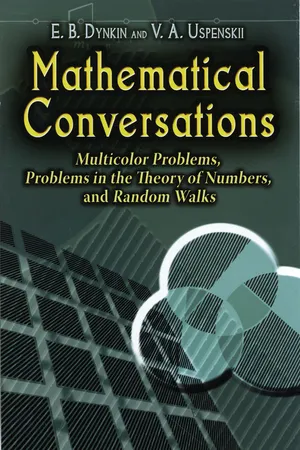
Mathematical Conversations
eBook - ePub

Mathematical Conversations

Multicolor Problems, Problems in the Theory of Numbers, and Random Walks

  1. 288 pages
  2. English
  3. ePUB (mobile friendly)
  4. Available on iOS & Android
eBook - ePub

Mathematical Conversations

Multicolor Problems, Problems in the Theory of Numbers, and Random Walks

About this book

Combining three books into a single volume, this text comprises Multicolor Problems, dealing with several of the classical map-coloring problems; Problems in the Theory of Numbers, an elementary introduction to algebraic number theory; and Random Walks, addressing basic problems in probability theory.
The book's primary aim is not so much to impart new information as to teach an active, creative attitude toward mathematics. The sole prerequisites are high-school algebra and (for Multicolor Problems) a familiarity with the methods of mathematical induction. The book is designed for the reader's active participation. The problems are carefully integrated into the text and should be solved in order. Although they are basic, they are by no means elementary. Some sequences of problems are geared toward the mastery of a new method, rather than a definitive result, and others are practice exercises, designed to introduce new concepts. Complete solutions appear at the end.


Frequently asked questions

Yes, you can cancel anytime from the Subscription tab in your account settings on the Perlego website. Your subscription will stay active until the end of your current billing period. Learn how to cancel your subscription.
No, books cannot be downloaded as external files, such as PDFs, for use outside of Perlego. However, you can download books within the Perlego app for offline reading on mobile or tablet. Learn more here.
Perlego offers two plans: Essential and Complete
  • Essential is ideal for learners and professionals who enjoy exploring a wide range of subjects. Access the Essential Library with 800,000+ trusted titles and best-sellers across business, personal growth, and the humanities. Includes unlimited reading time and Standard Read Aloud voice.
  • Complete: Perfect for advanced learners and researchers needing full, unrestricted access. Unlock 1.4M+ books across hundreds of subjects, including academic and specialized titles. The Complete Plan also includes advanced features like Premium Read Aloud and Research Assistant.
Both plans are available with monthly, semester, or annual billing cycles.
We are an online textbook subscription service, where you can get access to an entire online library for less than the price of a single book per month. With over 1 million books across 1000+ topics, we’ve got you covered! Learn more here.
Look out for the read-aloud symbol on your next book to see if you can listen to it. The read-aloud tool reads text aloud for you, highlighting the text as it is being read. You can pause it, speed it up and slow it down. Learn more here.
Yes! You can use the Perlego app on both iOS or Android devices to read anytime, anywhere — even offline. Perfect for commutes or when you’re on the go.
Please note we cannot support devices running on iOS 13 and Android 7 or earlier. Learn more about using the app.
Yes, you can access Mathematical Conversations by E. B. Dynkin,V. A. Uspenskii in PDF and/or ePUB format, as well as other popular books in Mathematics & Algebra. We have over one million books available in our catalogue for you to explore.

Information

SECTION TWO
Problems in the Theory of Numbers
1. The Arithmetic of Residue Classes
1. ARITHMETIC, MODULO m, OR m-ARITHMETIC1
When we add two one-digit numbers we obtain either a onedigit number, for example,
images
or a two-digit number,
images
We now consider only the last digit in the case of two-digit sums, and we write
images
With this new definition of addition, the sum of two one-digit numbers is always a one-digit number.
When we multiply two one-digit numbers we likewise obtain either a one-digit number:
images
or a two-digit number:
images
Again, we shall consider only the last digit of a two-digit product, and we write
images
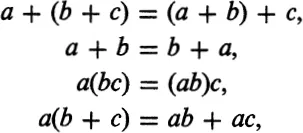
With this new definition of multiplication, the product of two onedigit numbers is always a one-digit number. Though the operations introduced here are different from those that we call ordinary addition and multiplication, the formulas of ordinary algebra that contain only the symbols for addition and multiplication and an arbitrary number of parentheses hold also for the new operations.2 In particular, the following formulas hold:
images
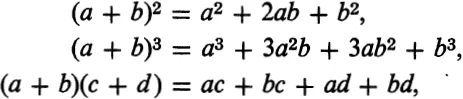
as well as the formulas
images
and others. Hence, the use of the customary symbols cannot lead to a misunderstanding.
In this way, we have constructed a new arithmetic, which differs from ordinary arithmetic and yet resembles it in many respects. This new arithmetic will be helpful in the solution of many problems in ordinary arithmetic and algebra.
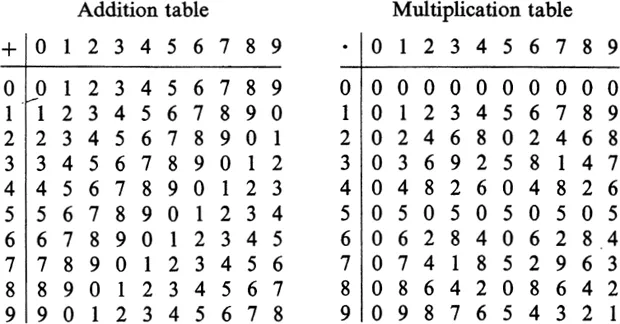
We have begun to develop the arithmetic of residue classes, modulo 10, or more briefly, 10-arithmetic. It contains only the numbers 0, 1, 2, 3, 4, 5, 6, 7, 8, 9. Let us set up the addition and multiplication tables of this 10-arithmetic:
images
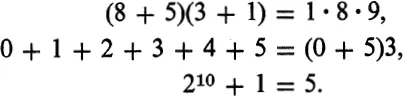
We make one additional remark. Suppose that we have any equality of ordinary arithmetic which contains, besides numbers, only addition sighs, multiplication signs, and parentheses, and we replace every number by its last digit. We then obtain an equation that holds in 10-arithmetic. For example, we can obtain from the equalities of ordinary arithmetic,
images
the equalities of 10-arithmetic,3
images
Problem 1. Exh...

Table of contents

  1. Cover
  2. Title Page
  3. Copyright Page
  4. Contents
  5. Section I: Multicolor Problems
  6. Section II: Problems in the Theory of Numbers
  7. Section III: Random Walks