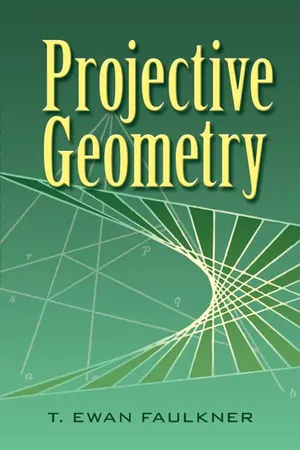
This text explores the methods of the projective geometry of the plane. Some knowledge of the elements of metrical and analytical geometry is assumed; a rigorous first chapter serves to prepare readers. Following an introduction to the methods of the symbolic notation, the text advances to a consideration of the theory of one-to-one correspondence. It derives the projective properties of the conic and discusses the representation of these properties by the general equation of the second degree. A study of the relationship between Euclidean and projective geometry concludes the presentation. Numerous illustrative examples appear throughout the text.
- 144 pages
- English
- ePUB (mobile friendly)
- Available on iOS & Android
eBook - ePub
Projective Geometry
About this book
Information
Topic
MatematicaSubtopic
GeometriaCHAPTER I
INTRODUCTION : THE PROPOSITIONS OF INCIDENCE
1. Historical note.—The study of geometry began well over two thousand years ago, and it is inevitable that in that long period there should have been several courses of development. Modern geometry is built on more than one foundation and cannot be fully appreciated without some knowledge of its history. There are three main lines of approach to the study of geometry—the metrical, the projective and the analytical—and it is important to understand the contribution which each has made to our present knowledge.
The first method of study began with the Greek geometers, and is associated with the name of Euclid. Euclidean geometry is based upon the fundamental notion of distance, or length ; distance is never defined, but is regarded as an intuitive concept which underlies every geometrical theorem. Euclidean geometry is metrical, for it assumes that every segment or angle can be measured and expressed in terms of a standard distance or standard angle.
However, in addition to theorems which were very obviously concerned with distance, geometers were interested in theorems involving the concurrency of lines or the collinearity of points. A typical example is Pappus’ theorem, proved by Pappus using the methods of metrical geometry about the year A.D. 300. These projective theorems, as they were called, were for many centuries merely added to the propositions of Euclid, and were not regarded as being of a different character. Development was slow, and it was not until the seventeenth century that Desargues, and to a lesser extent Pascal, established the main theorems of projective geometry. Both Desargues and Pascal made full use of the theorems of metrical geometry, and it was only after the publication of Geometrie der Lage by von Staudt in 1847 that projective geometry was established as a science built upon a different set of axioms from those of Euclid. It was shown that the theorems of projective geometry were independent of the concept of distance, and that distance itself could be expressed in terms of simpler projective elements. The theorems of metrical geometry were found to be special cases of the more general theorems of projective geometry, with Euclidean geometry as only part of the field covered by the science of projective geometry.
The third method of geometrical study is that known as coordinate or analytical geometry. It was introduced by Descartes, who represented a point by a set of numbers, and thus applied the methods of algebra to the solution of geometrical problems. Descartes used the idea of distance, and his geometry is thus metrical ; his achievement was that, by expressing geometrical ideas in the language of algebra, he was able to provide simple proofs of many theorems difficult to deal with by the traditional methods of metrical geometry. However, the methods of analytical geometry have not been limited in their application to metrical problems only, and since the time of Descartes, geometers such as Poncelet and Cayley have applied these methods, with modification, to the whole field of projective geometry. The Cartesian coordinates of Descartes have been replaced by homogeneous coordinates, which, since they are independent of metrical concepts, are able to deal more conveniently with projective problems.
Complex points.—The application of algebra to geometry had a very important consequence. Once the theory of complex numbers was established and it was agreed that every quadratic equation had two roots whether real or complex, it was a simple matter to deduce the existence of complex or imaginary points. Previously the problem of finding the points common to a line and a conic could not be solved satisfactorily, but, when it was known that the problem was identical with that of solving a quadratic equation, it became clear that a line and conic always had two points in common, but that these two points could be real, coincident or complex. The use of complex points opened up a very fruitful field of study, for it enabled geometers to elaborate general theorems which would not be true if the field of real points only were considered. In particular, the discovery of the “ circular points ” made it possible to generalise well-established theorems about circles and obtain theorems about conics through two fixed points.
2. The projective method.—The raw material of projective geometry consists of a number of elements, points, lines and planes. We make no attempt to define these concepts, but regard them as undefined elements related to each other according to certain axioms which we call the propositions of incidence. These axioms are not the only set of axioms upon which a logical and self-consistent geometry could be built...
Table of contents
- DOVER BOOKS ON MATHEMATICS
- Title Page
- Copyright Page
- PREFACE
- Table of Contents
- CHAPTER I - INTRODUCTION : THE PROPOSITIONS OF INCIDENCE
- CHAPTER II - RELATED RANGES AND PENCILS : INVOLUTIONS
- CHAPTER III - THE CONIC
- CHAPTER IV - ABSOLUTE ELEMENTS: THE CIRCLE: FOCI OF CONICS
- CHAPTER V - THE EQUATION OF A LINE AND OF A CONIC : ALGEBRAIC CORRESPONDENCE ON A CONIC : THE HARMONIC LOCUS AND ENVELOPE
- CHAPTER VI - METRICAL GEOMETRY
- INDEX
Trusted by 375,005 students
Access to over 1.5 million titles for a fair monthly price.
Study more efficiently using our study tools.
Frequently asked questions
Yes, you can cancel anytime from the Subscription tab in your account settings on the Perlego website. Your subscription will stay active until the end of your current billing period. Learn how to cancel your subscription
No, books cannot be downloaded as external files, such as PDFs, for use outside of Perlego. However, you can download books within the Perlego app for offline reading on mobile or tablet. Learn how to download books offline
Perlego offers two plans: Essential and Complete
- Essential is ideal for learners and professionals who enjoy exploring a wide range of subjects. Access the Essential Library with 800,000+ trusted titles and best-sellers across business, personal growth, and the humanities. Includes unlimited reading time and Standard Read Aloud voice.
- Complete: Perfect for advanced learners and researchers needing full, unrestricted access. Unlock 1.5M+ books across hundreds of subjects, including academic and specialized titles. The Complete Plan also includes advanced features like Premium Read Aloud and Research Assistant.
We are an online textbook subscription service, where you can get access to an entire online library for less than the price of a single book per month. With over 1.5 million books across 990+ topics, we’ve got you covered! Learn about our mission
Look out for the read-aloud symbol on your next book to see if you can listen to it. The read-aloud tool reads text aloud for you, highlighting the text as it is being read. You can pause it, speed it up and slow it down. Learn more about Read Aloud
Yes! You can use the Perlego app on both iOS and Android devices to read anytime, anywhere — even offline. Perfect for commutes or when you’re on the go.
Please note we cannot support devices running on iOS 13 and Android 7 or earlier. Learn more about using the app
Please note we cannot support devices running on iOS 13 and Android 7 or earlier. Learn more about using the app
Yes, you can access Projective Geometry by T. Ewan Faulkner in PDF and/or ePUB format, as well as other popular books in Matematica & Geometria. We have over 1.5 million books available in our catalogue for you to explore.