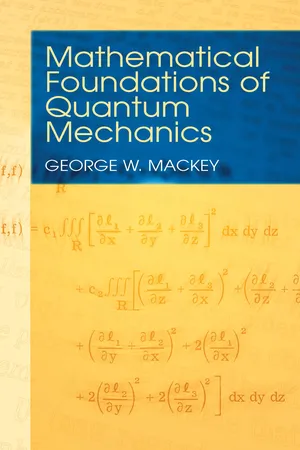
Designed for students familiar with abstract mathematical concepts but possessing little knowledge of physics, this text focuses on generality and careful formulation rather than problem-solving. Its author, a member of the distinguished National Academy of Science, based this graduate-level text on the course he taught at Harvard University. Opening chapters on classical mechanics examine the laws of particle mechanics; generalized coordinates and differentiable manifolds; oscillations, waves, and Hilbert space; and statistical mechanics. A survey of quantum mechanics covers the old quantum theory; the quantum-mechanical substitute for phase space; quantum dynamics and the Schrödinger equation; the canonical "quantization" of a classical system; some elementary examples and original discoveries by Schrödinger and Heisenberg; generalized coordinates; linear systems and the quantization of the electromagnetic field; and quantum-statistical mechanics. The final section on group theory and quantum mechanics of the atom explores basic notions in the theory of group representations; perturbations and the group theoretical classification of eigenvalues; spherical symmetry and spin; and the n-electron atom and the Pauli exclusion principle.
Let S denote the set of all “states” of a physical system, where “state” is defined in such a way that the state of the system at a time t = t0 > 0 is uniquely determined by the appropriate physical law and the state at t = 0. For example, the state of a system of n interacting mass particles is determined by giving the 3n position coordinates and the 3n velocity coordinates of the n particles. For each s ∈ S and each t > 0 let Ut(s) denote the state at time t when the state at time 0 is s. Then for each fixed t, Ut is a transformation of S into S. Now Ut1(Ut2(s)) is the state t1 time units after the state was Ut1(s) and Ut2(s) is the state t2 time units after it was s. Thus Ut1(Ut2(s)) is the state t1 + t2 time units after it was s; that is, Ut1 + t2(s). In other words, for all t1 and t2 with t1 > 0, t2 > 0 we have
It follows in particular that the set of all Ut is a semi-group of transformations. A semi-group which has been parameterized by the real numbers so that (1) holds is said to be a one-parameter semi-group. Thus the change in time of a physical system is described by a one-parameter semi-group. We shall call it the dynamical semi-group of the system.
If each Ut is a one-to-one map of S onto S so that
exists, we shall write
and U0 = I, where I is the identity transformation. Then (1) holds for all real t1 and t2 and we have a one-parameter group. We shall deal mainly with systems that are reversible in the sense that the dynamical semi-group may be expanded to a one- parameter group as indicated above.
When our system is reversible, each s lies on one and only one “orbit,” where an orbit is the set of all points Ut(s) for fixed s and variable t. Each orbit is a curve in S. Generally speaking (we shall give precise details in various special cases) S has sufficient extra structure so that it makes sense to discuss the “tangent vectors” to the points of each orbit. In this way the dynamical group assigns a “vector” to each point of S, i. e., a “vector field.” This vector field is called the “infinitesimal generator” of the group and in many cases determines the group uniquely. This is of great importance because the physical law is usually much more easily expressed by describing the infinitesimal generator of the group than by describing the group itself. Indeed, physical laws are almost always given in infinitesimal form, and in order to obtain the orbits of the group one has to integrate differential equations.
In the special case in which S is an open subset of Euclidean n-space we may make the above considerations much more definite. (We shall consider more general cases later.) Then each orbit in S is a curve in n-space described by n functions of t: q1(t), … , qn(t). Here q1(t), … , qn(t) = Ut(q1(0), … ,qn(0)). If th...
Table of contents
Cover
Title Page
Copyright Page
Editor’s Foreword
Preface
Contents
Chapter 1. Classical Mechanics
Chapter 2. Quantum Mechanics
Chapter 3. Group Theory and the Quantum Mechanics of the Atom
Appendix
Trusted by 375,005 students
Access to over 1.5 million titles for a fair monthly price.
Study more efficiently using our study tools.
Frequently asked questions
Yes, you can cancel anytime from the Subscription tab in your account settings on the Perlego website. Your subscription will stay active until the end of your current billing period. Learn how to cancel your subscription
No, books cannot be downloaded as external files, such as PDFs, for use outside of Perlego. However, you can download books within the Perlego app for offline reading on mobile or tablet. Learn how to download books offline
Perlego offers two plans: Essential and Complete
Essential is ideal for learners and professionals who enjoy exploring a wide range of subjects. Access the Essential Library with 800,000+ trusted titles and best-sellers across business, personal growth, and the humanities. Includes unlimited reading time and Standard Read Aloud voice.
Complete: Perfect for advanced learners and researchers needing full, unrestricted access. Unlock 1.5M+ books across hundreds of subjects, including academic and specialized titles. The Complete Plan also includes advanced features like Premium Read Aloud and Research Assistant.
Both plans are available with monthly, semester, or annual billing cycles.
We are an online textbook subscription service, where you can get access to an entire online library for less than the price of a single book per month. With over 1.5 million books across 990+ topics, we’ve got you covered! Learn about our mission
Look out for the read-aloud symbol on your next book to see if you can listen to it. The read-aloud tool reads text aloud for you, highlighting the text as it is being read. You can pause it, speed it up and slow it down. Learn more about Read Aloud
Yes! You can use the Perlego app on both iOS and Android devices to read anytime, anywhere — even offline. Perfect for commutes or when you’re on the go. Please note we cannot support devices running on iOS 13 and Android 7 or earlier. Learn more about using the app
Yes, you can access Mathematical Foundations of Quantum Mechanics by George W. Mackey in PDF and/or ePUB format, as well as other popular books in Mathematics & Mathematical Analysis. We have over 1.5 million books available in our catalogue for you to explore.