Real Computing Made Real
eBook - ePub

Real Computing Made Real

Preventing Errors in Scientific and Engineering Calculations

  1. 288 pages
  2. English
  3. ePUB (mobile friendly)
  4. Available on iOS & Android
eBook - ePub

Real Computing Made Real

Preventing Errors in Scientific and Engineering Calculations

About this book

Engineers and scientists who want to avoid insidious errors in their computer-assisted calculations will welcome this concise guide to trouble-shooting. Real Computing Made Real offers practical advice on detecting and removing bugs. It also outlines techniques for preserving significant figures, avoiding extraneous solutions, and finding efficient iterative processes for solving nonlinear equations.
Those who compute with real numbers (for example, floating-point numbers stored with limited precision) tend to develop techniques that increase the frequency of useful answers. But although there might be ample guidance for those addressing linear problems, little help awaits those negotiating the nonlinear world. This book, geared toward upper-level undergraduates and graduate students, helps rectify that imbalance. Its examples and exercises (with answers) help readers develop problem-formulating skills and assist them in avoiding the common pitfalls that software packages seldom detect. Some experience with standard numerical methods is assumed, but beginners will find this volume a highly practical introduction, particularly in its treatment of often-overlooked topics.

Frequently asked questions

Yes, you can cancel anytime from the Subscription tab in your account settings on the Perlego website. Your subscription will stay active until the end of your current billing period. Learn how to cancel your subscription.
No, books cannot be downloaded as external files, such as PDFs, for use outside of Perlego. However, you can download books within the Perlego app for offline reading on mobile or tablet. Learn more here.
Perlego offers two plans: Essential and Complete
  • Essential is ideal for learners and professionals who enjoy exploring a wide range of subjects. Access the Essential Library with 800,000+ trusted titles and best-sellers across business, personal growth, and the humanities. Includes unlimited reading time and Standard Read Aloud voice.
  • Complete: Perfect for advanced learners and researchers needing full, unrestricted access. Unlock 1.4M+ books across hundreds of subjects, including academic and specialized titles. The Complete Plan also includes advanced features like Premium Read Aloud and Research Assistant.
Both plans are available with monthly, semester, or annual billing cycles.
We are an online textbook subscription service, where you can get access to an entire online library for less than the price of a single book per month. With over 1 million books across 1000+ topics, we’ve got you covered! Learn more here.
Look out for the read-aloud symbol on your next book to see if you can listen to it. The read-aloud tool reads text aloud for you, highlighting the text as it is being read. You can pause it, speed it up and slow it down. Learn more here.
Yes! You can use the Perlego app on both iOS or Android devices to read anytime, anywhere — even offline. Perfect for commutes or when you’re on the go.
Please note we cannot support devices running on iOS 13 and Android 7 or earlier. Learn more about using the app.
Yes, you can access Real Computing Made Real by Forman S. Acton in PDF and/or ePUB format, as well as other popular books in Mathematics & Discrete Mathematics. We have over one million books available in our catalogue for you to explore.

Information

e9780486152936_i0250.webp

A PILLOW PROBLEM

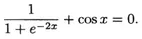
Find the smallest positive root of
e9780486152936_i0251.webp
Three student proposals for solving this equation were:
  1. e9780486152936_i0252.webp
  2. e9780486152936_i0253.webp
  3. Newton’s method, starting with x = 3.
Who did well — and did you do any better?

Chapter 1

NONLINEAR EQUATIONS

“Thou hast damnable iterations, and art indeed able to corrupt a saint.”
Falstaff


Nonlinear equations are divided into transcendental equations (strictly, equations containing a transcendental function — but often loosely applied to almost anything nasty), algebraic equations (things with square and cube roots or other fractional powers) and polynomial equations. Of these, polynomials are sufficiently specialized to warrant separate treatment. This chapter is concerned with the rest.
Before spending time trying to solve an unfamiliar nonlinear equation carefully, plot it! Or sketch it with some care. And look at it. You may be surprised at what you see. In the event, you will probably see enough of its geometry to suggest a reasonable solution method and, conversely, to rule out other methods you might have tried. We cannot overemphasize this advice:
Look at your equation’s geometry first!
Nonlinear equations usually have several roots and they require iterative algorithms that will not work well unless started “geometrically near” a root. Without a good start, most methods will bounce all over the numerical landscape before either generating the machine equivalent of infinity or else settling down to laboriously deliver a root you probably did not want. (Newton’s method is more efficient than most, but efficiency in getting a wrong answer is not a virtue. Don’t turn Newton loose unchaperoned.)

Black-box equation solvers

Before turning to specific examples, we ought to say a few cautionary words about equation “solvers” that are now available in several mathematical software packages on PC’s and mainframe computers and, more recently, in top-of-the-line pocket calculators. Most of them are quite accurate for cleanly posed problems, that is, for problems where an uncritical application of Newton’s method will succeed. They do not invent a suitable starting value — that is a job they leave to you, with “If at first you don’t succeed ...”. They do, however, have two faults: they are frequently brute-force inefficient and they do not have the ability to reformulate an ill-conditioned problem — or even to detect its troubles. They just give you a poor answer, without comment. Caveat emptor!

A sine and a line

Let’s explore a simple example: Find the smallest positive root of the equation system
e9780486152936_i0254.webp
(1) (2)
which, being the sine curve and a straight line with slope 1/2 and a small intercept, 0.1, is easy to sketch (figure 1). Since the line is fairly flat, an iterative procedure comes to mind:
Step 1. Having an x, we move vertically to the line via
y ← 0.1 + x/2.
Step 2. Using this y we move horizontally to the sine curve via
x ← arcsin y
then go to Step 1.
We show one possible iteration, starting at 0.48, in our figure 1. In practice we usually will combine the steps to execut...

Table of contents

  1. Title Page
  2. Copyright Page
  3. Table of Contents
  4. ACKNOWLEDGMENTS
  5. AN EXHORTATION
  6. Chapter 0 - TOOLS OF THE TRADE
  7. A WORKSHOP FOR PRACTICE IN SKETCHING FUNCTIONS
  8. GLOOMY MUSINGS: - Correctness, Efficiency and Responsibility in Computation
  9. Chapter 1 - NONLINEAR EQUATIONS
  10. Chapter 2 - PRESERVING SIGNIFICANT DIGITS
  11. Chapter 3 - QUADRATURES
  12. Chapter 4 - RECURRENCE RELATIONS
  13. Chapter 5 - CHOOSING AND TUNING AN ALGORITHM
  14. ANSWERS TO MOST OF THE EXERCISES
  15. INDEX


