This graduate-level text offers a comprehensive account of the general theory of stationary processes, with special emphasis on the properties of sample functions. Assuming a familiarity with the basic features of modern probability theory, the text develops the foundations of the general theory of stochastic processes, examines processes with a continuous-time parameter, and applies the general theory to procedures key to the study of stationary processes. Additional topics include analytic properties of the sample functions and the problem of time distribution of the intersections between a sample function. 1967 edition.
An important motivation for studying any branch of probability theory arises from its application to practical situations involving random phenomena. That is, the theory provides a mathematical description, or model for, say, a given experiment in which random influences are involved. Such a model provides a basis for making statistical decisions concerning possible courses of action resulting from the experiment. The situation is thus closely akin to that in many other fields of application of mathematics such as, for example, Euclidean geometry, where we have an abstract theory on the one hand and important practical applications on the other.
In this book we shall be concerned primarily with the probabilistic structure of certain types of stochastic processes, or random functions of a variable which, in most practical applications, will signify time. Hence, it is appropriate that we begin with a general discussion of the empirical probability background concerning practical situations which lead to the consideration of such processes.
1.1 RANDOM EXPERIMENTS AND RANDOM VARIABLES
In Chapter 2 we shall be concerned with a proper mathematical foundation for probability theory. It is appropriate here, however, to consider the intuitive concepts of the theory.
The practical situation with which we are concerned involves a random experiment. That is, we consider an experiment E, the outcome of which is determined, at least partially, by some random mechanism whose effect we cannot predict exactly in advance. The word “experiment” is here used in a broad sense; we may be concerned with n tosses of a coin, a measurement of the height of a random individual in a population, or of the lifetime of a light bulb, and so on.
In conducting a random experiment, one is interested in the probabilities that certain events will occur. For example, if A denotes the event that a single toss of an unbiased coin will yield a head, we define P(A), the probability that event A occurs, as having the value
. In any case, the definition of the probability p= P(A) of an event A which may or may not occur when the experiment E is performed, is motivated by the requirement that the proportion of times A occurs in a large number of repetitions of E should eventually, in some reasonable sense, approximate the value p. Probabilities of certain events may often be found by means of combinatorial rules from known probabilities of simpler events; for example, the probability of two heads in two tosses with a coin is
. In more complex situations, a strict definition of the “probability of an event” is best given in measure-theoretic terms involving a mathematical model for the random experiment concerned.
In virtually every kind of random experiment, even the simplest, one is interested in some numerical quantity associated with the experiment. For example, one may be interested in the number of heads in n tosses of a coin, or the total score in n throws of a die. Such a numerical quantity is termed a random variable. The name “random variable” derives from the fact that its value cannot generally be predicted exactly in advance, and repetitions of the experiment do not usually give the same numerical value; if in three tosses of a coin three heads are obtained, there is no guarantee that three further tosses will produce another three heads.
It is random variables which are of primary interest in probability and statistics. Although a random variable is, in general, best defined within a measure-theoretic framework (which will be described in Chapter 2), we note here that the probabilistic behaviour of a random variable ξ is specified by means of its distribution function F(x) where
F(x) = P{ξ ≤ x}.
That is, F(x) is the probability of the event in braces (the event that the experiment yields a value of ξ which does not exceed the real number x). The knowledge of F(x) enables one to obtain the probability that the value of the random variable ξ should lie in a set S of real numbers, for a very wide class of such sets S. In this way, the distribution function uniquely determines the probabilistic properties of interest relative to the random variable ξ.
1.2 FINITE FAMILIES OF RANDOM VARIABLES
In many cases, we are concerned with not just one, but a number of random variables considered simultaneously. For example, if we choose an individual at random from a community and measure his height, weight, and I.Q., we obtain three random variables, ξ1, ξ2, and ξ3.
More generally, we may consider a finite family (ξ1 ... ξn) or vector random variableξ = (ξ1 ··· ξn), where ξ’s are each random variables. To discuss the probabilistic behaviour of the family, we would like to specify the probability that the point (ξ1 ··· ξn) in n-dimensional space should lie in a given n-dimensional set S. As in the case of a single random variable, this is uniquely specified for a large class of such sets S by the joint distribution function of ξ1··· ξn, namely,
F(x1 ··· xn) = P(ξ1 ≤ x1, ... , ξn ≤ xn).
This distribution function is thus the probability that no ξi should exceed the corresponding xi. Again, a fuller and more precise discussion of the properties of such finite-dimensional distribution functions will be given in the following chapters. Here we simply note that the function F(x1··· xn) summarizes all the information concerning the probabilities of interest, relative to the joint behaviour of the finite family (ξ1 ··· ξn).
1.3 INFINITE FAMILIES—STOCHASTIC PROCESSES
In this book our main interest will center on the generalization of the preceding cases to include arbitrary families of random variables. That is, we shall consider a family {ξt} of random variables where t runs through some index set T. If T consists of a single point, we return to the case of a single random variable, while a finite T-set corresponds to the finite family of the preceding section.
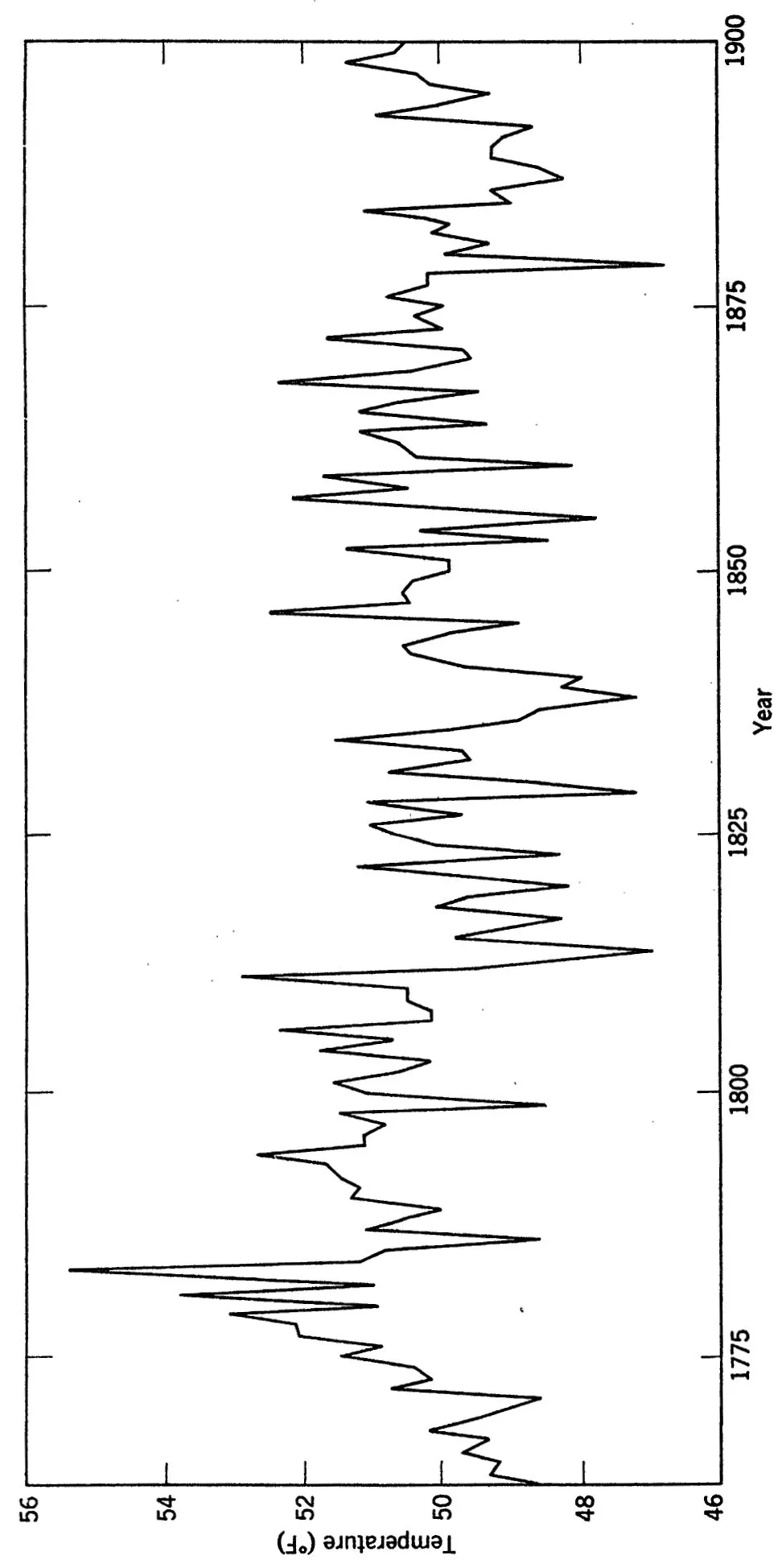
Fig. 1.3.1. Annual mean air temperatures in London from 1763 to 1900.
Fig. 1.3.2. Phase error in phase tracking experiment.
From our point of view, the most interesting cases will be when T consists of the set of integers (or ...
Table of contents
Title Page
Copyright Page
Preface
Table of Contents
CHAPTER 1 - Empirical Background
CHAPTER 2 - Some Fundamental Concepts and Results of Mathematical Probability Theory
CHAPTER 3 - Foundations of the Theory of Stochastic Processes
CHAPTER 4 - Analytic Properties of Sample Functions
CHAPTER 5 - Processes with Finite Second-Order Moments
CHAPTER 6 - Processes with Orthogonal Increments
CHAPTER 7 - Stationary Processes
CHAPTER 8 - Generalizations
CHAPTER 9 - Analytic Properties of the Sample Functions of Normal Processes
CHAPTER 10 - “Crossing” Problems and Related Topics
CHAPTER 11 - Properties of Streams of Crossings
CHAPTER 12 - Limit Theorems for Crossings
CHAPTER 13 - Nonstationary Normal Processes Curve Crossing Problems
CHAPTER 14 - Frequency Detection and Related Topics
CHAPTER 15 - Some Aspects of the Reliability of Linear Systems
References
Index
Trusted by 375,005 students
Access to over 1.5 million titles for a fair monthly price.
Study more efficiently using our study tools.
Frequently asked questions
Yes, you can cancel anytime from the Subscription tab in your account settings on the Perlego website. Your subscription will stay active until the end of your current billing period. Learn how to cancel your subscription
No, books cannot be downloaded as external files, such as PDFs, for use outside of Perlego. However, you can download books within the Perlego app for offline reading on mobile or tablet. Learn how to download books offline
We are an online textbook subscription service, where you can get access to an entire online library for less than the price of a single book per month. With over 1.5 million books across 990+ topics, we’ve got you covered! Learn about our mission
Look out for the read-aloud symbol on your next book to see if you can listen to it. The read-aloud tool reads text aloud for you, highlighting the text as it is being read. You can pause it, speed it up and slow it down. Learn more about Read Aloud
Yes! You can use the Perlego app on both iOS and Android devices to read anytime, anywhere — even offline. Perfect for commutes or when you’re on the go. Please note we cannot support devices running on iOS 13 and Android 7 or earlier. Learn more about using the app
Yes, you can access Stationary and Related Stochastic Processes by Harald Cramér,M. Ross Leadbetter in PDF and/or ePUB format, as well as other popular books in Mathematics & Probability & Statistics. We have over 1.5 million books available in our catalogue for you to explore.