This concise volume offers undergraduate students of chemistry an introduction to the mathematical formalism encountered in problems of molecular structure and motion. The author presents only two main topics from mathematics and two from physics: the calculus of orthogonal functions and the algebra of vector spaces from mathematics; and from physics, the Lagrangian and Hamiltonian formulation of classical mechanics and its applications to molecular motion.
The chosen topics possess particular relevance to modern quantum chemistry, especially in regard to the application of quantum mechanics to molecular spectroscopy. Mathematics for Quantum Chemistry develops the foundations for a physical and mathematical background in quantum chemistry in general, and for molecular spectroscopy in particular. It assumes a knowledge of calculus through partial derivatives and multiple integration, a year of physics, and chemistry through a year of physical chemistry.

- 160 pages
- English
- ePUB (mobile friendly)
- Available on iOS & Android
eBook - ePub
Mathematics for Quantum Chemistry
About this book
Trusted by 375,005 students
Access to over 1.5 million titles for a fair monthly price.
Study more efficiently using our study tools.
Information
Topic
NaturwissenschaftenSubtopic
Chemie1
Introduction
1-1 EIGENVALUE PROBLEMS IN QUANTUM MECHANICS
The mathematics and physics that are relevant to quantum chemistry are, almost without exception, oriented toward the solution of a particular kind of problem, the calculation of properties of a molecular system from the fundamental properties (charge, mass) of the particles composing the system. A good example of this is the calculation of the energy of the electrons in a molecule, using only the charge of the electron, Planck’s constant, and so forth. The reader is probably already aware of the nature of the answer to this problem. There are a number of discrete values for the energy which the electrons in the molecule can assume up to a point, but higher values for the electronic energy occur in a continuous range. These energy values are shown qualitatively in Fig. 1-1. Quantum mechanics does provide the result that some physical quantities may take on only some values, not all values, as experiments indicated. The allowed values for a physical quantity are called eigenvalues, from the German for characteristic values. A particular physical quantity may assume an eigenvalue from a continuum, or perhaps from a finite or infinite discrete set of eigenvalues. The energy of an atom, for instance, may take on one of an infinite number of discrete values, as well as values from a higher-lying range of continuous eigenvalues, called the continuum. More often than not, chemistry is concerned with the discrete eigenvalues of a quantity, rather than its continuum of eigenvalues.

Figure 1-1 Eigenvalues of the energy of a molecule.
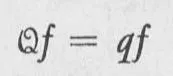
The mathematical problem of finding the eigenvalues of a quantity is called an eigenvalue problem; it is usually cast in the form of an equation called an eigenvalue equation. An eigenvalue equation for a physical quantity Q has the deceptively simple appearance
(1–1)
In this equation, f is a function, called the eigenfunction for the quantity Q, with the eigenvalue q. The element Q is called an operator, and the statement Qf tells us to change the function f into a new function, according to a set of instructions implicit in the definition of the operator Q. The eigenvalue equation, Eq. 1-1, then informs us that, by applying these “instructions” of the operator Q to ƒ, we get merely a multiple, q, of the function f. The function Qf differs from the function f by a multiplicative constant q. It may very well be the case that several eigenfunctions have the same eigenvalue; that is, Qƒ1 = qƒ1 Qƒ2 = qƒ2, and so forth. If this is the case, the eigenvalue q is said to be degenerate; and the number of eigenfunctions that have the same eigenvalue is called the degree of degeneracy.
Operators may simply be numbers or functions; for example, the operator X may be defined by the instruction “multiply the operand function by x”; thus, X x2 = x3. On the other hand, operators may be more complex than just numbers or functions. For example, the student has already used the operator (although probably not by that name) Δ which means, or is defined by the instructions, “evaluate the change in.” For example, if we operate Δ on the thermodynamic function H, the enthalpy, we get a new function ΔH, the change in the enthalpy, ΔH = H2 − H1. Another operator that is familiar is d/dx, meaning, “evaluate the derivative with respect to x. ”
It is the job of quantum mechanics to tell us how to form operators corresponding to the physical quantities which we wish to measure. Our task for the moment will be to learn how to solve the eigenvalue equations for such operators, and especially the vocabulary and concepts that are used to discuss the solutions. Quantum mechanics itself, however, grew up from two different points of view, which represent two analogous mathematical formulations of eigenvalue problems.
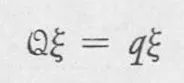
The first of these points of view is the wave mechanics of Schrödinger In wave mechanics, operators are differential expressions, such as the operator d/dx referred to above, and the eigenvalue equation then takes the form of a differential equation, and relies on the calculus for its solution. The second formulation is the matrix mechanics of Heisenberg, in which operators are represented by algebraic entities called matrices; instead of a function in the eigenvalue equation, the matrix operator operates on a vector ξ to transform ξ into a vector parallel to ξ, but q times as long:
(1-2)
Equation 1–2 is the matrix-mechanical formulation of the eigenvalue problem. Matrices and vectors are defined and discussed in detail in Chapter 3. As in Eq. 1–1, q is the eigenvalue of the quantity Q, ξ is the eigenvector, and Q is the operator represented as a matrix. The solution of this form of the eigenvalue problem relies on algebra.
These apparently different mathematical and physical approaches to quantum mechanical problems are really deeply interrelated; the work of Dirac shows the underlying equivalence of the two points of view, as well as of the corresponding mathematical techniques.
1–2 EIGENVALUE PROBLEMS IN CLASSICAL MECHANICS
We have briefly discussed the role of eigenvalue equations in quantum mechanics. But a number of problems of classical mechanics may also be expressed in a simple and meaningful way as eigenvalue problems. Among these are the problems of the vibrations and rotations of a mechanical system, such as a molecule. These physical problems are of importance to the chemist concerned with molecular motion and spectroscopy. In vibrations, the normal modes and frequencies of oscillation appear as eigenvectors and eigenvalues; in rotations, the principal axes and moments of inertia emerge from an eigenvalue problem. It should be noted, however, that a correct description of these systems on the molecular level nearly always requires quantum mechanics, not classical mechanics.
1–3 SCOPE OF THIS BOOK
With our course thus determined by the kinds of problems we wish to be able to set up, solve, and understand, we shall proceed first to a study of a certain class of functions germane to eigenfunction problems, then to a number of aspects of vector algebra and matrix algebra, finally to a synthesis of the two points of view of eigenvalue problems. We shall conclude with a study of classical mechanics to see how the vibrations of a mechanical system, such as a molecule, may be formulated as an eigenvalue problem. We shall also attempt to formulate Newtonian mechanics in such a way that the connection to quantum mechanics is clear.
Along the way, we shall learn some methods of solving eigenvalue problems, and take up applications of interest in chemistry. Our emphasis throughout will be primarily on concepts, secondarily on methods, and only lastly on the detailed proofs of the mathematical theorems. At the end of each chapter, a set of problems is given. Answers and hints for solution for many of the problems are found at the back of the book.
Problem
1. Find the eigenfunctions of the operator d/dx.
2
Orthogonal Functions
Two properties are, almost without exception, possessed by the eigenfunctions of operators corresponding to important physical quantities: orthogonality and normality. The purpose of this chapter is to deve...
Table of contents
- Title Page
- Copyright Page
- Preface
- Table of Contents
- 1 - Introduction
- 2 - Orthogonal Functions
- 3 - Linear Algebra
- 4 - Classical Mechanics
- 5 - Conclusion
- Appendix - Mathematical Background and Bibliography
- Answers to Problems
- Index
- DOVER BOOKS ON CHEMISTRY
Frequently asked questions
Yes, you can cancel anytime from the Subscription tab in your account settings on the Perlego website. Your subscription will stay active until the end of your current billing period. Learn how to cancel your subscription
No, books cannot be downloaded as external files, such as PDFs, for use outside of Perlego. However, you can download books within the Perlego app for offline reading on mobile or tablet. Learn how to download books offline
Perlego offers two plans: Essential and Complete
- Essential is ideal for learners and professionals who enjoy exploring a wide range of subjects. Access the Essential Library with 800,000+ trusted titles and best-sellers across business, personal growth, and the humanities. Includes unlimited reading time and Standard Read Aloud voice.
- Complete: Perfect for advanced learners and researchers needing full, unrestricted access. Unlock 1.5M+ books across hundreds of subjects, including academic and specialized titles. The Complete Plan also includes advanced features like Premium Read Aloud and Research Assistant.
We are an online textbook subscription service, where you can get access to an entire online library for less than the price of a single book per month. With over 1.5 million books across 990+ topics, we’ve got you covered! Learn about our mission
Look out for the read-aloud symbol on your next book to see if you can listen to it. The read-aloud tool reads text aloud for you, highlighting the text as it is being read. You can pause it, speed it up and slow it down. Learn more about Read Aloud
Yes! You can use the Perlego app on both iOS and Android devices to read anytime, anywhere — even offline. Perfect for commutes or when you’re on the go.
Please note we cannot support devices running on iOS 13 and Android 7 or earlier. Learn more about using the app
Please note we cannot support devices running on iOS 13 and Android 7 or earlier. Learn more about using the app
Yes, you can access Mathematics for Quantum Chemistry by Jay Martin Anderson in PDF and/or ePUB format, as well as other popular books in Naturwissenschaften & Chemie. We have over 1.5 million books available in our catalogue for you to explore.