
eBook - ePub
Mendeleev on the Periodic Law
Selected Writings, 1869 - 1905
- 320 pages
- English
- ePUB (mobile friendly)
- Available on iOS & Android
eBook - ePub
Mendeleev on the Periodic Law
Selected Writings, 1869 - 1905
About this book
By the dawn of the nineteenth century, "elements" had been defined as basic building blocks of nature resistant to decomposition by chemical means. In 1869, the Russian chemist Dmitri Ivanovich Mendeleev organized the discord of the elements into the periodic table, assigning each element to a row, with each row corresponding to an elemental category. The underlying order of matter, hitherto only dimly perceived, was suddenly clearly revealed.
This is the first English-language collection of Mendeleev's most important writings on the periodic law. Thirteen papers and essays, divided into three groups, reflect the period corresponding to the initial establishment of the periodic law (three papers: 1869-71), a period of priority disputes and experimental confirmations (five papers: 1871-86), and a final period of general acceptance for the law and increasing international recognition for Mendeleev (five papers: 1887-1905). A single, easily accessible source for Mendeleev's principle papers, this volume offers a history of the development of the periodic law, written by the law's own founder.
Frequently asked questions
Yes, you can cancel anytime from the Subscription tab in your account settings on the Perlego website. Your subscription will stay active until the end of your current billing period. Learn how to cancel your subscription.
No, books cannot be downloaded as external files, such as PDFs, for use outside of Perlego. However, you can download books within the Perlego app for offline reading on mobile or tablet. Learn more here.
Perlego offers two plans: Essential and Complete
- Essential is ideal for learners and professionals who enjoy exploring a wide range of subjects. Access the Essential Library with 800,000+ trusted titles and best-sellers across business, personal growth, and the humanities. Includes unlimited reading time and Standard Read Aloud voice.
- Complete: Perfect for advanced learners and researchers needing full, unrestricted access. Unlock 1.4M+ books across hundreds of subjects, including academic and specialized titles. The Complete Plan also includes advanced features like Premium Read Aloud and Research Assistant.
We are an online textbook subscription service, where you can get access to an entire online library for less than the price of a single book per month. With over 1 million books across 1000+ topics, we’ve got you covered! Learn more here.
Look out for the read-aloud symbol on your next book to see if you can listen to it. The read-aloud tool reads text aloud for you, highlighting the text as it is being read. You can pause it, speed it up and slow it down. Learn more here.
Yes! You can use the Perlego app on both iOS or Android devices to read anytime, anywhere — even offline. Perfect for commutes or when you’re on the go.
Please note we cannot support devices running on iOS 13 and Android 7 or earlier. Learn more about using the app.
Yes, you can access Mendeleev on the Periodic Law by Dmitri Ivanovich Mendeleev, William B. Jensen in PDF and/or ePUB format, as well as other popular books in Physical Sciences & Chemistry. We have over one million books available in our catalogue for you to explore.
Information
Introduction to Papers 1-3:
Origins of the Periodic Law, 1869-1871
IN 1868 Mendeleev began writing his famous textbook, Principles of Chemistry 1. As he later related, it was while exploring various alternative organizational schemes for this book that he hit upon the periodic law (2, 3). While waiting for the book to appear in print (the first edition was published in installments between 1868 and 1871), Mendeleev produced a single-page flier summarizing his new organizational scheme entitled An Attempted System of the Elements Based on their Atomic Weights and Chemical Analogies, which he circulated among Russian chemists in early 1869 (4). In March of that year he presented a more detailed paper to the newly founded Russian Chemical Society (later known as the Russian Physico-Chemical Society) entitled “On the Correlation Between the Properties of the Elements and their Atomic Weights” (the paper was actually read by the Russian chemist, Nikolai Menshutkin, as Mendeleev was ill at the time). This, in turn, was published in the first volume of the society’s new journal and appears in English translation as paper 2 of this collection (5).
Why this publication does not appear as paper 1 is because it was not translated from Russian until 1895 and consequently played little or no role in initially acquainting American, British and western European chemists with the periodic law. This role was played instead by two short German abstracts of the paper, one of which appeared in the Journal für praktische Chemie (6) and the other in the Zeitschrift für Chemie (7). Neither of these abstracts served Mendeleev well. The first reproduced only Mendeleev’s table, without any commentary or explanation, whereas the second failed to mention the word periodic, stating instead that the elements displayed a step-like (stufenweise), rather than a periodic, alteration in their properties when arranged in order of increasing atomic weight. In addition, the second abstract also muddled a typo in the original paper in which Mendeleev intended to put forward the claim that the periodic law predicted an analogy between uranium, on the one hand, and both boron and aluminum, on the other, but instead stated the tautology that aluminum should be analogous to aluminum. The abstract replaced this with the equally obvious tautology that boron should be analogous to boron. To the best of our knowledge, only the longer abstract in the Zeitschrift für Chemie had a significant impact, as it was the reading of this abstract that stimulated the German chemist, Lothar Meyer, to publish his own thoughts on the periodic law in late 1870 and which ultimately gave rise to a vigorous priority debate (8, 9). It is the English translation of this abstract which is reproduced in this collection as paper 1.
In the summer of 1869 Mendeleev presented a paper to the Second Congress of Russian Physicians and Naturalists on the periodicity of atomic (i.e., molar) volumes and that autumn also made some supplementary comments to the Russian Chemical Society relative to his earlier paper on the periodic law (10, 11). In 1870 he presented two additional papers to the Society dealing with the periodicity of oxide formulas (12) and the prediction of unknown elements (13). Though no abstracts of the first and third papers appeared in western journals, his supplementary comments and his fourth paper were both summarized in the Berichte der deutschen chemischen Gesellschaft by the journal’s Russian correspondent (14, 15). The latter of these summaries, in particular, showed that Mendeleev had made significant refinements in his original periodic table of 1869 (including the use of what later became known as the standard “short table,” with horizontal rather than vertical periods, and Roman-numeral group labels based on oxide type) and in his ability to predict the properties of as yet undiscovered elements. Finally, in 1871 Mendeleev summarized all of these previous publications in the form of a major review of the periodic law published in German in Liebig’s prestigious journal, Annalen der Chemie und Pharmacie (16). It is really this review, more than the papers and abstracts of 1869 and 1870, which defined the periodic law and table for the rest of the 19th century and which served as the primary reference for western chemists. It is reproduced in English translation as paper 3 of this collection.
The translation of paper 1 used in this collection is based in part on that given by Tilden in 1909 (17). As already mentioned, paper 2 was not translated from the Russian until 1895 – 26 years after its original publication – when Lothar Meyer’s student, Karl Seubert, commissioned a German translation by Fehrmann for inclusion in his volume of reprints on the periodic law published as part of Wilhelm Ostwald’s series, Klassiker der exakten Wissenschaften (18). However, Seubert reported that the resulting translation was not very satisfactory and contained many awkward phrases. Consequently he rewrote much of the original translation, though he claimed to have done so in a manner faithful to the original (19). About 90% of this German rewrite was translated into English in 1947 and made available in mimeographed form for use in a course at the University of Chicago (20). This was reprinted by Schwartz and Bishop in 1958 (21) and again by Hurd and Kipling in 1964 (22). The complete version given here is based on a revision of this translation with fresh translations of the missing sections added.
Paper 3 was originally written in Russian by Mendeleev and translated into German by Felix Wreden for publication in the Annalen der Chemie und Pharmacie in 1871 (16). The discovery of gallium by Lecoq de Boisbaudran in 1875 sparked a great interest in the periodic law among French chemists, and in 1879 the French journal, Le moniteur scientifique, published a French translation by Charles Baye of the 1871 review (23). This, in turn, was translated into English and published in serialized form by William Crookes in The Chemical News in late 1879 and early 1880 (24). Though Harrow called attention to this English translation in 1927 and Knight published a defective reprint of it in 1970, neither editor seems to have realized that it was a translation, however indirect, of the famous review of 1871, as Crookes had failed to indicate this fact in his serialization (25, 26). The original British translation shows signs of having been made in great haste and, even by Victorian standards, abounds in awkward phrases, word choices, and sentence structures, as well as containing incorrect formulas and occasional mistranslations. Consequently, the version given here, though based on the Crookes translation, has been extensively revised after comparison with the German original.
References and Notes
1
D. I. Mendeleev, Osnovyi khimii, Vols. 1 and 2, Obshchestvennaia pol‘za: St. Petersburg, 1868 – 1871.
2
Paper 2, this collection.
3
Discussion of the relation between Mendeleev’s textbook and his discovery of the periodic law may be found in L. Graham, “Textbook Writing and Scientific Creativity: The Case of Mendeleev,” National Forum, 1982 (Winter), 22 – 23; and N. M. Brooks, “Dmitri Mendeleev’s Principles of Chemistry and the Periodic Law,” in A. Lundgren, B. Bensaude-Vincent, Eds., Communicating Chemistry: Textbooks and Their Audiences, 1789 – 1939, Science History Publications: Canton, MA, 2000, pp. 295 – 309.
4
See footnote 12 of selection 13 in this collection.
5
D. I. Mendeleev, “On the Correlation Between the Properties of the Elements and their Atomic Weights,” Zhur. Russ. Khim. Obshch, 1869, 1, 35, 60 – 77 (In Russian).
6
D. I. Mendeleev, “Versuch eines Systems der Elemente nach ihren Atomgewichten und chemischen Funktionen,” J. prakt. Chem., 1869, 106, 251.
7
D. I. Mendeleev, “Über die Beziehungen der Eigenschaften zu den Atomgewichten der Elemente,” Zeit. Chem., 1869, 5, 405 – 406.
8
L. Meyer, “Die Natur der chemischen Elemente als Function ihrer Atomgewichte,” Ann. Chem. Pharm., 1870, 7 (Suppl.), 354 – 364.
9
See papers 4 and 8 in this collection.
10
D. I. Mendeleev, “Concerning the Atomic Volumes of Simple Bodies,” Arb. II Kongr. Russ. Ärzt. Naturf., 1869 (In Russian).
11
D. I. Mendeleev, “On the Correlation Between the Properties of the Elements and their Atomic Weights,” Zhur. Russ. Khim. Obshch, 1869, 1, 229 – 230 (In Russian).
12
D. I. Mendeleev, “On the Quantity of Oxygen in Metal Oxides and on the Valency of the Elements,” Zhur. Russ. Khim. Obshch.,1870, 2, 14 – 21 (In Russian).
13
D. I. Mendeleev, “Concerning the Natural System of the Elements and Its Application in Determining the Properties of Undiscovered Elements,” Zhur. Russ. Khim. Obshch., 1871, 3, 7, 25 – 56 (In Russian).
14
D. I. Mendeleev, “Die Beziehungen zwischen den Eigenschaften der Elemente und ihrer Atomgewichten,” Berichte, 1869, 2, 553.
15
D. I. Mendeleev, “Über das natürliche System der Elemente und seine Anwendung zum Ermitteln der Eigenschaften unentdeckter Elemente,” Berichte, 1870, 3, 990 – 991.
16
D. I. Mendeleev, “Die periodischen Gesetzmässigkeit der chemischen Elemente,” Ann. Chem. Pharm., 1871, 8 (Suppl.), 133 – 229.
17
W. A. Tilden, “Mendeléeff Memorial Lecture,” J. Chem. Soc., 1909, 95, 2077 – 2105. Tilden corrected the error in conclusion 8 and mistakenly translated the word Maassstab or Massstab in conclusion 4 as “unit of mass” rather than as “standard or measure.”
18
K. Seubert, Ed., Das naturliche System der chemischen Elemente: Abhandlungen von Lothar Meyer 1864 – 1869 und D. Mendelejeff 1869 – 1871, Engelmann: Leipzig, 1895.
19
See the editorial comment at the bottom of page 20 of reference 18.
20
Anon., Selected Readings in Natural Science, University of Chicago: Chicago, IL, 1947.
21
G. Schwartz, P. W. Bishop, Eds., Moments of Discovery, Vol. 2. Basic Books: New York, NY, 1958, pp. 821 – 836.
22
D. L. Hurd, J. J. Kipling, Eds., The Origins and Growth of Physical Science, Vol. 2, Pelican Books: Baltimore, MD, 1964, pp. 81 – 100.
23
D. I. Mendeleev, “La loi périodique des elements chimiques,” Le moniteur scientifique, 1879, 21, 693 – 737.
24
D. L. Mendeleev, ’“The Periodic Law of the Chemical Elements,” Chem. News, 1879, 40, 231 – 232,243 – 244, 255 – 256, 267 – 268, 279 – 280, 291 – 292, 303 – 304; Ibid, 1880, 41, 2 – 3, 27 – 28, 39 – 40, 49 – 50, 61 – 62, 71 – 72, 83 – 84, 93 – 94, 106 – 108, 113 – 114, 125 – 126.
25
B. Harrow, Eminent Chemists of Our Time, 2nd ed., Van Nostrand, New York, NY, 1927, p. 273.
26
D. M. Knight, Ed., Classical Scientific Papers: Chemistry, Second Series, American Elsevier...
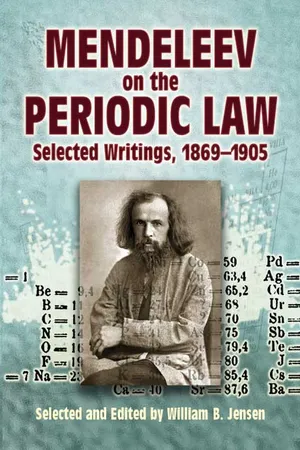
Table of contents
- DOVER BOOKS ON CHEMISTRY
- Title Page
- Copyright Page
- Dedication
- Preface
- Table of Contents
- General Introduction
- Introduction to Papers 1-3: - Origins of the Periodic Law, 1869-1871
- Introduction to Papers 4-8: - Priority Disputes and Confirmations, 1871-1886
- Introduction to Papers 9-13: - Acceptance and Recognition, 1887-1907