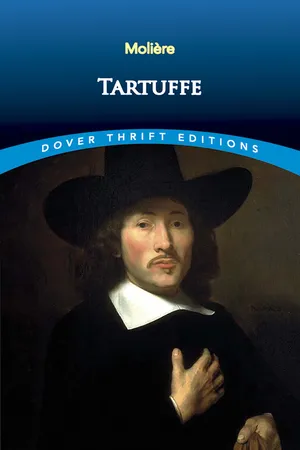
Renowned for his satirical works, Molière (Jean-Baptiste Poquelin, 1622–1673) delighted in lampooning the social pretensions and conceits of 17th-century French society. In this 1664 verse comedy with serious overtones, Tartuffe, a penniless scoundrel and religious poseur, is invited by a gullible benefactor to live in his home.
Imposing a rigidly puritanical regimen on the formerly happy household, Tartuffe wreaks havoc among family members. He breaks off the daughter's engagement, attempts to seduce the wife of his host, acquires his patron's property, and eventually resorts to blackmail and extortion. But ultimately, his schemes and malicious deeds lead to his own downfall.
Attacked by the Church and twice suppressed, Tartuffe opened to packed houses in 1669. Teeming with lively humor and satirical plot devices, this timeless comedy by one of France's greatest and most influential playwrights is essential reading for students of theater and literature.
eBook - ePub
Tartuffe
About this book
Information
Act II.
Scene I.
ORGON, MARIANE.
ORGON. Mariane!
MARIANE. Sir.
ORGON. Come hither; I have something to say to you in private.
MARIANE. [To ORGON, who is looking into a closet] What are you looking for, sir?
ORGON. I’m looking if anybody’s there who might overhear us. This little place is fit for such a purpose. So, we’re all safe. I have always, Mariane, found you of a sweet disposition, and you have always been very dear to me.
MARIANE. I am very much obliged to you, sir, for your fatherly affection.
ORGON. ’Tis very well said, daughter, and to deserve it, your chief care should be to make me easy.
MARIANE. That is the height of my ambition.
ORGON. Very well. Then what say you of Tartuffe, our guest?
MARIANE. Who, I?
ORGON. Yes, you; pray take heed how you answer.
MARIANE. Alas! sir, I’ll say what you will of him.
Scene II.
ORGON, MARIANE, DORINE, who comes in softly, and stands behind ORGON without being seen.
ORGON. That’s discreetly said. Tell me then, my girl, that he’s a very deserving person, that you like him, and that it would be agreeable if, with my consent, you might have him for a husband, ha?
MARIANE. How, sir?
ORGON. What’s the matter?
MARIANE. What said you?
ORGON. What?
MARIANE. Did I mistake you?
ORGON. As how?
MARIANE. Whom would you have me say I liked, sir, and should be glad, with your approbation, to have for a husband?
ORGON. Tartuffe.
MARIANE. I protest to you, sir, there’s nothing in it. Why would you make me tell you such a story?
ORGON. But I would have it to be no story, and ’tis enough that I have pitched upon him for you.
MARIANE. What, would you, sir—
ORGON. Ay, child, I purpose, by your marriage, to join Tartuffe to my family. I have resolved upon’t, and as I have a right to—[Spying DORINE] What business have you there? Your curiosity is very great, sweetheart, to bring you to listen in this manner.
DORINE. In troth, sir, whether this report proceeds from conjecture or chance, I don’t know; but they have been just telling me the news of this match, and I have been making a very great jest of it.
ORGON. Why, is the thing so incredible?
DORINE. So incredible that were you to tell me so yourself, I should not believe you.
ORGON. I know how to make you believe it, though.
DORINE. Ay, ay, sir, you tell us a comical story.
ORGON. I tell you just what will prove true in a short time.
DORINE . Stuff!
ORGON. [To MARIANE] Daughter, I promise you I’m not in jest.
DORINE. Go, go; don’t believe your father, madame, he does but joke.
ORGON. I tell you—
DORINE. No, ’tis in vain, nobody will believe you.
ORGON. My anger at length—
DORINE. Well, sir, we will believe you; and so much the worse on your side. What, sir, is it possible that with that air of wisdom, and that spacious beard on your face, you should be weak enough but to wish—
ORGON. Harkee, you have taken certain liberties of late that I dislike. I tell you that, child.
DORINE. Good sir, let us argue this affair calmly. You really must banter people by this scheme. Your daughter is not cut out for a bigot; he has other things to think on. And then, what will such an alliance bring you in? For what reason would you go, with all your wealth, to choose a beggar for a son-in-law—
ORGON. Hold your tongue! If he has nothing, know that we ought to esteem him for it. His poverty is an honest poverty which raises him above all grandeur, because he has suffered himself, in short, to be deprived of his fortune by his negligence for things temporal and his strong attachment to things eternal. But my assistance may put him in a way of getting out of trouble and of recovering his own. As poor as he is, he’s a gentleman, and the estate he was born to is not inconsiderable.
DORINE. Yes, he says so; and this vanity, sir, does not very well suit with piety. He that embraces the simplicity of a holy life should not set forth his name and family so much. The humble procedure of devotion does but ill agree with the glare of ambition. To what purpose all this pride?—But this talk offends you. Then let us lay aside his quality, and speak to his person. Can you have the heart to fling away such a girl as this upon such a man as he? Should you not consult propriety, and look a little forward to the consequences of such a union as this? Depend upon’t, a young woman’s virtue is in some danger when she isn’t married to her mind; that her living virtuously afterward depends, in a great measure, upon the good qualities of her husband; and that those whom people everywhere point at with the finger to the forehead, often make their wives what we find they are. It is no easy task to be faithful to some sorts of husbands; and he that gives his daughter a man she hates, is accountable to Heaven for the slips she makes. Consider then to what danger your design exposes you.
ORGON. I tell you, she is to learn from me what to do.
DORINE. You could not do better with her than to follow my advice.
ORGON. Don’t let us amuse ourselves, daughter, with this silly stuff. I am your father, and know what you must do. I had indeed promised you to Valère, but, besides that ’tis reported he is given to play, I suspect him of being a little profligate. I don’t observe that he frequents the church.
DORINE. Would you have him run to church at your precise hours, as people do who go there only to be taken notice of?
ORGON. I am not consulting you about it. [To his daughter] The other, in short, is a favourite of Heaven, and that is beyond any other possessions. This union will crown your wishes with every sort of good; it will be one continued scene of pleasure and delight. You’ll live in faithful love together, really like two children, like two turtle-doves. No unhappy debate will e’er rise between you; and you’ll make anything of him you can well desire.
DORINE. She? She’ll ne’er make anything but a fool of him, I assure you.
ORGON. Hey! What language!
DORINE. I say, he has the look of a fool; and his ascendant will overbear all the virtue your daughter has.
ORGON. Have done with your interruptions. Learn to hold your peace, and don’t you put in your oar where you have nothing to do.
DORINE. Nay, sir, I only speak for your good.
ORGON. You are too officious. Pray hold your tongue, if you please.
DORINE. If one had not a love for you—
ORGON. I desire none of your love.
DORINE. But I will love you, sir, in spite of your teeth.
ORGON. Ha!
DORINE. I have your reputation much at heart, and can’t bear to have you made the subject of every gossip’s tale.
ORGON. Then you won’t have done?
DORINE. It would be a sin to let you make such an alliance as this.
ORGON. Will you hold your tongue, you serpent, whose impudence—
DORINE. Oh! what, a devotee, and fly into such a rage?
ORGON. Yes, my choler is moved at this impertinence, and I’m resolved you shall hold your tongue.
DORINE. Be it so. But though I don’t speak a word, I don’t think the less.
ORGON. Think if you will, but take care not to say a syllable to me about it, or—Enough—[To his daughter] I have maturely weighed all things as a wise man should.
DORINE. [Aside] It makes me mad that I must not speak now!
ORGON. Tartuffe, without foppery, is a person so formed—
DORINE. [Aside] Yes, ’tis a pretty phiz.
ORGON. That should you have no great relish for his other qualifications—
DORINE. [Aside] She’ll have a very fine bargain of him! [ORGON turns about towards DORINE, and eyes her with his arms across.] Were I in her place, though, no man alive should marry me against my will, with impunity. I’d let him see, soon after the ceremony was over, that a wife has a revenge always at hand.
ORGON. [To DORINE] Then what I say, stands for nothing with you?
DORINE. What do you complain of? I don’t speak to you.
ORGON. What is it you do then?
DORINE. I talk to myself.
ORGON. [Aside] Very well! I must give her a slap on the face, to correct her prodigious insolence. [He puts himself into a posture to strike DORINE, and at every word he speaks to his daughter he casts his eyes upon DORINE, who stands bolt-upright, without speaking.] Daughter, you must needs approve of my design—and believe that the husband—which I have picked out for you—[To DORINE] Why dost thou not talk to thyself now?
DORINE. Because I have nothing to say to myself.
ORGON. One little word more.
DORINE. I’ve no mind to it.
ORGON. To be sure I watched you.
DORINE. A downright fool, i’faith.
ORGAN. [To MARIANE] In short, daughter, you must obey, and show an entire deference for my choice.
DORINE. [As she runs off] I should scorn to take such a husband myself.
ORGON. [Strikes at her, but misses] You have a pestilent hussy with you there, daughter, that I can’t live with any longer, without sin. I’m not in a condition to proceed at present; her insolence has put my spirits into such a ferment that I must go take the air to recover myself a little.
Scene III.
MARIANE, DORINE.
DORINE. Pray tell me, have you lost your tongue? Must I play your part for you on this occasion? What, suffer a silly overture to be made you, without saying the least word against it!
MARIANE. What should one do with a positive father?
DORINE. Anything, to ward off such a menace.
MARIANE. But what?
DORINE. W...
Table of contents
- Title Page
- Copyright Page
- Note
- Table of Contents
- Dramatis Personnae
- Act I.
- Act II.
- Act III.
- Act IV
- Act V.
- DOVER • THRIFT • EDITIONS
Trusted by 375,005 students
Access to over 1.5 million titles for a fair monthly price.
Study more efficiently using our study tools.
Frequently asked questions
Yes, you can cancel anytime from the Subscription tab in your account settings on the Perlego website. Your subscription will stay active until the end of your current billing period. Learn how to cancel your subscription
No, books cannot be downloaded as external files, such as PDFs, for use outside of Perlego. However, you can download books within the Perlego app for offline reading on mobile or tablet. Learn how to download books offline
Perlego offers two plans: Essential and Complete
- Essential is ideal for learners and professionals who enjoy exploring a wide range of subjects. Access the Essential Library with 800,000+ trusted titles and best-sellers across business, personal growth, and the humanities. Includes unlimited reading time and Standard Read Aloud voice.
- Complete: Perfect for advanced learners and researchers needing full, unrestricted access. Unlock 1.5M+ books across hundreds of subjects, including academic and specialized titles. The Complete Plan also includes advanced features like Premium Read Aloud and Research Assistant.
We are an online textbook subscription service, where you can get access to an entire online library for less than the price of a single book per month. With over 1.5 million books across 990+ topics, we’ve got you covered! Learn about our mission
Look out for the read-aloud symbol on your next book to see if you can listen to it. The read-aloud tool reads text aloud for you, highlighting the text as it is being read. You can pause it, speed it up and slow it down. Learn more about Read Aloud
Yes! You can use the Perlego app on both iOS and Android devices to read anytime, anywhere — even offline. Perfect for commutes or when you’re on the go.
Please note we cannot support devices running on iOS 13 and Android 7 or earlier. Learn more about using the app
Please note we cannot support devices running on iOS 13 and Android 7 or earlier. Learn more about using the app
Yes, you can access Tartuffe by Molière in PDF and/or ePUB format, as well as other popular books in Literature & European Drama. We have over 1.5 million books available in our catalogue for you to explore.