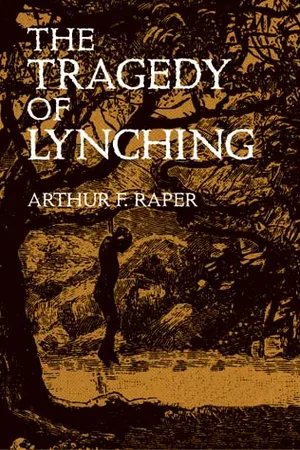
Thorough accounts and analyses of more than 20 lynchings that occurred in America during 1930, prepared by a commission composed of Southern scholars and investigators. Each lynching is examined in detail, including the formation of the mob, behavior of the police, and economic background of the area where the crime occurred.
- 507 pages
- English
- ePUB (mobile friendly)
- Available on iOS & Android
eBook - ePub
The Tragedy of Lynching
About this book
Information
PART ONE
THE TOLL OF THE MOB
THE TOLL of the mob reckons not alone the victims but the lynchers themselves and the economic, social, and cultural meaning of their lawlessness. Three thousand seven hundred and twenty-four people were lynched in the United States from 1889 through 1930.1 Over four-fifths of these were Negroes, less than one-sixth of whom were accused of rape. Practically all of the lynchers were native whites. The lynching rates have been highest in the newer and more sparsely settled portions of the South, where cultural and economic institutions are least stable and officers of the law are farthest apart, poorest paid, and most dependent upon local sentiment.
Of the twenty-one persons lynched in 1930, many were captured after extended man-hunts organized by undeputized armed men who used bloodhounds and conducted some type of mock trial before the lynching. Though two of the victims were unaccused, and there is grave doubt as to the guilt of many more, the findings of these mob trials were the lynchers’ assurance that their victims were guilty of the crimes of which they were accused. The fact that a number of the victims were tortured, mutilated, dragged, or burned suggests the presence of sadistic tendencies among the lynchers; herein lies one of the most baffling phases of the mob situation. Though there were a few notable exceptions, most of the lynchers, chiefly young men between their late teens and twenty-five, were from that unattached group of people which exercised least public responsibility and was farthest removed from the institutions and agencies determining accepted standards of conduct. A number of middle-aged women figured prominently in some of the outbreaks; children, too, were present, making more difficult any effective resistance by officers.
Of the tens of thousands of lynchers and onlookers, the latter not guiltless, only forty-nine were indicted and only four have been sentenced. Chief among the factors rendering the courts ineffective was the prevalent indifference of peace officers and court officials and the apathy of the general white public concerning matters affecting Negroes. With but rare exceptions, leaders and members of the local religious and civic organizations were maneuvered by the pro-lynchers into a position of silent acquiescence.
And so the lynchers went unpunished and the communities paid the bills. Hundreds of thousands of dollars worth of property was destroyed with no insurance collectible; indirect financial losses accrued from the unfavorable publicity. Labor was disorganized and racial antagonisms were accentuated, forming the basis for further racial exploitation. The local and state governments were openly defied; the officials along with the general public, by winking at the lawlessness, rendered more difficult the realization of a community where the basic rights of human beings are respected.
CHAPTER I
SALIENT FACTS ABOUT 1930’S LYNCHINGS
IN 1930, twenty-one persons were lynched in the United States. Six of these were in Georgia; four in Mississippi; three in Texas; two in Indiana; two in South Carolina, and one each in Oklahoma, Alabama, North Carolina, and Florida. The Florida victim was a foreign-born white; the other twenty were Negroes.
PERSONS LYNCHED AND COUNTIES INVOLVED
Some Facts About Persons Lynched. The ages of the mob victims ranged from the late teens to seventy, with over two-thirds of them less than twenty-five, and only three over forty-five. Ten of them were married, and twenty children, many of them quite young, and all dependent, were left without support.
Sixteen of the victims had never been before the courts. Of the five with court records, two had been charged with rape, two with theft, and one with concealing stolen goods by painting a black mule white.
Four of the mob victims were property owners; the remaining seventeen paid no direct taxes on real estate or other productive property. Most of them had come from homes where father and mother separated when the victims were small boys; for many of them life had been hard and unattractive from the outset. Of the background of some nothing was learned except that they were seemingly without family. When the lynchings occurred, the fathers of two of the victims were serving road sentences. Scarcely half the victims were identified with any church or lodge organization. The Negroes lynched at Union, Bryan, Ocilla, Cartersville, and the first one at Thomasville, were considered “outsiders” by the local Negroes.
The mob victims had but little formal education. Not one had had high school training, and only one had gone beyond the fifth grade; three were illiterate and eight nearly so. The mental status of the victims covered a wide range. S. S. Mincey, though without formal education, was unusually capable and had attained considerable prominence as politician and lodge leader. Allen Greene also was regarded as highly intelligent. Others of the victims, notably Henry Argo and George Hughes, were termed “half wits” or “crazy,” and Hughes was said to be subject to “spells.” Will Roan, James Irwin, and others were little better; local Negroes termed them “thick skulls.”
These data are comments on the South’s failure to provide sufficient educational opportunities and adequate institutional care for her population. Adequate provision for the confinement and treatment of imbeciles, insane persons, and certain types of feeble-minded and hopelessly defective persons would have prevented the crimes leading to several of 1930’s lynchings.
Alleged Crimes and Probable Guilt of Mob Victims. The alleged crimes which caused the twenty-one lynchings of 1930 were: murder, five; rape, eight;2 robbery or theft, three; attempted rape, two; bombing a house, one; no crime alleged, two.
All of the alleged crimes of the nineteen accused mob victims were against white people, one of whom was foreign-born. In eight instances the mob victims were accused of crimes involving women; in four, involving men and women; in seven, involving only men. In four instances, the alleged crimes were against members of small farm-owning families; in three, officers of the law; in three, farm tenants; in two, farm wage hands; in two, farm overseers; in two, factory workers; in two, motorists en route; and in one, a filling station operator. Ten of the lynched persons and three of their accusers had used guns or other concealed weapons in the altercations which precipitated the lynchings.
Two of the 1930 mob victims were innocent of crime (they were not even accused), and there is grave doubt of the guilt of eleven others. In six of these eleven cases there is considerable doubt as to just what crimes, if any, were committed, and in the other five, in which there is no question as to the crimes committed, there is considerable doubt as to whether the mobs got the guilty men.
By their very nature, lynchings made it practically impossible to get at the exact facts of the alleged crimes. In practically every community with a lynching a tradition of the absolute guilt of the person lynched sprang up immediately and cut off all further legal investigation. Had the Negroes at Huntsville and Norfolk been lynched, it is highly probable that their guilt would never have been questioned, though their innocence was later established and the blame placed upon their white accusers by the courts.
Location and General Characteristics of Counties Involved. Five of Georgia’s six lynchings of 1930 occurred in the southeastern part of the state, the newest and poorest section. Here churches, schools, and a stabilizing tradition are less powerful than in the older communities. In the last decade, this section has been the scene of numerous floggings, with white as well as Negro victims. It is a belated frontier, and one lacking the virility of the typical American frontier. The sixth lynching in Georgia along with South Carolina’s two, occurred in the Piedmont section where the textile industry is concentrated. Scarcely any Negroes are employed in these cotton mills.
Other lynchings occurring in communities characterized by open antipathy to Negroes, or by lack of economic need for Negroes, include Brazos, Grayson, and Fannin Counties, Texas; Grady County, Oklahoma, and Grant County, Indiana. No specific background condition appeared as a factor in the lynching of the foreign-born white near Plant City, Florida.
Seven lynchings were in Black Belt counties: Bolivar, Hinds, and Kemper—with two lynchings—Mississippi; Sumter County, Alabama; Brazos County, Texas; and Edgecombe County, North Carolina. In these counties the Negroes live principally in the open country as tenants or wage hands on large plantations. The domination of the plantation system roots back into the master-slave regime. Negroes are considered valuable only in proportion as they are productive. As a corollary, to all practical purposes, the sheriff and other peace officers are the planters’ agents.
Two-thirds of the lynchings occurred in the open country or in towns of less than 2,500 population; in five of these counties there were larger towns, but in no case was the actual lynching within six miles of it. Four lynchings were staged in towns of 2,500 to 15,000 inhabitants, and three in towns of 15,000 to 25,000. Sherman and Marion, in the 15,000 to 25,000 population group, are relatively regressive towns of Texas and Indiana and in many respects fall below the average of their respective states.
Poorer Counties the Scene of Most Lynchings. The measures available show that the counties where lynchings occurred in 1930 were economically below the average. In approximately nine-tenths of them the per capita tax valuation was below the general state average as was also the per capita bank deposit. In three-fourths of the counties the per capita income from farm and factory was below the state average, in many cases less than one-half ; in nine-tenths, fewer and smaller income tax returns were made per thousand population than throughout the state. In over two-thirds, the proportion of farms operated by tenants was in excess of the state rate; and in nearly three-fourths of the counties, automobiles were less common than in their respective states. As would be expected from their poor economic rating, the educational facilities in many of these counties were far below the state average. Baptists and Methodists account for over three-fourths of all church members in nearly three-fourths of the counties, and two-thirds of them regularly poll Democratic majorities.
MOBS AND MOB MEMBERS
The Extremes of Mob Action. Mobs are capable of unbelievable atrocity. James Irwin at Ocilla, Georgia, was jabbed in his mouth with a sharp pole. His toes were cut off joint by joint. His fingers were similarly removed, and his teeth extracted with wire pliers. After further unmentionable mutilations, the Negro’s still living body was saturated with gasoline and a lighted match was applied. As the flames leaped up, hundreds of shots were fired into the dying victim. During the day, thousands of people from miles around rode out to see the sight. Not till nightfall did the officers remove the body and bury it.
The Sherman mob also went to extreme lengths. The courthouse was fired. Many of the court officials and four Texas rangers escaped by second-floor windows. The accused Negro was placed in the second story of a large vault, where he remained while the courthouse burned to the ground. Members of the mob cut the water hose and thwarted the fire department’s attempt to save the building. With evening, a small group of militiamen was driven from the courthouse grounds to the county jail. A little later, a larger unit of militiamen, just arrived from Dallas, was forced to retire to the protection of the jail. Shortly before midnight, with an acetylene torch and high explosives, a second-story vault window was blown open and the Negro’s body was thrown to the crowd below. It was greeted by loud applause from the thousands who jammed the courthouse square. Police directed traffic while the corpse was dragged through the streets to a cottonwood tree in the Negro business section. There it was burned. Soon Negro business properties valued at between $50,000 and $100,000 were fired, and the fire department was not allowed to throw water on them, though the mob permitted a hose to be trained on a white man’s dwelling within fifteen feet of a burning Negro residence.
At Honey Grove the body of George Johnson was fastened by the feet to the back of a truck to keep the face down. In this position the corpse was dragged for five miles in and out of town, and later burned in front of a Negro church.
In most of the 1930 lynchings, there were evidences of a madness similar to that at Ocilla, Sherman, and Honey Grove. The roots of mob psychology might well be given extended study by competent scientists. ,
Characteristics of the Mob Mind. One of the most obvious things about the mental make-up of the lyncher or pro-lyncher was that he tended to accept unqualifiedly any and all reports which fitted into certain preconceived notions about Negroes and the kinds of crimes which warrant lynching. The active lynchers and those who sympathized with them wove into a unit all sorts of unfounded rumors arising from many persons and many situations widely separated as to time and place. The avidity with which the general white populace of Sherman received each new bit of gory detail accounts for the staggering magnitude of the disorders there. Though informed physicians refuted many of the bloody stories which motivated the mob, once the excitement was aroused, facts made no difference.
Another obvious mental characteristic of the lyncher was his dogmatic assertion that the right person was lynched. The lynchers or pro-lynchers built up a complete case against their victims. One of the methods of placing greater guilt upon the intended victim was the mob’s mock trial immediately before the lynching. While some of these mob trials were little more than tortures, others were conducted with the semblance of regular courts. In cases where there was no conclusive evidence of the victim’s guilt, there developed, nevertheless, immediately after the lynchings were consummated, a tradition of absolute guilt, based in part on the mob trial.
The credulity of the lyncher or pro-lyncher in taking at face value all rumors, and the development of the tradition of the absolute guilt of the mob’s victims are both phases of the inability of the mass of white people to deal dispassionately with situations involving actual or potential racial conflict.
Many white people—particularly in the open country—as—sume that Negroes are prone to crimes against women and that unless a Negro is lynched now and then the women on the solitary farms are in danger. These assumptions have been kept alive by certain types of politicians who keep themselves in office by appeals to racial fear and antagonism. In a few cases church leaders have appealed to the same race fears in religious controversies.3
The Man-Hunt Tradition. These assumptions underlie the traditional practice of Southern white men in arming themselves unofficially and hunting down an accused person. This method of mutual aid in policing an area, evolved on the frontier, persists in localities where police power is least adequate, or where the populace, for whatever reasons, insist upon dealing directly with crime and criminals. By its very nature the man-hunt operates through a highly selective process. In the first place, people who have regular work-hours and routine responsibilities are precluded from participating in all-day and all-night hunts. Again, those who have faith in the peace officers and courts, are not likely to take part. And, finally, the man-hunt tradition, an important element of which seems to be the lure of the chase, brings together the people who find lynching attractive.
The man-hunt provides an opportunity for carrying and flourishing firearms with impunity, a privilege which appeals strongly to the more irresponsible elements. Moreover, man-hunts and lynchings make it possible for obscure and irresponsible people to play the roles of arresting officers, grand jurors, trial jurors, judges, and executioners. An added attraction is that they often afford an avenue of emotional escape from a life so drab and unilluminated that any alternative is welcomed.
Man-Hunters and Bloodhounds. Before a half dozen of 1930’s lynchings had been investigated, it became obvious that the man-hunt tradition rests on the assumptions of the unlimited rights of white men and the absence of any rights on the part of an accused Negro. Simply by being accused of some crime, the latter—so the man-hunters feel—has forfeited every claim upon society. With men of this mind scouring the woods and fields, it is little wonder that the Negroes lynched near Rosedale, Bryan, and Union never came into the custody of the sheriff or other peace officers.
Even when the accused was captured by peace officers, the presence of man-hunters militated against his ever getting before the courts. Usually the man-hunters rather than the officers dominated the situation throughout. At Emelle, Honey Grove, and Ocilla they wreaked vengeance on their victims in the presence of the sheriff and his deputies. In each of these cases, the man-hunters felt that the captured Negro was their prey. They had caught him, and consequently it was rightfully within their province to decide whether they would turn him over to the sheriff and the courts, kill him on the spot, or torture and mutilate him and then let a slow fire do the rest.
To facilitate the capture of the accused, man-hunters often resorted to the use of bloodho...
Table of contents
- SOUTHERN COMMISSION ON THE STUDY - OF LYNCHING
- Title Page
- Copyright Page
- INTRODUCTION
- Table of Contents
- PART ONE - THE TOLL OF THE MOB
- PART TWO - LYNCHINGS IN BLACK BELT COUNTIES
- PART THREE - LYNCHINGS IN SOUTHEAST GEORGIA
- PART FOUR - LYNCHINGS IN PIEDMONT COUNTIES
- PART FIVE - MOB OUTBREAKS IN NORTH TEXAS AND CENTRAL OKLAHOMA
- APPENDIX A - THE TWENTY-ONE LYNCHINGS IN 1930
- APPENDIX B - THREATENED LYNCHINGS PREVENTED
- APPENDIX C
- INDEX
Trusted by 375,005 students
Access to over 1.5 million titles for a fair monthly price.
Study more efficiently using our study tools.
Frequently asked questions
Yes, you can cancel anytime from the Subscription tab in your account settings on the Perlego website. Your subscription will stay active until the end of your current billing period. Learn how to cancel your subscription
No, books cannot be downloaded as external files, such as PDFs, for use outside of Perlego. However, you can download books within the Perlego app for offline reading on mobile or tablet. Learn how to download books offline
Perlego offers two plans: Essential and Complete
- Essential is ideal for learners and professionals who enjoy exploring a wide range of subjects. Access the Essential Library with 800,000+ trusted titles and best-sellers across business, personal growth, and the humanities. Includes unlimited reading time and Standard Read Aloud voice.
- Complete: Perfect for advanced learners and researchers needing full, unrestricted access. Unlock 1.5M+ books across hundreds of subjects, including academic and specialized titles. The Complete Plan also includes advanced features like Premium Read Aloud and Research Assistant.
We are an online textbook subscription service, where you can get access to an entire online library for less than the price of a single book per month. With over 1.5 million books across 990+ topics, we’ve got you covered! Learn about our mission
Look out for the read-aloud symbol on your next book to see if you can listen to it. The read-aloud tool reads text aloud for you, highlighting the text as it is being read. You can pause it, speed it up and slow it down. Learn more about Read Aloud
Yes! You can use the Perlego app on both iOS and Android devices to read anytime, anywhere — even offline. Perfect for commutes or when you’re on the go.
Please note we cannot support devices running on iOS 13 and Android 7 or earlier. Learn more about using the app
Please note we cannot support devices running on iOS 13 and Android 7 or earlier. Learn more about using the app
Yes, you can access The Tragedy of Lynching by Arthur F. Raper in PDF and/or ePUB format, as well as other popular books in Social Sciences & African American Studies. We have over 1.5 million books available in our catalogue for you to explore.