![]()
CHAPTER I
EARLY EARTHWORKS AND ROMAN STATIONS
THE history of military fortification in England begins with those strongholds which, at vast expense of labour, the early inhabitants of Britain hewed out of the soil, surrounding defensible positions with ramparts of earth, divided by deep fosses. The approximate date of these earthworks can be determined only by excavation, and a vast amount of work remains to be done in this direction. The number, however, of those which can be proved to be earlier than the Roman occupation is very large ; and, of this number, a considerable portion, including some of the most stupendous examples of fortified hill-camps, may have been the work of neolithic man some two thousand years before the Christian era. Relative dates in this connection concern us less than principles of fortification. The hill-camps of pre-Roman Britain may be divided roughly into two classes. In the first place, there are those which occupy the summit of a promontory of high land, which slopes so steeply on all sides but one that artificial defence is necessary on that side alone. The second class is that of the so-called “contour forts,” in which the summit of a hill is utilised for the camp, and encircled by trenches following the contour of the ground.
In each case the defences provided by the inhabitants consist of earthen banks, the materials of which have been dug from the fosses or ditches which surround their outer face. An earthen bank and fosse, thrown across the neck of land between the promontory and the plateau beyond, convert the extremity of the promontory into a fortified enclosure. Well-known examples of such fortresses are the three camps, one on the east and two on the west side of the river, which guarded the valley of the Avon at Clifton. The labour necessary for the construction of these was naturally far less than that which went to the making of the great contour fortresses, of which so many splendid examples remain in Somerset, Wiltshire, Dorset, and in the chalk districts generally. In these cases, the whole area, or at any rate the greater part of it, stood in need of entrenchment. There are points at which the slope is so precipitous that the bank and ditch were dispensed with, or, as in part of Cissbury camp near Worthing, only a single bank or ditch was necessary.1 Also, the steeper the ground, the less was the labour required in constructing the entrenchments.
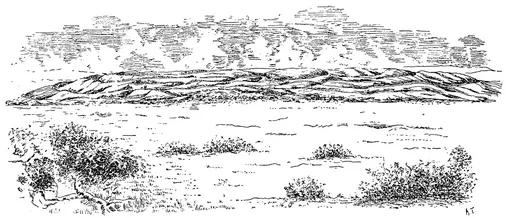
But these positions often took the form of enclosures surrounded by double or triple lines of defence, often of stupendous size. For the greater part of its extent, the vallum or bank of the oval camp of Cissbury is double, and along the outer edge of the encircling fosse is a formidable counterscarp or parapet. Poundbury, which lies on the high ground west of Dorchester, has a single bank and ditch on its east and south sides. On the west side the bank is doubled ; but the north side, where the hill falls almost perpendicularly to the Frome, was left without artificial defence. The superb fortress of Maiden Castle (2), which crowns an isolated hill, 432 feet high, south of Dorchester, shows a bewildering complication of plan. The oval central space is ringed by a number of banks and ditches, which varies from three on the north side to as many as eight about the western entrance.
These early camps form merely the preface to our subject, and attention need be called only to some general features. Their character, like that of the medieval town or castle, was strictly defensive. They were the strongholds of races whose weapons were of a very primitive description, and could carry to no great range. What their inhabitants needed was an impregnable fortress, within which they and their herds could be well sheltered from attack. They belong to a day before siege operations were possible. To carry them, a determined onset and a hand-to-hand fight were necessary. Their strength therefore depended on the complexity of their defences. No enemy could hope to scale the flanking banks of Maiden Castle, one by one. The entrances to the camp, at its eastern and western ends (3), were so elaborately concealed by the overlapping ramparts, that even on a ground-plan they are far from obvious ; and it was almost inevitable that an attacking force, without a guide acquainted with the ground, would be decoyed into a cul-de-sac and overwhelmed by the missiles of the defenders on the ramparts.
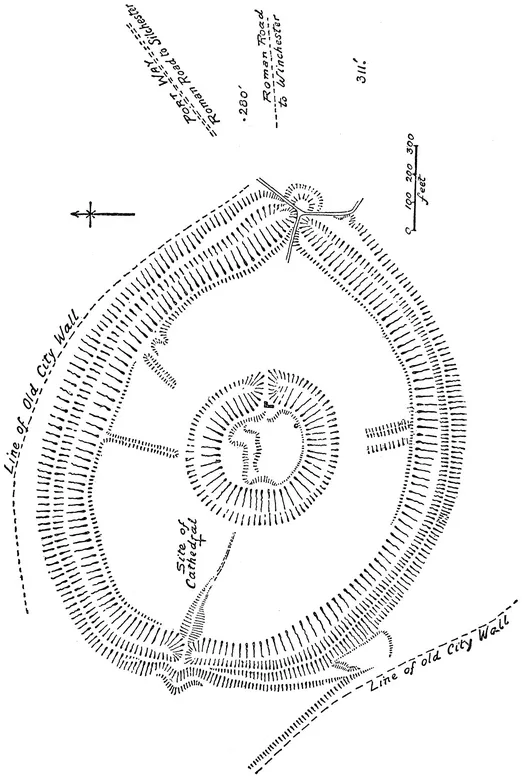
The steepness of the bank itself constituted a formidable means of defence. At Maiden Castle the great northern banks rise to a height of 60 feet or more. The top of the outer bank of Old Sarum (4) is 106 feet above the level of the ditch below.2 In many cases, and probably in all, the inner bank was crowned by a stockade, consisting of a series of upright stakes, between and round which was twined an impenetrable hedge of thorns. The plateau or berm which was sometimes left behind the parapet of the bank, where there was more than a single bank and ditch, was a valuable asset to the defenders of prehistoric strongholds, forming an advance post from which they were able to wield their missiles freely; while sometimes the summit of one or more of the outer banks was made for the same purpose into a broad platform, which allowed greater freedom of movement. The parapet or counterscarp of the outer ditch was probably defended by a stockade, and it is known that in some cases sharpened stakes or stones were fixed firmly in the bottom of the ditches.
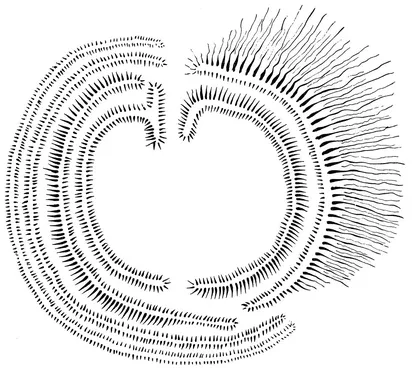
Old Sarum
(From Mr Hadrian Allcroft’s Earthwork of England by kind permission of Messrs Macmillan & Co.)
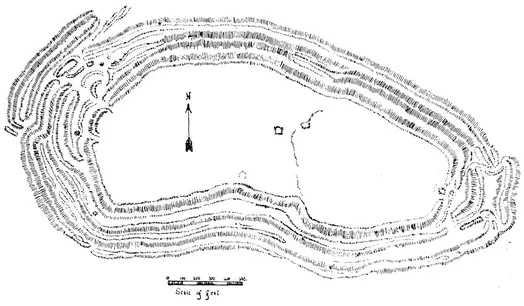
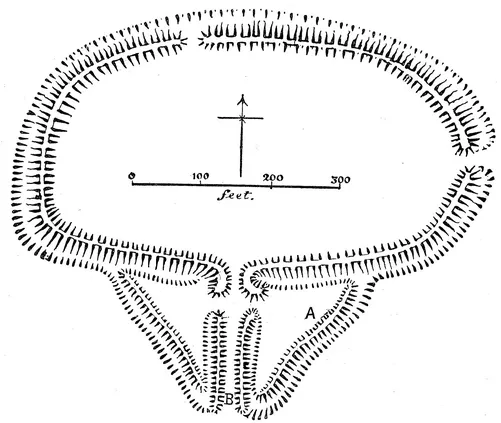
The impregnable character of the enceinte was thus ensured. But further skill was necessary to defend the entrances of the camp. Of these there was usually more than one, and these were necessarily formed by cuttings through the banks. As in the case of Maiden Castle, the path of entry could be converted into a labyrinth by multiplying the banks and ditches. Every inch of this circuitous path is guarded by tall ramparts: there are seven or eight points in its course at which fatal error was possible, and one at any rate where an attacking army could hardly fail to rush securely upon destruction. The eastern entrance is so guarded by transverse banks that the path is almost equally difficult to find. It was seldom, however, that entrances were so elaborately protected. At Old Sarum the western entrance is covered by a semicircular outwork, on the flanks of which are the two inlets to the passage through the outer vallum. On the east side the entrance is through a narrow passage which runs for some distance between the parapet of the outer ditch and an outwork, and is at right angles to the actual passage through the bank. The most common method of defending the entrance was to make a diagonal path, usually from right to left, through the banks. Each bank would thus overlap the next: the summits above the path would be broadened out into platforms, capable of occupation by bodies of defenders ; and the right flank of the enemy, unprotected by shields, would be exposed to their missiles. The entrance, however, might be substantially protected by giving an inward curve to the inner bank on each side of the path; and this is a plan very frequently employed.3 Where outworks were specially constructed, their form differs considerably : we have seen them employed in two ways at Old Sarum—as a kind of horn-work thrown out in front of a passage, and as a spur projecting at right angles in front of an entrance. In both cases an absolutely straight approach is precluded. Occasionally, where an approximately direct approach was permitted, it is guarded on one side by a spur thrown out at right angles to the bank. At Blackbury castle, an early earthwork in south Devon, the main entrance has a straight approach guarded on either side by a triangular outwork, which is formed by a most ingenious arrangement of banks and by prolongations of the main ditch (7). At the actual entrance the main bank is curved outwards, with broad platforms at the top. The hollow interiors of the outworks might serve as guard-houses, or the attacking force could be driven into them from the gateway of the fort, and penned in a position from which escape was impossible. Sometimes hollows were made in the bank or in a projecting outwork near the gateway to serve as guard-houses. On either side of the main entrance, the bank was often slightly raised. At least one instance is known in which the main gate was concealed by making a break in another part of the rampart, and raising the bank on either side. The enemy, making for this point, would miss the real entrance, and run the risk of losing his life in a cul-de-sac purposely constructed within the rampart.
In these fortresses, the defences of which were due to instinctive skill in the face of constant danger, it is impossible not to recognise how many of the most scientific features of medieval fortification were anticipated. The concentric plan of Caerphilly castle (270), with its easy provisions of egress, and its difficulty of access ; the spurs which guard the approaches to Beaumaris (277) and Conway castles; the barbicans which form so prominent a defence of Alnwick castle (243), and the gateways of York have prototypes, of which their engineers were probably unconscious, in the huge earthworks of prehistoric Britain. Through a long interval, in which military art pursued a very gradual evolution, the wheel came full circle. The devices of the earthwork builders were translated into stone with far greater economy of labour.
Blackbury Castle
(From Mr Hadrian Allcroft’s Earthwork of England) by kind permission of Messrs Macmillan & Co.)
Although the most conspicuous examples of early earthwork are found in hill fortresses, camps were not confined to hilly sites, nor were their defences always composed of earthwork. There are districts where the hard nature of the soil forbade the construction of earthen banks and fosses ; and consequently there are many camps which are surrounded by walls of rough uncemented stone, originally kept in place by facings and bondings of larger and smoother stones.4 These camps are usually not large. They occur very commonly in the north of England: a good example is that known as the Castles, in the valley of the Bedburn, seven or eight miles west of Bishop Auckland. The enclosure, situated on a boggy slope, is surrounded by shapeless masses of débris, the ruins of the dry-built ring wall, which has lost its facing and so has fallen to pieces. Stone was also used in the ramparts of some of the camps on the rocky hills of Somerset, as in the camps on either side of the Avon at Clifton. The great fortress of Worlebury, above Weston-super-Mare, was surrounded by an immense wall of uncemented stone, brought to great thickness by building several walls, each with its own set of facing stones, up against each other. On its eastern front, separated from the main rampart by a deep ditch, cut in the solid rock, was another wall of stone ; and this again was protected by a series of outer earthworks (9). Dolebury, at the western extremity of the Mendips, is surrounded by a double wall of loose limestone.5 In these cases, as in the Welsh strongholds of Penmaenmawr and Tre’r Ceiri, geological conditions made the earthen bank an impossibility, and the stone of the neighbourhood took its place.
It has often been argued that these prehistoric fortresses were merely places of refuge, to which, in time of war, the dwellers in the levels below betook themselves and their flocks. But it is much more probable that they were the permanent habitations of communities, not merely camps, but fixed settlements, chosen for habitation on account of their strong position, and gradually fortified by labour which may have been the work, in the more elaborate examples, of many generations. The need of permanent protection for themselves and their flocks and herds seems to have been felt by the early inhabitants of Britain to such an extent that their regular settlements naturally took the semblance of fortified camps. This is very evident in the case of those camps which are found in positions where the natural advantages are very small—positions which might be chosen by people in search of an abode, but would hardly be chosen merely as a refuge. Camps in these positions are never so imposing as those which crown hill-tops : the labour of excavating the ditches and heaping up the banks was not aided by the natural slope of a hill, and the earthworks, being slighter and nearer the more recent haunts of men, are more l...