![]()
SECOND PART
Antiquity
![]()
3. Sumer and Babylonia
THE evolution from prehistoric and primitive civilizations to the higher civilizations involves a corresponding evolution from folk and ritual instruments to instruments intended for entertainment and art. Division of labor and class distinctions in an urban culture result in the formation of a professional class of singers and musicians. It is no more the ‘people’ that play and sing for magic, devotional and social purposes, but a distinct class, or even caste, of musicians. From this moment, instruments can be divided into two kinds—popular instruments and instruments used by professional artists. The latter evolve in the direction of greater musical effectiveness and easier manipulation.
The history of these higher civilizations begins in Mesopotamia, the once fertile plain between the rivers Tigris and Euphrates. Her first rulers were the Sumerians, a people of uncertain race who seem to have come from a neighboring country farther east in the fifth millennium B.C. Contemporaries of the Old Kingdom of Egypt, the Sumerian dynasties were replaced before 2000 B.C. by the Babylonians, a Semitic people who were contemporaneous with the Middle Kingdom in Egypt. At about 1750 B.C., the Kassites, a non-Semitic people, invaded from the east and reigned in Mesopotamia until about 1100 B.C. In the last millennium B.C., Mesopotamia was ruled successively by Assyrians and Babylonians (the Dynasty of King Nebuchadrezzar and the Babylonian Exile of the Jews), by Medes and Persians, and finally by Greeks. The reader may compare the following synopsis.
| MESOPOTAMIA | EGYPT | CRETE AND GREECE |
| Sumerians | Old Kingdom | Early Crete |
| –2040 | –2160 | –2100 |
| Babylonians | Middle Kingdom | Middle Crete |
| 2040–1750 | 2160–1580 | 2100–1580 |
| Kassites | New Kingdom | Late Crete |
| 1740-1160 | 1580–1090 | 1580–1400 |
| Assyrians | Nubians | Dorian migration |
| 1160-625 | 1090–663 | 11th century |
| Babylonians | Saïtes | |
| 625–538 | 663–382 | |
| Persians | | Classic Period |
| 538–331 | | 6-4th century |
| Greeks | Greeks | Alexander |
| from 331 | from 332 | 336–323 |
The two chief languages used in Mesopotamia were Sumerian and Akkadian. Sumerian was a non-Semitic language; Akkadian, comprising Babylonian and Assyrian, was Semitic. As long as Sumerian was generally spoken, the Sumerian names of ritual objects passed from this language into Akkadian and were only slightly transformed according to its phonetic and grammatical rules. Later, when Sumerian was used only as a holy language in the temple, while Akkadian had become the current language, the Akkadian names of newly introduced objects were taken into the Sumerian language. In consequence, most Sumerian names had an Akkadian equivalent, no matter whether the Sumerian or the Akkadian form was the original.
Very few musical instruments have been excavated in Mesopotamia, and most of them were found in the royal cemetery at Ur, Abraham’s native town. However, there are many reliefs and plaques, seals and mosaics, from a period extending over three thousand years, that depict players and musical scenes. Cuneiform written texts in Sumerian or Akkadian contain a quantity of names of musical instruments.
The scholar’s task of compiling the actual instruments excavated from Mesopotamian soil, as well as the depicted instruments, and matching them to the few names given in contemporaneous texts is particularly difficult. A few ideograms can be traced back to pictures of things: an ear of corn, a bull’s head, a hand, a man, a door. In the advanced cuneiform script the original pictures are so schematized that they are unrecognizable, and it is impossible to deduce the form of an instrument from the particular arrangement of the wedges in the cuneiform ideogram of its name. If the ideograms had been recognizable even in their time, the Sumerians would not have helped the reader by occasional determinatives, that is, specifying prefixes to make up for the ambiguity of the phonetic symbols. With musical instruments, such determinatives indicate the material of which they are made: kuš or šu—‘skin,’ giš—‘cane,’ giš—‘wood,’ urudu—‘metal.’
Even if a name can be identified, we face a second difficulty: different names do not necessarily designate different instruments, and different instruments do not necessarily have different names. In ancient Egypt both
r and
tbn mean a frame drum, and
ma is given to flutes, oboes and clarinets.
Thus research must be based on archeological rather than on philological clues.
IDIOPHONIC INSTRUMENTS, vibrating without any special tension, have left few traces in Mesopotamia. It would be wrong, however, to conclude that they were not frequent in ancient Mesopotamia; as the scenes represented by Sumerian and Babylonian artists were in the main ceremonial, they mirror but one side of Mesopotamian life. Altogether we know six types of idiophones employed between the Two Rivers; namely, concussion clubs, clappers, sistra, bells, cymbals and rattles.
Concussion clubs had the bent form of primitive boomerangs of the nontwisted type, such as Australian tribes use for hunting and also to accompany their songs. They are depicted on some of the oldest seals of Sumer, resembling exactly those drawn on prehistoric potteries of Egypt; dancers are holding one in each hand and hitting them together.
On an archaic seal from Ur, which dates from about 2800 B.C. and is owned by the University Museum in Philadelphia, a small animal is playing a pair of short clappers of the kind that youths call bones in this country. Fourteen or fifteen centuries later similar clappers appear on Egyptian reliefs of the New Kingdom.
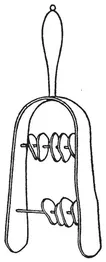
More interesting than clubs and clappers are the sistra, which will be spoken of more fully in the Egyptian chapter. They had the U form of a spur (the point of the spur forming the handle) with a few loose crossbars, which jingled when the little implement was shaken. Thus, they were similar in shape to those sistra that have been found near Tiflis in Georgia and still exist in the Christian Church of Ethiopia, and also similar, surprisingly enough, to sistra found among the Yaqui in North America and among the Kadiuveo in South America. The clearest reproduction of a Sumerian sistrum is on a seal dating about 2500 B.C. in the Louvre. (fig. 28)
The Sumerian spur sistrum differed from the usual Egyptian sistrum, which had the arch on top opposite the handle. Only one Egyptian specimen, of wood, is carved in the Sumerian shape; it came from a tomb of the Middle Kingdom, about 2000 B.C., and probably was not common at that time. A relationship between the Mesopotamian and the Egyptian sistra cannot be doubted; we know that in prehistoric times the countries were connected by commercial trade. That the sistrum originated in Mesopotamia is not likely, as this country is on the periphery, rather than in the center, of the area of distribution. Also, the earlier spur sistrum was, and is, used on the periphery, except for that one obsolete specimen in Egypt; again, a later type was used in Egypt only. Thus, all the facts indicate that the sistrum came from Egypt rather than from Mesopotamia.
FIGURE 28. Sistrum, Caucasus.
We can trace the sistrum even further back than Egypt. Its ancestors, huge and rough, as might be supposed, are preserved in a peculiar implement of Malayan and Melanesian fishermen. To entice the shark, these men bend a rattan rod, either in the shape of a two-pronged fork or in the shape of the frame of a tennis racket. With the fork shape they squeeze a crossbar between the prongs and string rattling coconut shells on it; with a tennis racket shape, they string the shells on the frame itself. This shark rattle anticipates both forms of the sistrum, the Sumerian and early Egyptian spur sistrum, and also the horseshoe-shaped sistrum of classical Egypt to be described in the following chapter.
Small bells were hung around the necks of animals in comparatively recent times. A larger ceremonial bell, with the symbols of the gods Ea, Nergal and Ninurti and a clapper inside, is preserved in the Vorderasiatische Abteilung of the Berlin Museum. It dates from the Assyrian epoch, about 600 B.C.
Cymbals appear as late as the seventh century in Assyria. Here they are used in two different forms. In one form they are held in a horizontal position and softly struck in a vertical movement; in the other form they are held in a vertical position and vigorously struck in a horizontal movement. In the former case they are funnel-shaped, the necks of the funnels serving as handles.
Dr. Francis W. Galpin suggests the Akkadian word kat...