Written in 1661 by the founder of Boyle's Law, a major figure in the scientific revolution of the 17th century, this chemistry classic departs from alchemical tradition by asserting that all natural phenomena can be explained by the motion and organization of primary particles. Contents: Introduction. Physiological Considerations Touching the Experiments Wont to Be Employed to Evince Either the Four Peripatetick Elements, or the Three Chymical Principles of Mixt Bodies. Six Parts. Conclusion.
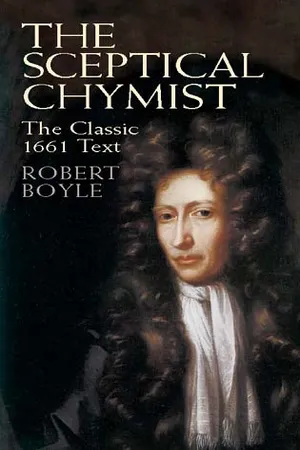
- 254 pages
- English
- ePUB (mobile friendly)
- Available on iOS & Android
eBook - ePub
The Sceptical Chymist
About this book
Information
THE FOURTH PART
AND thus much (saies Carneades) may suffice to be said of the number of the distinct substances separable from mixt bodies by the fire: wherefore I now proceed to consider the nature of them, and shew you, that though they seem homogeneous bodies, yet have they not the purity and simplicity that is requisite to elements. And I should immediately proceed to the proof of my assertion, but that the confidence wherewith chymists are wont to call each of the substances we speak of by the name of sulphur or mercury, or the other of the hypostatical principles, and the intolerable ambiguity they allow themselves in their writings and expressions, makes it necessary for me in order to the keeping you either from mistaking me, or thinking I mistake the controversie, to take notice to you and complain of the unreasonable liberty they give themselves of playing with names at pleasure. And indeed if I were obliged in this dispute, to have such regard to the phraseology of each particular chymist, as not to write anything which this or that author may not pretend, not to contradict this or that sence, which he may give us as occasion serves to his ambiguous expressions, I should scarce know how to dispute, nor which way to turn myself. For I find that even eminent writers (such as Raymund Lully, Paracelsus and others) do so abuse the termes they employ, that as they will now and then give divers things, one name; so they will oftentimes give one thing, many names; and some of them (perhaps) such, as do much more properly signifie some distinct body of another kind; nay even in technical words or termes of art, they refrain not from this confounding liberty; but will, as I have observed, call the same substance, sometimes the sulphur, and sometimes the mercury of a body. And now I speak of mercury, I cannot but take notice, that the descriptions they give us of that principle or ingredient of mixt bodies, 113 are so intricate, that even those that have endeavoured to polish and illustrate the notions of the chymists, are fain to confess that they know not what to make of it either by ingenuous acknowledgments, or descriptions that are not intelligible.
I must confess (saies Eleutherius) I have, in the reading of Paracelsus and other chymical authors, been troubled to find, that such hard words and equivocal expressions, as you justly complain of, do even when they treat of principles, seem to be studiously affected by those writers; whether to make themselves to be admired by their readers, and their art appear more venerable and mysterious, or (as they would have us think) to conceal from them a knowledge themselves judge inestimable.
But whatever (saies Carneades) these men may promise themselves from a canting way of delivering the principles of nature, they will find the major part of knowing men so vain, as when they understand not what they read, to conclude, that it is rather the writers fault than their own. And those that are so ambitious to be admired by the vulgar, that rather than go without the admiration of the ignorant they will expose themselves to the contempt of the learned, those shall, by my consent, freely enjoy their option. As for the mystical writers scrupling to communicate their knowledge, they might less to their own disparagement, and to the trouble of their readers, have concealed it by writing no books, than by writing bad ones. If Themistius were here, he would not stick to say, that chymists write thus darkly, not because they think their notions too precious to be explained, but because they fear that if they were explained, men would discern, that they are farr from being precious. And indeed, I fear that the chief reason why chymists have written so obscurely of their three principles, may be, that not having clear and distinct notions of them themselves, they cannot write otherwise than confusedly of what they but confusedly apprehend: not to say that divers of them, being conscious to the invalidity of their doctrine, might well enough discerne that they could scarce keep themselves from being confuted, but by keeping themselves from being clearly understood. But though much may be said to excuse the chymists when they write darkly, and ænigmatically, about the preparation of their elixir, and some few other grand arcana, the divulging of which they may upon grounds plausible enough esteem unfit; yet when they pretend to teach the general principles of natural philosophers, this equivocal way of writing is not to be endured. For in such speculative enquiries, where the naked knowledge of the truth is the thing principally aimed at, what does he teach me worth thanks that does not, if he can, make his notion intelligible to me, but by mystical termes, and ambiguous phrases darkens what he should clear up; and makes me add the trouble of guessing at the sence of what he equivocally expresses, to that of examining the truth of what he seems to deliver. And if the matter of the philosophers stone, and the manner of preparing it, be such mysteries as they would have the world believe them, they may write intelligibly and clearly of the principles of mixt bodies in general, without discovering what they call the great work. But for my part (continues Carneades) what my indignation at this unphilosophical way of teaching principles has now extorted from me, is meant chiefly to excuse myself, if I shall hereafter oppose any particular opinion or assertion, that some follower of Paracelsus or any eminent artist may pretend not to be his masters. For, as I told you long since, I am not obliged to examine private men’s writings, (which were a labour as endless as unprofitable) being only engaged to examine those opinions about the tria prima, which I find those chymists I have met with to agree in most: and I doubt not but my arguments against their doctrine will be in great part easily enough applicable even to those private opinions, which they do not so directly and expressly oppose. And indeed, that which I am now entering upon being the consideration of the things themselves whereinto spagyrists resolve mixt bodies by the fire, if I can shew that these are not of an elementary nature, it will be no great matter what names these or those chymists have been pleased to give them. And I question not that to a wise man, and consequently to Eleutherius, it will be lesse considerable to know, what men have thought of things, than what they should have thought.
In the fourth and last place, then, I consider, that as generally as chymists are wont to appeal to experience, and as confidently as they use to instance the several substances separated by the fire from a mixt body, as a sufficient proof of their being its component elements: yet those differing substances are many of them farr enough from elementary simplicity, and may be yet looked upon as mixt bodies, most of them also retaining, somewhat at least, if not very much, of the nature of those concretes whence they were forced.
I am glad (saies Eleutherius) to see the vanity or envy of the canting chymists thus discovered and chastised; and I could wish, that learned men would conspire together to make these deluding writers sensible, that they must no longer hope with impunity to abuse the world. For whilst such men are quietly permitted to publish books with promising titles, and therein to assert what they please, and contradict others, and even themselves as they please, with as little danger of being confuted as of being understood, they are encouraged to get themselves a name, at the cost of the readers, by finding that intelligent men are wont for the reason newly mentioned, to let their books and them alone: and the ignorant and credulous (of which the number is still much greater than that of the other) are forward to admire most what they least understand. But if judicious men skilled in chymical affaires shall once agree to write clearly and plainly of them, and thereby keep men from being stunned, as it were, or imposed upon by dark or empty words; ’tis to be hoped that these men finding that they can no longer write impertinently and absurdly, without being laughed at for doing so, will be reduced either to write nothing, or books that may teach us something, and not rob men, as formerly, of invaluable time; and so ceasing to trouble the world with riddles or impertinencies, we shall either by their books receive an advantage, or by their silence escape an inconvenience.
But after all this is said (continues Eleutherius) it may be represented in favour of the chymists, that, in one regard the liberty they take in using names, if it be excusable at any time, may be more so when they speak of the substances whereinto their analysis resolves mixt bodies: since as parents have the right to name their own children, it has ever been allowed to the authors of new inventions, to impose names upon them. And therefore the subjects we speak of being so the productions of the chymists art, as not to be otherwise, but by it, obtainable; it seems but equitable to give the artists leave to name them as they please: considering also that none are so fit and likely to teach us what those bodies are, as they to whom we owed them.
I told you already (saies Carneades) that there is great difference betwixt the being able to make experiments, and the being able to give a philosophical account of them. And I will not now add, that many a mine-digger may meet, whilst he follows his work, with a gemm or a mineral which he knowes not what to make of, till he shewes it a jeweller or a mineralist to be informed what it is. But that which I would rather have here observed is, that the chymists I am now in debate with have given up the liberty you challenged for them, of using names at pleasure, and confined themselves by their descriptions, though but such as they are, of their principles; so that although they might freely have called anything their analysis presents them with, either sulphur, or mercury, or gas, or blas, or what they pleased; yet when they have told me that sulphur (for instance) is a primogeneal and simple body, inflamable, odorous, etc. they must give me leave to disbelieve them, if they tell me that a body that is either compounded or uninflamable is such a sulphur; and to think they play with words, when they teach that gold and some other minerals abound with an incombustible sulphur, which is as proper an expression, as a sun-shine night, or fluid ice.
But before I descend to the mention of particulars belonging to my fourth consideration, I think it convenient to premise a few generals; some of which I shall the less need to insist on at present, because I have touched on them already.
And first I must invite you to take notice of a certain passage in Helmont; 3 which though I have not found much heeded by his readers, he himself mentions as a notable thing, and I take to be a very considerable one; for whereas the distilled oyle of oyle-olive, though drawn per se, is (as I have tryed) of a very sharp and fretting quality, and of an odious taste, he tells us that simple oyle being only digested with Paracelsus’s sal circulatum, is reduced into dissimilar parts, and yeelds a sweet oyle, very differing from the oyle distilled, from sallet oyle; as also that by the same way there may be separated from wine a very sweet and gentle spirit, partaking of a far other and nobler quality than that which is immediately drawn by distillation and called dephlegmed aqua vitœ, from whose acrimony this other spirit is exceedingly remote, although the sal circulatum that makes these anatomies be separated from the analyzed bodies, in the same weight and with the same qualities it had before; which affirmation of Helmont if we admit to be true, we must acknowledge that there may be a very great disparity betwixt bodies of the same denomination (as several oyles, or several spirits) separable from compound bodies: for, besides the differences I shall anon take notice of, betwixt those distilled oyles that are commonly known to chymists, it appears by this, that by means of the sal circulatum, there may be quite another sort of oyles obtained from the same body; and who knowes but that there may be yet other agents found in nature, by whose help there may, whether by transmutation or otherwise, be obtained from the bodies vulgarly called mixt, oyles or other substances, differing from those of the same denomination, known either to vulgar chymists, or even to Helmont himself: but for fear you should tell me, that this is but a conjecture grounded upon another man’s relation, whose truth we have not the means to experiment, I will not insist upon it; but leaving you to consider of it at leasure, I shall proceed to what is next.
Secondly, then, if that be true which was the opinion of Leucippus, Democritus, and other prime anatomists of old, and is in our dayes revived by no mean philosophers; namely, that our culinary fire, such as chymists use, consists of swarmes of little bodies swiftly moving, which by their smallness and motion are able to permeate the sollidest and compactest bodies, and even glass itself; if this (I say) be true, since we see that in flints and other concretes, the fiery part is incorporated with the grosser, it will not be irrational to conjecture, that multitudes of these fiery corpuscles, getting in at the pores of the glass, may associate themselves with the parts of the mixt body whereon they work, and with them constitute new kinds of compound bodies, according as the shape, size, and other affections of the parts of the dissipated body happen to dispose them, in reference to such combinations; of which also there may be the greater number; if it be likewise granted that the corpuscles of the fire, though all exceeding minute, and very swiftly moved, are not all of the same bigness, nor figure: and if I had not weightier considerations to discourse to you of, I could name to you, to countenance what I have newly said, some particular experiments by which I have been deduced to think, that the particles of an open fire working upon some bodies may really associate themselves therewith, and add to the quantity. But because I am not sure, that when the fire works upon bodies included in glasses, it does it by a reall trajection of the fiery corpuscles themselves, through the substance of the glass, I will proceed to what is next to be mentioned.
I could (saies Eleutherius) help you to some proofs, whereby I think it may be made very probable, that when the fire acts immediately upon a body, some of its corpuscles may stick to those of the burnt body, as they seem to do in quicklime, but in greater numbers and more permanently. But for fear of retarding your progress, I shall desire you to deferr this enquiry till another time, and proceed as you intended.
You may then in the next place (saies Carneades) observe with me, that not only there are some bodies, as gold, and silver, which do not by the usual examens, made by fire, discover themselves to be mixt; but if (as you may remember I formerly told you) it be a decompound body that is dissipable into several substances, by being exposed to the fire it may be resolved into such as are neither elementary, nor such as it was upon its last mixture compounded of; but into new kinds of mixts. Of this I have already given you some examples in sope, sugar of lead, and vitriol. Now if we shall consider that there are some bodies, as well natural, (as that I last named) as factitious, manifestly decompounded; that in the bowells of the earth nature may, as we see she sometimes does, make strange mixtures; that animals are nourished with other animals and plants; and, that these themselves have almost all of them their nutriment and growth, either from a certain nitrous juice harboured in the pores of the earth, or from the excrements of animalls, or from the putrifyed bodies, either of living creatures or vegetables, or from other substances of a compounded nature; if, I say, we consider this, it may seem probable, that there may be among the works of nature (not to mention those of art) a greater number of decompound bodies, than men take notice of; and indeed, as I have formerly also observed, it does not at all appear, that all mixtures must be of elementary bodies; but it seems farr more probable, that there are divers sorts of compound bodies, even in regard of all or some of their ingredients, considered antecedently to their mixture. For though some seem to be made up by the immediate coalitions of the elements, or principles themselves, and therefore may be called prima mista, or mista primaria ; yet it seems that many other bodies are mingled (if I may so speak) at the second hand, their immediate ingredients being not elementary, but these primary mixt newly spoken of; and from divers of those secondary sorts of mixts may result, by a further composition, a third sort, and so onwards. Nor is it improbable, that some bodies are made up of mixt bodies, not all of the same order, but of several; as (for instance) a concrete may consist of ingredients, whereof the one may have been a primary, the other a secondary mixt body; (as I have in native cinnaber, by my way of resolving it, found both that courser part that seems more properly to be oar, and a combustible sulphur, and a running mercury): or perhaps without any ingredient of this latter sort, it may be composed of mixt bodies, some of them of the first, and some of the third kind; and this may perhaps be somewhat illustrated by reflecting upon what happens in some chymical preparations of those medicines which they call their Bezoardicum’s. For first, they take antimony and iron, which may be looked upon as prima mista; of these they compound a starry regulus, and to this they add according to their intention, either gold, or silver, which makes with it a new and further composition. To this they add sublimate, which is itself a decompound body, (consisting of common quicksilver, and divers salts united by sublimation into a chrystalline substance) and from this sublimate, and the other metalline mixtures, they draw a liquor, which may be allowed to be of a yet more compounded nature. If it be true, as chymists affirm it, that by this art some of the gold or silver mingled with the regulus may be carryed over the helme with it by the sublimate; as indeed a skilfull and candid person complained to me a while since, that an experienced friend of his and mine, having by such a way brought over a great deal of gold, in hope to do something further with it, which might be gainful to him, has not only missed of his aim, but is unable to recover his volatilized gold out of the antimonial butter, wherewith it is strictly united.
Now (continues Carneades) if a compound body consist of ingredients that are not merely elementary; it is not hard to conceive, that the substances into which the fire dissolves it, though seemingly homogeneous enough, may be of a compounded nature, those parts of each body that are most of kin associating themselves into a compound of a new kind. As when (for example sake) I have caused vitriol and sal armoniack, and salt petre to be mingled and distilled together, the liquor that came over manifested itself not to be either spirit of nitre, or of sal armoniack, or of vitrioll. For none of these would dissolve crude gold, which yet my liquor was able readily to do; and thereby manifested itself to be a new compound, consisting at least of spirit of nitre, and sal armoniack, (for the latter dissolved in the former, will work on gold) which nevertheless are not by any known way separable, and consequently would not pass for a mixt body, if we ourselves did not, to obtain it, put and distill together divers concretes, whose distinct operations were known beforehand. And, to add on this occasion the experiment I lately promised you, because it is applicable to our present purpose, I shall acquaint you, that suspecting the common oyle of vitrioll not to be altogether such a simple liquor as chymists presume it, I mingled it with an equal or a double quantity (for I tryed the experiment more than once) of common oyle of turpentine, such as together with the other liquor I bought at the drugsters. And having carefully (for the experiment is nice, and somewhat dangerous) distilled the mixture in a small glass retort, I obtained according to my desire (besides, the two liquors I had put in) a pretty quantity of a certaine substance, which sticking all about the neck of the retort discovered itself to be sulphur, not only by a very strong sulphureous smell, and by the colour of brimstone; but also by this, that being put upon a coal, it was immediately kindled, and burned like common sulphur. And of this substance I have yet by me some little parcells, which you may command and examine when you please. So that from this experiment I may deduce either one, or both of these propositions, that a real sulphur may be made by the conjunction of two such substances as chymists take for elementary, and which did not either of them apart appear to have any such body in it; or that oyle of vitrioll though a distilled liquor, and taken for part of the saline principle of the concrete that yeelds it, may yet be so compounded a body as to contain, besides its saline part, a sulphur like common brimstone, which would hardly be itself a simple or uncompounded body.
I might (pursues Carneades) remind you, that I formerly represented it, as possible, that as there may be more elements than five, or six; so the elements of one body may be different from those of another; whence it would follow, that from the resolution of decompound bodies, there may result mixts of an altogether new kind, by the coalition of elements that never perhaps convened before. I might, I say, mind you of this, and add divers things to this second consideration; but for fear of wanting time I willingly pretermit them to pass on to the third, which is this, that the fire does not alwaies barely resolve or take asunder, but may also after a new manner mingle and compound together the parts (whether elementary or not) of the body dissipated by it.
This is so evident, (saies Carneades) in some obvious examples, that I cannot but wonder at their supineness that have not taken notice of it. For when wood being burnt in a chimney is dissipated by the fire into smoake and ashes, that smoake composes soot, which is so far from being any one of the principles of the wood, that (as I noted above) you may by a further analysis separate five or six distinct substances from it. And as for the remaining ashes, the chymists themselves teach us, that by a further degree of fire they may be indissolubly united into glass. ‘Tis true, that the analysis which the chymists principally build upon is made, not in the open air, but in close vessels; but however, the examples lately produced may invite you shrewdly to suspect, that heat may as well compound as dissipate the parts of mixt bodies: and not to tell you, that I have known a vitrification made even in close vessels, I must remind you that the flowers of antimony, and those of sulphur, are very mixed bodies, though they ascend in close vessels: and that ’twas in stopt glasses that I brought up the whole body of camphire. And whereas it may be objected that all these examples are of bodies forced up in a dry, not a fluid forme, as are the liquors wont to be obtained by distillation; I answer, that besides ‘tis possible, that a body may be changed from consistent to fluid, or from fluid to consistent, without being otherwise much altered, as may appear by the easiness wherewith in winter, without any addition or separation of visible ingredients, the same substance may be quickly hardened into brittle ice, and thawed again into fluid water; besides this, I say it would be considered, that common quicksilver itself, which the emi...
Table of contents
- Title Page
- Copyright Page
- NOTE
- Table of Contents
- INTRODUCTORY PREFACE TO THE FOLLOWING TREATISE
- PHYSIOLOGICAL CONSIDERATIONS - TOUCHING THE EXPERIMENTS WONT TO BE EMPLOYED TO EVINCE EITHER THE FOUR PERIPATETICK ELEMENTS, OR THE THREE CHYMICAL PRINCIPLES OF MIXT BODIES
- THE FIRST PART
- THE SECOND PART
- THE THIRD PART
- THE FOURTH PART
- THE FIFTH PART
- THE SIXTH PART
- THE CONCLUSION
Trusted by 375,005 students
Access to over 1.5 million titles for a fair monthly price.
Study more efficiently using our study tools.
Frequently asked questions
Yes, you can cancel anytime from the Subscription tab in your account settings on the Perlego website. Your subscription will stay active until the end of your current billing period. Learn how to cancel your subscription
No, books cannot be downloaded as external files, such as PDFs, for use outside of Perlego. However, you can download books within the Perlego app for offline reading on mobile or tablet. Learn how to download books offline
Perlego offers two plans: Essential and Complete
- Essential is ideal for learners and professionals who enjoy exploring a wide range of subjects. Access the Essential Library with 800,000+ trusted titles and best-sellers across business, personal growth, and the humanities. Includes unlimited reading time and Standard Read Aloud voice.
- Complete: Perfect for advanced learners and researchers needing full, unrestricted access. Unlock 1.5M+ books across hundreds of subjects, including academic and specialized titles. The Complete Plan also includes advanced features like Premium Read Aloud and Research Assistant.
We are an online textbook subscription service, where you can get access to an entire online library for less than the price of a single book per month. With over 1.5 million books across 990+ topics, we’ve got you covered! Learn about our mission
Look out for the read-aloud symbol on your next book to see if you can listen to it. The read-aloud tool reads text aloud for you, highlighting the text as it is being read. You can pause it, speed it up and slow it down. Learn more about Read Aloud
Yes! You can use the Perlego app on both iOS and Android devices to read anytime, anywhere — even offline. Perfect for commutes or when you’re on the go.
Please note we cannot support devices running on iOS 13 and Android 7 or earlier. Learn more about using the app
Please note we cannot support devices running on iOS 13 and Android 7 or earlier. Learn more about using the app
Yes, you can access The Sceptical Chymist by Robert Boyle in PDF and/or ePUB format, as well as other popular books in Physical Sciences & Chemistry. We have over 1.5 million books available in our catalogue for you to explore.