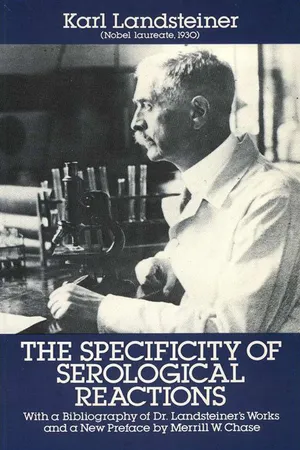
Since the discovery that each particular antibody in the blood tends to react primarily with one specific antigen among the hundreds that can be introduced into the system, great strides have been made toward the elimination of disease through immunization. The late Dr. Karl Landsteiner, winner of the Nobel Price in 1930 for the discovery of human blood groups, devoted his life to fundamental research and played a guiding role in the development of several important branches of immunology. This authoritative study is an account of the experiments he and his colleagues carried out on antigens and serological reactions with simple compounds.
Beginning with a general discussion of the phenomena of serological specificity, with the emphasis chiefly on the chemical aspects of those reactions that involve immunization, Dr. Landsteiner goes on to cover the topics of natural antigens and antibodies, artificial conjugated antigens, and the reactivity of simple chemical compounds, the chemistry of specific non-protein cell substances, and the developments in our knowledge of serological reactions from a physico-chemical approach. Included in the discussion are his original and fundamental studies in hypersensitivity to chemical allergens and his work with "haptens," on which modern immunochemistry has leaned very heavily. The final chapter, written by Dr. Linus Pauling, carefully presents the principles of molecular structure and intermolecular forces.
An extremely valuable feature of this book is the massive bibliography compiled by the author — over 2,100 items are listed at the chapter ends. A further aid to study and research is the definitive bibliography of Dr. Landsteiner's own writings, new to this edition, and reprinted through the courtesy of the Journal of Immunology.
The beginner and advanced student alike will find nowhere else the breadth of coverage given here to basic concepts of immunology. Comprehensive enough for the use of the worker in the field, the book also provides, primarily in an introductory section, explanations and definitions of elementary terminology, concepts, and phenomena of serology for those unacquainted with the subject.
- 348 pages
- English
- ePUB (mobile friendly)
- Available on iOS & Android
eBook - ePub
The Specificity of Serological Reactions
About this book
Information
Table of contents
- COVER
- TITLE PAGE
- COPYRIGHT PAGE
- PREFACE
- FOREWORD
- AUTHOR’S PREFACE
- CONTENTS
- KEY TO ABBREVIATIONS
- I. INTRODUCTION
- II. THE SEROLOGICAL SPECIFICITY OF PROTEINS
- III. CELL ANTIGENS
- IV. THE NATURE AND SPECIFICITY OF ANTIBODIES
- V. ARTIFICIAL CONJUGATED ANTIGENS. SEROLOGICAL REACTIONS WITH SIMPLE CHEMICAL COMPOUNDS
- VI. CHEMICAL INVESTIGATIONS ON SPECIFIC NON-PROTEIN CELL SUBSTANCES
- VII. ANTIGEN-ANTIBODY REACTIONS
- VIII. MOLECULAR STRUCTURE AND INTERMOLECULAR FORCES, by Dr. Linus Pauling
- LIST OF TEXTBOOKS, REVIEWS, MONOGRAPHS, AND SURVEYS
- BIBLIOGRAPHY OF DR. KARL LANDSTEINER
- INDEX
Trusted by 375,005 students
Access to over 1.5 million titles for a fair monthly price.
Study more efficiently using our study tools.
Frequently asked questions
Yes, you can cancel anytime from the Subscription tab in your account settings on the Perlego website. Your subscription will stay active until the end of your current billing period. Learn how to cancel your subscription
No, books cannot be downloaded as external files, such as PDFs, for use outside of Perlego. However, you can download books within the Perlego app for offline reading on mobile or tablet. Learn how to download books offline
Perlego offers two plans: Essential and Complete
- Essential is ideal for learners and professionals who enjoy exploring a wide range of subjects. Access the Essential Library with 800,000+ trusted titles and best-sellers across business, personal growth, and the humanities. Includes unlimited reading time and Standard Read Aloud voice.
- Complete: Perfect for advanced learners and researchers needing full, unrestricted access. Unlock 1.5M+ books across hundreds of subjects, including academic and specialized titles. The Complete Plan also includes advanced features like Premium Read Aloud and Research Assistant.
We are an online textbook subscription service, where you can get access to an entire online library for less than the price of a single book per month. With over 1.5 million books across 990+ topics, we’ve got you covered! Learn about our mission
Look out for the read-aloud symbol on your next book to see if you can listen to it. The read-aloud tool reads text aloud for you, highlighting the text as it is being read. You can pause it, speed it up and slow it down. Learn more about Read Aloud
Yes! You can use the Perlego app on both iOS and Android devices to read anytime, anywhere — even offline. Perfect for commutes or when you’re on the go.
Please note we cannot support devices running on iOS 13 and Android 7 or earlier. Learn more about using the app
Please note we cannot support devices running on iOS 13 and Android 7 or earlier. Learn more about using the app
Yes, you can access The Specificity of Serological Reactions by Karl Landsteiner in PDF and/or ePUB format, as well as other popular books in Biological Sciences & Biology. We have over 1.5 million books available in our catalogue for you to explore.