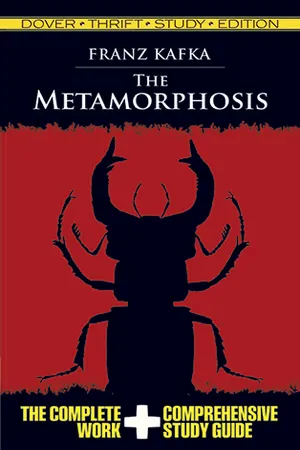
![]()
Study Guide
Text by
Stanley Taikeff
(M. A., Hunter College)
Department of English
CUNY–Laguardia Community College
Long Island City, New York
Contents
Section One: Introduction
The Life and Work of Franz Kafka
Historical Background
Master List of Characters
Summary of the Novel
Estimated Reading Time
Each part includes List of Characters, Summary, Analysis, Study Questions and Answers, and Suggested Essay Topics.
Section Two: The Metamorphosis
Part I, Division 1
Part I, Division 2
Part II, Division 1
Part II, Division 2
Part III, Division 1
Part III, Division 2
Section Three: Bibliography 107
![]()
SECTION ONE
Introduction
The Life and Work of Franz Kafka
The oldest of six children, Franz Kafka was born in Prague, Czechoslovakia on July 3, 1883, the son of prosperous, middle-class parents, Hermann and Julie Löwy. Kafka’s childhood and adolescence were dominated by his father, a successful merchant who owned a dry goods business. Kafka’s father’s powerful influence and often tyrannical presence marked Kafka’s life both as an artist and as a man. The struggle to free himself from his overbearing father found expression in his fiction as the shy, passive, sensitive victim who suffers and struggles against authoritarian forces and figures. In his Letter to His Father (1919), Kafka wrote: “My writing was all about you.”
After completing his elementary and secondary education, Kafka graduated from the German University of Prague with a degree in law. Always an avid reader, Kafka was drawn to philosophy and literature, and he soon started to write his own sketches and stories. Among his favorite writers were Dickens, Göethe, Flaubert, Kleist, Thomas Mann, and the Danish philosopher Kierkegaard, the founder of modern existentialism, a philosophy that emphasizes the individual as an agent responsible for his own choices in life.
In 1902, Kafka met the writer Max Brod, who became his close friend, admirer, and biographer. The two young men shared a passion for literature, and they often traveled together in the early years of their friendship. In 1908, Kafka began working for the Workman’s Accident Insurance Company in Prague, a government job that would later provide him with material for two of his unfinished novels, The Trial (1915) and The Castle (1921).
In 1912, an important year in Kafka’s life, Kafka met Felice Bauer. Kafka was engaged to her twice during a five-year period, but never married her. During this year, he also finished two important works, The Judgment and The Metamorphosis. Both stories focus on the tortured, father–son relationship; in the latter story, the theme of the individual’s estrangement from society is given compelling, dramatic expression. This theme occupied Kafka throughout his life, and recurs throughout his mature fiction.
The year 1919 saw three more important works: A Country Doctor, In the Penal Colony, and the autobiographical document Letter to His Father.
In 1924, while receiving treatment for tuberculosis in Merano, Italy, Kafka met the married writer, Milena Jesenka, with whom he had an affair. In 1923, losing his battle with tuberculosis, Kafka met the 19-year-old Orthodox Jewish woman, Dora Dymant. Dora devoted herself completely to Kafka’s care and welfare, and they lived together in Berlin until Kafka’s death. He died on June 3, 1924 in Kierling, outside Vienna. He was buried alongside his parents in the Jewish cemetery of Prague-Straschnitz. His three sisters all perished in Hitler’s concentration camps.
Kafka’s influence on twentieth-century literature is both profound and incalculable. The word Kafkaesque has passed into the literature to describe an unsettling, disorienting, nightmarish world that is at once both fearful and menacing in its ambiguity and complexity. His haunting, disturbing, and sometimes grotesque images, combined with his struggling but ultimately defeated heroes, defined an age wherein alienated man — the anti-hero — grappling with meaning and justice in an inscrutable world, is denied answers to both.
Historical Background
The years 1880–1914 (1914 marked the outbreak of World War I) were significant in terms of the changes taking place in the arts in Europe. Traditional artistic forms and structures in literature, painting, poetry, music, and the theatre were undergoing innovative, and in some cases, revolutionary change. Romanticism and naturalism in the fields of painting, music, and literature and realism in the theatre spawned other artistic movements: impressionism and cubism in painting, the atonal system in music, dadaism in poetry and art, and expressionism and absurdism in the theatre. Composers like Debussy, Stravinsky, and Schönberg, writers like James Joyce, Alfred Jarry, and Apollinaire, and painters like Henri Rousseau and Piet Mondrian were experimenting with conventional artistic forms and creating newer, more abstract and symbolic works of art. It was into this vital period of dramatic change in the arts that Franz Kafka was born.
In 1883, the year of Kafka’s birth, modern Czechoslovakia was part of the Austro-Hungarian Empire. For Kafka, a Jew who wrote his stories and novels in German, living in Prague forced him into a certain kind of social and cultural isolation. He was not an observant, Orthodox Jew and was therefore estranged from his own people. And since he considered himself a German in language and culture, he was alienated from the Czech people, who comprised the majority of people living in the country. This sense of cultural and societal estrangement was keenly felt by Kafka and it influenced his thought and outlook and contributed to his artistic expression as a writer.
At the age of 28, Kafka wrote in a letter, “I am separated from all things by a hollow space, and I do not even reach to its boundaries.” Prague — with its old, crooked streets and ancient, medieval buildings, with its diverse population of Czechs, Germans, Rumanians, and Jews — fed Kafka’s imagination from his birth to his death. It was into that “hollow space” that he placed his tormented, alienated characters.
The theme of the artist as an “outsider,” cut off from every day reality to create his own transcendent reality, is seen in German literature from Goethe’s Tasso to Thomas Mann’s Tonio Kröger. Kafka’s own fiction continues in this tradition, but whereas Mann gives us a reality that is recognizable and familiar to us, Kafka’s world is more opaque, symbolic, and dream-like in quality, often defying interpretation itself. Like the hero K. of the novels The Trial and The Castle, we find ourselves struggling to gain a foothold in vastly unfamiliar territory that is both treacherous and terrifying to negotiate.
Hermann Hesse, a German writer and contemporary of Kafka, called Kafka “The uncrowned King of German prose.” Kafka’s prose style shares the simplicity, clarity, and logic of other German writers, namely, the brothers Grimm and E.T.A. Hofmann. But Kafka’s art, with its emphasis on symbol and on the juxtaposition of the real and the fantastic, the rational and the irrational, the ordinary and the extraordinary is unmistakably modern in its sensibility, themes, and vision of the future.
Master List of Characters
Gregor Samsa — the protagonist or hero of the story.
Mr. Samsa — the protagonist’s father; an old man, described as having bushy eyebrows and black eyes.
Mrs. Samsa — the protagonist’s mother; she suffers from asthma and is anxious to please her husband.
Grete — the protagonist’s younger sister; 17 years old, she plays the violin.
Chief — the protagonist’s boss; although he is never seen in the story, he is much on Gregor’s mind in the early part of the story.
Chief Clerk — a bureaucrat representing the Chief.
Anna — the 16-year-old servant girl.
Household Cook — the woman who asks to be dismissed from her job.
Three Lodgers — the three bearded men who rent a room in the Samsa apartment.
Cleaning Woman (Charwoman) — the woman who takes on the job of cleaning out the protagonist’s room in Part Three.
Summary of the Novel
Gregor Samsa, a traveling salesman, awakes one morning to find out that he has been transformed into a gigantic insect. From his bed, he looks around his room, adjusting physically and mentally to his new body and wondering if he hasn’t been dreaming. But when he tries to turn over onto his right side and can’t, he realizes that it is no dream, that indeed he is an insect, complete with a hard shell for a back, wriggling legs, and feelers.
He wants to go back to sleep, but he remembers that he has to get up for work and is already late. His thoughts turn to his job and to the work he does. He hates his job, and he dislikes the Chief of the company. Five years before, Gregor’s father’s business failed, and Gregor has been supporting his parents and his sister ever since. He has also been paying off his parents’ personal debts to the Chief, and he hopes one day to quit his job, settle his parents’ accounts, and send his sister to the Conservatory to study music.
While his parents are trying to find out why Gregor hasn’t come out of his room, the chief clerk arrives to inquire about Gregor’s lateness. When Gregor still doesn’t emerge from his room, his parents become worried and send Grete and Anna to get the doctor and locksmith, respectively. The chief clerk threatens Gregor with the loss of his job if he doesn’t come out and report for work. Gregor responds by saying that he hasn’t been feeling well, but promises to report for work anyway.
When Gregor finally unlocks the door to his room and shows his face, the chief clerk, who is the first to see him, reacts with shock and horror and retreats to the staircase. Mrs. Samsa collapses to the floor at the sight of her son, and Mr. Samsa breaks down and cries. The chief clerk meanwhile is on the landing and wants to flee. Gregor tries to speak to him in order to give him some explanation for what has happened to him, but the clerk flies out of the house. Gregor’s father picks up the chief clerk’s walking stick, which he left behind, and a rolled newspaper and drives Gregor back into his room. In his panic to escape his father, Gregor gets caught in the door of his room and sustains multiple injuries to himself. Shaken and bleeding, he lies dazed on the floor of his room.
When Part II opens, it is twilight of the same day, but we learn later that more time has really elapsed between the morning’s events and the time Gregor wakes up again in his room. Grete has taken on the responsibility of feeding Gregor and cleaning out his room, since her parents seem unwilling or unable to cope with the new crisis. The cook implores Mrs. Samsa to let her go. Mrs. Samsa has no choice but to dismiss her, and now Grete must help her mother with the cooking chores as well.
Gregor is able to listen in on his parents’ conversation, and he learns that the family has some money left over from his father’s investments to live on for about a year. Grete decides that it would be best if much of the furniture is removed from Gregor’s room to give him greater freedom of movement. To this end, she enlists her mother’s help and the two women start to take out the chest and the writing desk from Gregor’s room. When they come back for the picture on the wall, Gregor is clinging tenaciously to it, daring them to take it from him. When Mrs. Samsa sees Gregor spread out on the wallpaper, she shrieks with horror and faints. Grete rushes into another room for something to revive her with. Gregor worriedly follows Grete out, and when the two confront each other, Grete drops a bottle in alarm. The bottle shatters and a sliver of glass cuts Gregor’s face. At this point, Mr. Samsa returns to the apartment wearing a blue bank messenger’s uniform and cap. When he sees his stricken wife and learns from Grete what has happened, he begins to bombard Gregor with apples. One apple lodges in Gregor’s back. Hurt, exhausted, and mortally wounded, Gregor loses consciousness.
Refusing to eat, Gregor is growing weaker and thinner as Part III begins. His eyesight is failing him and, because of his injuries — one leg is badly mangled — his movements are severely restricted. The family is now working: Mr. Samsa as a bank messenger, Mrs. Samsa as a seamstress for an underwear company, and Grete as a salesgirl. As Gregor’s condition continues to deteriorate, Grete takes less interest in her brother’s health and welfare.
Three men come to rent a room in the Samsa apartment. One night after dinner, when Grete is serenading them with her violin, Gregor, who is drawn to the music, sticks his head out his door and is spotted by one of the lodgers. The three men express their outrage and threaten to sue Mr. Samsa for damages. Soon after the men depart to their room, Grete sits down with her parents and urges them to get rid of Gregor.
That night, plagued by guilt, Gregor agrees with his sister that the only solution is for him to disappear. At three o’clock in the morning, he dies.
The new cleaning woman discovers his body. She alerts the Samsas, and then she quickly sweeps up Gregor’s corpse. The Samsa family decides to take a ride in the country. They now pin all their hopes for the future on Grete who, despite her ordeal, has grown into a beautiful, prospective bride.
Estimated Reading Time
The Metamorphosis is a comparatively short work, which is divided into three parts of approximately equal length. An average reader, reading 25 pages an hour, should be able to read the entire work in under three hours. You may want to read each part carefully and slowly at first, and then at a later reading, read the complete work for its continuity and sweep of the action.
![]()
SECTION TWO
The Metamorphosis
Part I, Division 1 (pages 1–10)
New Characters:
Gregor Samsa: the protagonist or hero of the story
Mr. Samsa: the protagonist’s father; an old man, described as having bushy eyebrows and black eyes
Grete: the protagonist’s younger sister; 17 years old, she plays the violin
Mrs. Samsa: the protagonist’s mother; she suffers from asthma and is anxious to please her husband
Anna: the 16-year-old servant girl
Chief Clerk: a bureaucrat representing the Chief
Summary
Although The Metamorphosis falls neatly into three parts, for the purposes of our discussion, we will divide the work itself into six parts. Part I, Division 1 covers the action of the story from early morning to the chief clerk’s discovery of Gregor Samsa.
When Gregor Samsa awakes one misty, rainy morning in his bed, he is astonished to learn that he has been changed into a gigantic insect. He looks around his room and sees all the familiar sights and objects of his former life as a traveling salesman — the sample cloths laid out on his table, his writing desk and chest, the ticking alarm clock, the picture of the woman clothed in furs on the wall that he had cut out of a magazine and framed — and comes to the conclusion that he must have been dreaming. When he tries to move around in his bed and over onto his right side, he discovers that what has happened to him is, after all, no dream and that he is indeed a huge insect, with all the physical characteristics of an insect — a hard back, dome-like belly, and numerous legs.
Outside, as the rain beats down on his window pane, Gregor’s thoughts turn to his job and to the nature of his work as a salesman. Nevertheless, he is resolved to leave his job one day when he has saved enough money and paid off his parents’ personal debts to the chief of the company.
Meanwhile, the clock is ticking away, and Gregor becomes more anxious, fearful and worried since he is now already more than an hour late for work. His anxious parents call out to him through his locked door to find out why he hasn’t opened his door and come out for his breakfast. As Gregor decides upon a course of act...