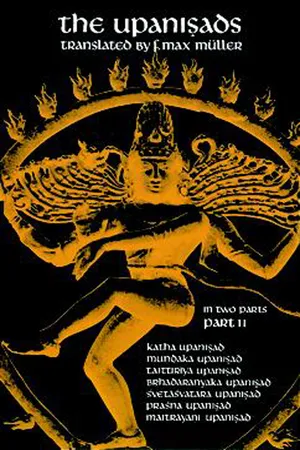
The Upanishads, Part II
eBook - ePub

The Upanishads, Part II

  1. 402 pages
  2. English
  3. ePUB (mobile friendly)
  4. Available on iOS & Android
eBook - ePub

The Upanishads, Part II

About this book

This two-volume set contains the famous Max Müller translation of the classical upanisads that first appeared as Volumes I and XV of the "Sacred Books of the East." It contains the full text, translated into English and annotated, of the following upanisads: Chandogya, Kena, Aitareya, Kaushitaki, Isa, Katha, Mundaka, Taittiriyaka, Brhadaranyaka, Svetasvatara, Prasna, and Maitriyana. These are the most important upanisads, the classical basic documents that have been accepted as authoritative by practically all Indian religious and philosophic traditions.
These remarkable mystical and philosophical treatises have not only created the later wisdom of India, they have also played an important part in Western thought. While one many be doubtful of their claimed influence upon the Neoplatonists and the medieval Christian mystics, they still have greatly influenced later developments in Western philosophy, from the time of Schlegel, Hegel, Schopenhauer, and Schelling. Probably written by various authors over several centuries before 500 B.C., they exhibit a remarkable uniformity of purpose: they strive — through parable, proverb, simile, and metaphor, and through a method similar to Socratic dialogue — to arrive at truth without erecting a formal system.
Although there have been other translations of the upanisads, this edition of Max Müller has long enjoyed the reputation of being the most scholarly. Not only does the translation contain the mature reflections of the greatest Indologist and Sanskritologist of the nineteenth century (who was also a profound philosopher in his own right), it also contains his long introductions of more than 250 pages, discussing the position of the upanisads and their value for the modern world.
These profound writings are necessary reading for all Indologists, philosophers, and historians of religion. They are also most valuable experiences for the modern reader who is interested in learning about a great field of thought with deep mystical and existential implications.

Frequently asked questions

Yes, you can cancel anytime from the Subscription tab in your account settings on the Perlego website. Your subscription will stay active until the end of your current billing period. Learn how to cancel your subscription.
No, books cannot be downloaded as external files, such as PDFs, for use outside of Perlego. However, you can download books within the Perlego app for offline reading on mobile or tablet. Learn more here.
Perlego offers two plans: Essential and Complete
  • Essential is ideal for learners and professionals who enjoy exploring a wide range of subjects. Access the Essential Library with 800,000+ trusted titles and best-sellers across business, personal growth, and the humanities. Includes unlimited reading time and Standard Read Aloud voice.
  • Complete: Perfect for advanced learners and researchers needing full, unrestricted access. Unlock 1.4M+ books across hundreds of subjects, including academic and specialized titles. The Complete Plan also includes advanced features like Premium Read Aloud and Research Assistant.
Both plans are available with monthly, semester, or annual billing cycles.
We are an online textbook subscription service, where you can get access to an entire online library for less than the price of a single book per month. With over 1 million books across 1000+ topics, we’ve got you covered! Learn more here.
Look out for the read-aloud symbol on your next book to see if you can listen to it. The read-aloud tool reads text aloud for you, highlighting the text as it is being read. You can pause it, speed it up and slow it down. Learn more here.
Yes! You can use the Perlego app on both iOS or Android devices to read anytime, anywhere — even offline. Perfect for commutes or when you’re on the go.
Please note we cannot support devices running on iOS 13 and Android 7 or earlier. Learn more about using the app.
Yes, you can access The Upanishads, Part II by F. Max Müller in PDF and/or ePUB format, as well as other popular books in Philosophy & Eastern Philosophy. We have over one million books available in our catalogue for you to explore.

Information

EASTERN PHILOSOPHY AND RELIGION

MOHAMMED: THE MAN AND His FAITH, Tor Andrae. (41136-2)
THE MYSTERY-RELIGIONS, S. Angus. (23124-0)
THE SERPENT POWER, Arthur Avalon. (23058-9)
CONFUCIAN ANALECTS, GREAT LEARNING, AND THE DOCTRINE OF THE MEAN, Confucius. (22746-4)
CHRISTIAN AND ORIENTAL PHILOSOPHY OF ART, Ananda K. Coomaraswamy. (20378-6)
MYTHS OF THE HINDUS AND BUDDHISTS, Ananda K. Coomaraswamy and Sister Nivedita. (21759-0)
BUDDHIST MAHAYANA TEXTS, edited by E. B. Cowell and Others. (25552-2)
THE MYSTERIES OF MITHRA, Franz Cumont. (20323-9)
STORIES OF THE BUDDHA: BEING SELECTIONS FROM THE JATAKA, Caroline A. F. Rhys Davids. (26149-2)
INITIATIONS AND INITIATES IN TIBET, Alexandra David-Neel. (Available in U.S. only.) (27579-5)
MAGIC AND MYSTERY IN TIBET, Alexandra David-Neel. (Available in U.S. only.) (22682-4)
THE GODS OF NORTHERN BUDDHISM: THEIR HISTORY AND ICONOGRAPHY, Alice Getty. (Available in U.S. only.) (25575-1)
JEWISH LITURGY AND ITS DEVELOPMENT, A. Z. Idelsohn. (28648-7)
THE I CHING: THE BOOK OF CHANGES, James Legge (ed.). (21062-6)
THE TEXTS OF TAOISM, James Legge (ed.). (20990-3, 20991-1) (Two-volume set)
THE WORKS OF MENCIUS, James Legge (ed.). (26375-4)
ETHICAL WRITINGS OF MAIMONIDES, Maimonides. (24522-5)
THE GUIDE FOR THE PERPLEXED, Moses Maimonides. (20351-4)
THE UPANISHADS. F. Max Müller (tr.). (20992-X, 20993-8) (Two-volume set)
THE BOOK OF TEA, Kakuzo Okakura. (20070-1)
THE SAKTAS: AN INTRODUCTORY AND COMPARATIVE STUDY, Ernest A. Payne. (29866-3)
THE LIFE OF BUDDHA AS LEGEND AND HISTORY, Edward J. Thomas. (41132-X)
TIBETAN BUDDHISM, L. A. Waddell. (20130-9)
OUTLINES OF CHINESE SYMBOLISM AND ART MOTIVES, C. A. S. Williams. (23372-3)


Paperbound unless otherwise indicated. Available at your book dealer, online at www.doverpublications.com, or by writing to Dept. 23, Dover Publications, Inc., 31 East 2nd Street, Mineola, NY 11501. For current price information or for free catalogs (please indicate field of interest), write to Dover Publications or log on to www.doverpubllcations.com and see every Dover book in print. Each year Dover publishes over 500 books on fine art, music, crafts and needlework, antiques, languages, literature, children’s books, chess, cookery, nature, anthropology, science, mathematics, and other areas.
Manufactured in the U.SA.
1
See Deussen, Vedânta, Einleitung, p. 38. Sa
e9780486157115_img_7749.gif
kara occasionally refers also to the Paingi, Agnirahasya, Gâbâla, and Nârâyanîya Upanishads.
2
Deussen, loc. cit. p. 82.
3
I state this on the authority of Professor Cowell. See also Fitzedward Hall, Index to the Bibliography of the Indian Philosophical Systems, pp. 116 and 236.
4
They have been published by Dr. Roer in the Bibliotheca Indica.
5
Dr. Weber’s statement that Sa
e9780486157115_img_7749.gif
kara wrote a commentary on the Kaushîtaki-upanishad has been corrected by Deussen, loc. cit. p. 39.
6
See Deussen, loc. cit, p. 39.
7
A long list of works ascribed to Sa
e9780486157115_img_7749.gif
kara may be seen in Regnaud, Philosophie de l’Inde, p. 34, chiefly taken from Fitzedward Hall’s Index of Indian Philosophical Systems.
8
See Tarkaratna’s Viâpana, p. 3, 1. 5.
9
India, What can it teach us? p. 360.
10
Mr. Nehemiah Goreh writes aprâkshyo, and this is no doubt the reading adopted by Roer in his edition of the Khândogya-upanishad in the Bibliotheca Indica, p. 384. In Sa
e9780486157115_img_7749.gif
kara’s commentary also the same form is given. Still grammar requires aprâksho.
11
The Pañkadasî (I, 20) distinguishes between manas and buddhi, by saying, mano vimarsarûpam syâd buddhih syân niskayâtmikâ, which places the difference between the two rather in the degree of certainty, ascribing deliberation to mana...

Table of contents

  1. DOVER BOOKS ON THE OCCULT
  2. Title Page
  3. The Upaniads
  4. Copyright Page
  5. Table of Contents
  6. INTRODUCTION.
  7. KATHA-UPANISHAD.
  8. MUNDAKA-UPANISHAD.
  9. TAITTIRÎYAKA-UPANISHAD.
  10. BRIHADÂRANYAKA-UPANISHAD.
  11. SVETÂSVATARA-UPANISHAD.
  12. PRASÑA-UPANISHAD.
  13. MAITRÂYANA-BRÂH MANA-UPANISHAD.
  14. TRANSLITERATION OF ORIENTAL ALPHABETS ADOPTED FOR THE TRANSLATIONS OF THE SACRED BOOKS OF THE EAST.
  15. A CATALOG OF SELECTED DOVER BOOKS IN ALL FIELDS OF INTEREST
  16. EASTERN PHILOSOPHY AND RELIGION