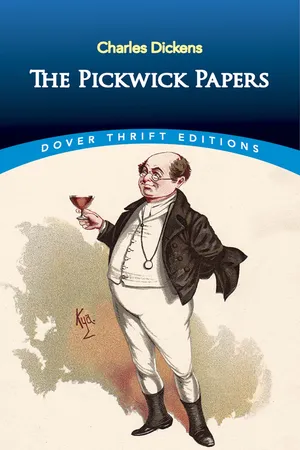
Mr. Pickwick, a convivial old gentleman, resolves that he and three other "Pickwickians" — Mr. Nathaniel Winkle, Mr. Augustus Snodgrass, and Mr. Tracy Tupman — should travel beyond London to add to their experiences of the quaint and curious phenomena of life. The friends traverse the countryside of Georgian England, where their comic misadventures include an encounter with highwaymen, romantic entanglements, and a challenge to a duel. Best of all, they meet Sam Weller, the Cockney valet whose comic philosophy forms the joyous soul of this picaresque romp.
Published serially in 1836–37, The Pickwick Papers was Dickens' first novel and its rousing success launched his lasting fame. This narrative of coach travel provides a vivid portrait of a world that was soon to vanish with the coming of the railroads. From the grim depiction of Fleet Prison to the exuberant account of the cricket match at Dingley Dell, the tales of the immortal Pickwick Club offer memorable scenes of nineteenth-century England.
- 704 pages
- English
- ePUB (mobile friendly)
- Available on iOS & Android
eBook - ePub
The Pickwick Papers
About this book
Information
CHAPTER I
THE PIGKWIGKIANS
THE first ray of light which illumines the gloom, and converts into a dazzling brilliancy that obscurity in which the earlier history of the public career of the immortal Pickwick would appear to be involved, is derived from the perusal of the following entry in the Transactions of the Pickwick Club, which the editor of these papers feels the highest pleasure in laying before his readers, as a proof of the careful attention, indefatigable assiduity, and nice discrimination, with which his search among the multifarious documents confided to him has been conducted.
“May 12, 1827. Joseph Smiggers, Esq., P.V.P.M.P.C.,1 presiding. The following resolutions unanimously agreed to:
“That this Association has heard read, with feelings of unmingled satisfaction, and unqualified approval, the paper communicated by Samuel Pickwick, Esq., G.C.M.P.C.,2 entitled Speculations on the Source of the Hampstead Ponds, with Some Observations on the Theory of Tittlebats; and that this Association does hereby return its warmest thanks to the said Samuel Pickwick, Esq., G.C.M.P.C, for the same.
“That while this Association is deeply sensible of the advantages which must accrue to the cause of science from the production to which they have just adverted—no less than from the unwearied researches of Samuel Pickwick, Esq., G.C.M.P.C, in Hornsey, High-gate, Brixton, and Camberwell—they cannot but entertain a lively sense of the inestimable benefits which must inevitably result from carrying the speculations of that learned man into a wider field, from extending his travels, and consequently enlarging his sphere of observation, to the advancement of knowledge, and the diffusion of learning.
“That, with the view just mentioned, this Association has taken into its serious consideration a proposal, emanating from the aforesaid Samuel Pickwick, Esq., G.C.M.P.C., and three other Pick-wickians hereinafter named, for forming a new branch of United Pickwickians, under the title of the Corresponding Society of the Pickwick Club.
“That the said proposal has received the sanction and approval of this Association.
“That the Corresponding Society of the Pickwick Club is therefore hereby constituted; and that Samuel Pickwick, Esq., G.C.M.P.C., Tracy Tupman, Esq., M.P.C., Augustus Snodgrass, Esq., M.P.C., and Nathaniel Winkle, Esq., M.P.C., are hereby nominated and appointed members of the same; and that they be requested to forward, from time to time, authenticated accounts of their journeys and investigations, of their observations of character and manners, and of the whole of their adventures, together with all tales and papers to which local scenery or associations may give rise, to the Pickwick Club, stationed in London.
“That this Association cordially recognises the principle of every member of the Corresponding Society defraying his own travelling expenses; and that k sees no objection whatever to the members of the said society pursuing their inquiries for any length of time they please, upon the same terms.
“That the members of the aforesaid Corresponding Society be, and are, hereby informed, that their proposal to pay the postage of their letters, and the carriage of their parcels, has been deliberated upon by this Association: that this Association considers such proposal worthy of the great minds from which it emanated, and that it hereby signifies its perfect acquiescence therein.”
A casual observer, adds the Secretary, to whose notes we are indebted for the following account—a casual observer might possibly have remarked nothing extraordinary In the bald head, and circular spectacles, which were intently turned towards his (the Secretary’s) face, during the reading of the above resolutions: to those who knew that the gigantic brain of Pickwick was working beneath that forehead, and that the beaming eyes of Pickwick were twinkling behind those glasses, the sight was indeed an interesting one. There sat the man who had traced to their source the mighty ponds of Hampstead, and agitated the scientific world with his Theory of Tittlebats, as calm and unmoved as the deep waters of the one on a frosty day, or as a solitary specimen of the other in the inmost recesses of an earthen jar. And how much more interesting did the spectacle become, when, starting into full life and animation, as a simultaneous call for “Pickwick” burst from his followers, that illustrious man slowly mounted into the Windsor chair, on which he had been previously seated, and addressed the club himself had founded. What a study for an artist did that exciting scene present! The eloquent Pickwick, with one hand gracefully concealed behind his coat-tails, and the other waving in air, to assist his glowing declamation; his elevated position revealing those tights and gaiters, which, had they clothed an ordinary man, might have passed without observation, but which, when Pickwick clothed them—if we may use the expression—inspired voluntary awe and respect; surrounded by the men who had volunteered to share the perils of his travels, and who were destined to participate in the glories of his discoveries. On his right hand sat Mr Tracy Tupman—the too susceptible Tupman, who to the wisdom and experience of maturer years superadded the enthusiasm and ardour of a boy, in the most interesting and pardonable of human weaknesses—love. Time and feeding had expanded that once romantic form; the black silk waistcoat had become more and more developed; inch by inch had the gold watch-chain beneath it disappeared from within the range of Tupman’s vision; and gradually had the capacious chin encroached upon the borders of the white cravat: but the soul of Tupman had known no change—admiration of the fair sex was still its ruling passion. On the left of his great leader sat the poetic Snodgrass, and near him again the sporting Winkle, the former poetically enveloped in a mysterious blue coat with a canine-skin collar, and the latter communicating additional lustre to a new green shooting-coat, plaid neckerchief, and closely fitted drabs.
Mr Pickwick’s oration upon this occasion, together with the debate thereon, is entered on the Transactions of the Club. Both bear a strong affinity to the discussions of other celebrated bodies; and, as it is always interesting to trace a resemblance between the proceedings of great men, we transfer the entry to these pages.
“Mr Pickwick observed (says the Secretary) that fame was dear to the heart of every man. Poetic fame was dear to the heart of his friend Snodgrass; the fame of conquest was equally dear to his friend Tupman; and the desire of earning fame in the sports of the field, the air, and the water, was uppermost in the breast of his friend Winkle. He (Mr Pickwick) would not deny that he was influenced by human passions, and human feelings (cheers)—possibly by human weaknesses—(loud cries of ‘No’); but this he would say, that if ever the fire of self-importance broke out in his bosom, the desire to benefit the human race in preference effectually quenched it. The praise of mankind was his Swing; philanthropy was his insurance office. (Vehement cheering.) He had felt some pride—he acknowledged it freely, and let his enemies make the most of it—he had felt some pride when he presented his Tittleba-tian Theory to the world; it might be celebrated or it might not. (A cry of ‘It is,’ and great cheering.) He would take the assertion of that honourable Pickwickian whose voice he had just heard—it was celebrated; but if the fame of that treatise were to extend to the furthest confines of the known world, the pride with which he should reflect on the authorship of that production would be as nothing compared with the pride with which he looked around him on this, the proudest moment of his existence. (Cheers.) He was a humble individual. (‘No, no.’) Still, he could not but feel that they had selected him for a service of great honour, and of some danger. Travelling was in a troubled state, and the minds of coach men were unsettled. Let them look abroad and contemplate the scenes which were enacting around them. Stage-coaches were up setting in all directions, horses were bolting, boats were overturning, and boilers were bursting. (Cheers—a voice ‘No.’) No! (Cheers.) Let that honourable Pickwickian who cried ‘No’ so loudly come for ward and deny it, if he could. (Cheers.) Who was it that cried ‘No’? (Enthusiastic cheering.) Was it some vain and disappointed man—he would not say haberdasher—(loud cheers)—who, jealous of the praise which had been—perhaps undeservedly—bestowed on his (Mr Pickwick’s) researches, and smarting under the censure which had been heaped upon his own feeble attempts at rivalry, now took this vile and calumnious mode of—
“Mr BLOTTON (of Aldgate) rose to order. Did the honourable Pickwickian allude to him? (Cries of ‘Order,’ ‘Chair,’ ‘Yes,’ ‘No,’ ‘Go on,’ ‘Leave off,’ etc.)
“Mr PICKWICK would not put up to be put down by clamour. He had alluded to the honourable gentleman. (Great excitement.)
“Mr BLOTTON would only say then, that he repelled the hon. gent.’s false and scurrilous accusation, with profound contempt. (Great cheering.) The hon. gent, was a humbug. (Immense confusion, and loud cries of ‘Chair,’ and ‘Order.’)
“Mr A. SNODGRASS rose to order. He threw himself upon the chair. (‘Hear.’) He wished to know whether this disgraceful contest between two members of that club should be allowed to continue. (‘Hear, hear.’)
“The CHAIRMAN was quite sure the hon. Pickwickian would withdraw the expression he had just made use of.
“Mr BLOTTON, with all possible respect for the chair, was quite sure he would not.
“The CHAIRMAN felt it his imperative duty to demand of the honourable gentleman, whether he had used the expression which had just escaped him in a common sense.
“Mr BLOTTON had no hesitation in saying that he had not—he had used the word in its Pickwickian sense. (‘Hear, hear.’) He was bound to acknowledge that, personally, he entertained the highest regard and esteem for the honourable gentleman; he had merely considered him a humbug in a Pickwickian point of view. (‘Hear, hear.’)
“Mr PICKWICK felt much gratified by the fair, candid, and full explanation of his honourable friend. He begged it to be at once understood, that his own observations had been merely intended to bear a Pickwickian construction. (Cheers.)”
Here the entry terminates, as we have no doubt the debate did also, after arriving at such a highly satisfactory and intelligible point. We have no official statement of the facts which the reader will find recorded in the next chapter, but they have been carefully collated from letters and other MS. authorities, so unquestionably genuine as to justify their narration in a connected form.
1 Perpetual Vice-President—Member Pickwick Club.
2 General Chairman—Member Pickwick Club.
CHAPTER II
THE FIRST DAY’S JOURNEY, AND THE FIRST EVENING’S ADVENTURES; WITH THEIR. CONSEQUENCES
THAT punctual servant of all work, the sun, had just risen, and begun to strike a light on the morning of the thirteenth of May, one thousand eight hundred and twenty-seven, when Mr Samuel Pickwick burst like another sun from his slumbers, threw open his chamber window, and looked out upon the world beneath. Goswell Street was at his feet, Goswell Street was on his right hand—as far as the eye could reach, Goswell Street extended on his left; and the opposite side of Goswell Street was over the way. “Such,” thought Mr Pickwick, “are the narrow views of those philosophers who, content with examining the things that lie before them, look not to the truths which are hidden beyond. As well might I be content to gaze on Goswell Street for ever, without one effort to penetrate to the hidden countries which on every side surround it.” And having given vent to this beautiful reflection, Mr Pickwick proceeded to put himself into his clothes, and his clothes into his portmanteau. Great men are seldom over scrupulous in the arrangement of their attire; the operation of shaving, dressing, and coffee-imbibing was soon performed: and in another hour, Mr Pickwick, with his portmanteau in his hand, his telescope in his greatcoat-pocket, and his notebook in his waistcoat, ready for the reception of any discoveries worthy of being noted down, had arrived at the coach-stand in St Martin’s-le-Grand.
“Cab!” said Mr Pickwick.
“Here you are, sir,” shouted a strange specimen of the human race, in a sackcloth coat, and apron of the same, who with a brass label and number round his neck, looked as if he were catalogued in some collection of rarities. This was the waterman. “Here you are, sir. Now, then, fust cab!” And the first cab having been fetched from the public-house, where he had been smoking his first pipe, Mr Pickwick and his portmanteau were thrown into the vehicle.
“Golden Cross,” said Mr Pickwick.
“Only a bob’s vorth, Tommy,” cried the driver, sulkily, for the information of his friend the waterman, as the cab drove off.
“How old is that horse, my friend?” inquired Mr Pickwick, rubbing his nose with the shilling he had reserved for the fare.
“Forty-two,” replied the driver, eyeing him askant.
“What!” ejaculated Mr Pickwick, laying his hand upon his notebook. The driver reiterated his former statement. Mr Pickwick looked very hard at the man’s face, but his features were immovable, so he noted down the fact forthwith.
“And how long do you keep him out at a time?” inquired Mr Pickwick, searching for further information.
“Two or three veeks,” replied the man.
“Weeks!” said Mr Pickwick in astonishment—and out came the notebook again.
“He lives at Pentonwil when he’s at home,” observed the driver, coolly, “but we seldom takes him home, on account of his veakness.”
“On account of his weakness!” reiterated the perplexed Mi Pickwick.
“He always falls down when he’s took out o’ the cab,” continued the driver, “but when he’s in it, we bears him up werry tight, and takes him in werry short, so as he can’t werry well fall down; and we’ve got a pair o’ precious large wheels on, so ven he does move, they run after him, and he must go on—he can’t help it.”
Mr Pickwick entered every word of this statement in his notebook, with the view of communicating it to the club, as a singular instance of the tenacity of life in horses, under trying circumstances. The entry was scarcely completed when they reached the Golden Cross. Down jumped the driver, and out got Mr Pickwick. Mr Tupman, Mr Snodgrass, and Mr Winkle, who had been anxiously waiting the arrival of their illustrious leader, crowded to welcome him.
“Here’s your fare,” said Mr Pickwick, holding out the shilling to the driver.
What was the learned man’s astonishment, when that unaccountable person flung the money on the pavement, and requested in figurative terms to be allowed the pleasure of fighting him (Mr Pickwick) for the amount!
“You are mad,” said Mr Snodgrass.
“Or drunk,” said Mr Winkle.
“Or both,” said Mr Tupman.
“Come on!” said the cab-driver, sparring away like clockwork. “Come on—all four on you.”
“Here’s a lark!” shouted half a dozen hackney-coachmen. “Go to vork, Sam”—and they crowded with great glee round the party.
“Wha...
Table of contents
- Cover
- Title Page
- Copyright page
- Preface
- Contents
- Characters
- Chapter I. The Pigkwickians
- Chapter II. The First Day’s Journey, and the First Evening’s Adventures; with their Consequences
- Chapter III. A New Acquaintance. The Stroller’s Tale. A disagreeable Interruption, and an Unpleasant Encounter
- Chapter IV. A Field-day and Bivouac. More New Friends. An Invitation to the Country
- Chapter V. A Short One. Showing, among Other Matters, how Mr Pickwick undertook to drive, and Mr Winkle to ride; and how they Both did it
- Chapter VI. An Old-fashioned Card party. The Clergyman’s Verses. The Story of the Convict’s Return
- Chapter VII. How Mr Winkle, instead of shooting at the Pigeon and killing the crow, shot at the crow and wounded the Pigeon; how the Dingley Dell Cricket Club played All-muggleton, and how all-muggleton dined at the dingley Dell Expense: with other Interesting and Instructive Matters
- Chapter VIII. Strongly Illustrative of the Position, that the Course of True Love is not a Railway
- Chapter IX. A Discovery and a Chase
- Chapter X. Clearing up All Doubts (if any existed) of the Disinterestedness of Mr Jingle’s Character
- Chapter XI. Involving another Journey, and an Antiquarian Discovery. Recording Mr Pickwick’s Determination to be present at an Election; and containing a Manuscript of the Old Clergyman’s
- Chapter XII. Descriptive of a Very Important Proceeding on the Part of Mr Pickwick; no less an Epoch in his Life, than in this History
- Chapter XIII. Some Account of Eatanswill; of the State of Parties therein; and of the election of a member to serve in parliament for that Ancient, Loyal, and Patriotic Borough
- Chapter XIV. Comprising a Brief Description of the Company at the Peacock assembled; and a Tale told by a Bagman
- Chapter XV. In which is given a Faithful Portraiture of Two Distinguished Persons: and an Accurate Description of a Public Breakfast in their House and Grounds; which Public Breakfast leads to the Recognition of an old Acquaintance, and the Commencement of another Chapter
- Chapter XVI. Too full of Adventure to be briefly described
- Chapter XVII. Showing that an Attack of Rheumatism, in Some Cases, acts as a Quickener to Inventive Genius
- Chapter XVIII. Briefly illustrative of two Points;—first, the Power of Hysterics, and, secondly, the Force of Circumstances
- Chapter XIX. A Pleasant Day, with an Unpleasant Termination
- Chapter XX. Showing how Dodson and Fogg were Men of Business, and their Clerks Men of Pleasure; and how an Affecting Interview took place between Mr Weller and his Long-lost Parent; showing also what Choice Spirits assembled at the Magpie and Stump, and what a Capital Chapter the Next One will be
- Chapter XXI. In which the Old Man launches forth into his Favourite Theme, and relates a Story about a Queer Client
- Chapter XXII. Mr Pickwick journeys to Ipswich, and meets with a Romantic Adventure with a Middle-aged Lady in Yellow Curl-papers
- Chapter XXIII. In which Mr Samuel Weller begins to devote his Energies to the Return Match between himself and Mr Trotter
- Chapter XXIV. Wherein Mr Peter Magnus grows Jealous, and the Middle-aged Lady Apprehensive, which brings the Pickwickians within the Grasp of the law
- Chapter XXV. Showing, among a Variety of Pleasant Matters, how Majestic and Impartial Mr Nupkins was; and how Mr Weller returned Mr Job Trotter’s Shuttlecock as heavily as it came. With another Matter, which will be found in its Place
- Chapter XXVI. Which contains a Brief Account of the Progress of the Action of Bardell against Pickwick
- Chapter XXVII. Samuel Weller makes a Pilgrimage to Dorking, and beholds his Mother-in-law
- Chapter XXVIII. A Good-humoured Christmas Chapter, containing an Account of a Wedding, and some other Sports beside: which although in their Way, even as Good Customs as Marriage itself, are not quite so religiously kept up in these Degenerate Times
- Chapter XXIX. The Story of the Goblins who stole a Sexton
- Chapter XXX. How the pickwickians made and cultivated the Acquaintance of a Couple of Nice Young Men belonging to one of the Liberal Professions; how they disported themselves on the Ice; and how their First Visit came to a Conclusion
- Chapter XXXI. Which is all about the Law, and Sundry Great Authorities learned therein
- Chapter XXXII. Describes, far more fully than the Court Newsman ever did, a Bachelor’s Party, given by Mr Bob Sawyer at his Lodgings in the Borough
- Chapter XXXIII. Mr Weller the Elder Delivers some Critical Sentiments respecting literary Composition; and, assisted by his Son Samuel, pays a Small Instalment of Retaliation to the Account of the Reverend Gentleman with the Red Nose
- Chapter XXXIV. Is wholly devoted to a Full and Faithful Report of the Memorable Trial of Bardell against Pickwick
- Chapter XXXV. In which Mr Pickwick thinks he had better go to Bath; and goes accordingly
- Chapter XXXVI. The Chief Features of which, will be found to be an Authentic Version of the Legend of Prince Bladud, and a most Extraordinary Calamity that befell Mr Winkle
- Chapter XXXVII. Honourably accounts for Mr Weller’s Absence, by describing a SoirÉe to which he was invited and went; also relates how he was entrusted by Mr Pickwick with a Private Mission of Delicacy and Importance
- Chapter XXXVIII. How Mr Winkle, when he stepped out of the Frying-pan, walked gently and comfortably into the Flre
- Chapter XXXIX. Mr Samuel Weller, being entrusted with a Mission of Love, proceeds to execute it; with what success will herein-after appear
- Chapter XL. Introduces Mr Pickwick to a New and not Uninteresting Scene in the Great Drama of Life
- Chapter XLI. What befell Mr Pickwick when he got into the Fleet; what Prisoners he saw there; and how he passed the Night
- Chapter XLII. Illustrative, like the Preceding one, of the Old Proverb that Adversity brings a Man acquainted with. Strange Bed-fellows. Likewise containing Mr Pickwick’s Extraordinary and Startling Announcement to Mr Samuel Weller
- Chapter XLIII. Showing how Mr Samuel Weller got into Difficulties
- Chapter XLIV. Treats of Divers Little Matters which occurred in the Fleet and of Mr Winkle’s Mysterious Behaviour; and showshow the Poor Chancery Prisoner obtained his Release at last
- Chapter XLV. Descriptive of an Affecting Interview between Mr Samuel Weller and a Family Party. Mr Pickwick makes a Tour of the Diminutive World he inhabits, and resolves to mix with it, in future, as little as possible
- Chapter XLVI. Records a Touching Act of Delicate Feeling, not unmixed with Pleasantry, achieved and performed by Messrs Dodson and Fogg
- Chapter XLVII. Is chiefly devoted to Matters of Business, and the Temporal Advantage of Dodson and Fogg. Mr Winkle reappears under Extraordinary Circumstances. Mr Pickwick’s Benevolence proves Stronger than his Obstinacy
- Chapter XLVIII. Relates how Mr Pickwick, with the Assistance of Samuel Weller, essayed to soften the Heart of Mr Benjamin Allen, and to mollify the Wrath of Mr Robert Sawyer 573
- Chapter XLIX. Containing the Story of the Bagman’s Uncle
- Chapter L. How Mr Pickwick sped upon his Mission, and how he was reinforced in the Outset by a Most Unexpected Auxiliary
- Chapter LI. In which Mr Pickwick encounters an Old Acquaintance. To which Fortunate Circumstance the Reader is mainly indebted for Matter of Thrilling interest herein set down, concerning Two Great Public Men of Might and Power
- Chapter LII. Involving a Serious Change in the Weller Family, and the Untimely Downfall of the Red-nosed Mr Stiggins
- Chapter LIII. Comprising the Final Exit of Mr Jingle and Job Trotter; with a Great Morning of Business in Gray’s Inn Square. Concluding with a Double Knock at Mr Perker’s Door
- Chapter LIV. Containing Some Particulars relative to the Double Knock, and other Matters: among which Certain Interesting Disclosures relative to Mr Snodgrass and a Young Lady are by no means Irrelevant to this History
- Chapter LV. Mr Solomon Pell, assisted by a Select Committee of Coachmen, arranges the Affairs of the Elder Mr Weller
- Chapter LVI. An Important Conference takes place between Mr Pickwick and Samuel Weller, at which his Parent assists. An Old Gentleman in a Snuff-coloured Suit arrives unexpectedly
- Chapter LVII. In which the Pickwick Club is finally dissolved, and Everything concluded to the Satisfaction of Everybody
Trusted by 375,005 students
Access to over 1.5 million titles for a fair monthly price.
Study more efficiently using our study tools.
Frequently asked questions
Yes, you can cancel anytime from the Subscription tab in your account settings on the Perlego website. Your subscription will stay active until the end of your current billing period. Learn how to cancel your subscription
No, books cannot be downloaded as external files, such as PDFs, for use outside of Perlego. However, you can download books within the Perlego app for offline reading on mobile or tablet. Learn how to download books offline
Perlego offers two plans: Essential and Complete
- Essential is ideal for learners and professionals who enjoy exploring a wide range of subjects. Access the Essential Library with 800,000+ trusted titles and best-sellers across business, personal growth, and the humanities. Includes unlimited reading time and Standard Read Aloud voice.
- Complete: Perfect for advanced learners and researchers needing full, unrestricted access. Unlock 1.5M+ books across hundreds of subjects, including academic and specialized titles. The Complete Plan also includes advanced features like Premium Read Aloud and Research Assistant.
We are an online textbook subscription service, where you can get access to an entire online library for less than the price of a single book per month. With over 1.5 million books across 990+ topics, we’ve got you covered! Learn about our mission
Look out for the read-aloud symbol on your next book to see if you can listen to it. The read-aloud tool reads text aloud for you, highlighting the text as it is being read. You can pause it, speed it up and slow it down. Learn more about Read Aloud
Yes! You can use the Perlego app on both iOS and Android devices to read anytime, anywhere — even offline. Perfect for commutes or when you’re on the go.
Please note we cannot support devices running on iOS 13 and Android 7 or earlier. Learn more about using the app
Please note we cannot support devices running on iOS 13 and Android 7 or earlier. Learn more about using the app
Yes, you can access The Pickwick Papers by Charles Dickens in PDF and/or ePUB format, as well as other popular books in Literature & Classics. We have over 1.5 million books available in our catalogue for you to explore.