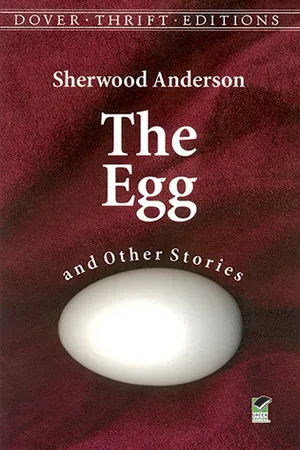
Published two years after the innovative, influential 1919 masterpiece Winesburg, Ohio, this collection of short stories solidified the author’s reputation as a major American writer. Despite their narrative simplicity (similar in style to the work of Hemingway, who was highly influenced by Anderson’s technique), these stories explore intriguing psychological depths, redolent with personal epiphanies, erotic undercurrents, and sudden eruptions of passion among seemingly repressed, inarticulate Midwesterners.
- 128 pages
- English
- ePUB (mobile friendly)
- Available on iOS & Android
eBook - ePub
The Egg and Other Stories
About this book
Information
Print ISBN
9780486414119
Subtopic
American LiteratureOUT OF NOWHERE INTO NOTHING
I
ROSALIND WESCOTT, a tall strong looking woman of twenty-seven, was walking on the railroad track near the town of Willow Springs, Iowa. It was about four in the afternoon of a day in August, and the third day since she had come home to her native town from Chicago, where she was employed.
At that time Willow Springs was a town of about three thousand people. It has grown since. There was a public square with the town hall in the centre and about the four sides of the square and facing it were the merchandising establishments. The public square was bare and grassless, and out of it ran streets of frame houses, long straight streets that finally became country roads running away into the flat prairie country.
Although she had told everyone that she had merely come home for a short visit because she was a little homesick, and although she wanted in particular to have a talk with her mother in regard to a certain matter, Rosalind had been unable to talk with anyone. Indeed she had found it difficult to stay in the house with her mother and father and all the time, day and night, she was haunted by a desire to get out of town. As she went along the railroad tracks in the hot afternoon sunshine she kept scolding herself. “I’ve grown moody and no good. If I want to do it why don’t I just go ahead and not make a fuss,” she thought.
For two miles the railroad tracks, eastward out of Willow Springs, went through corn fields on a flat plain. Then there was a little dip in the land and a bridge over Willow Creek. The Creek was altogether dry now but trees grew along the edge of the grey streak of cracked mud that in the fall, winter and spring would be the bed of the stream. Rosalind left the tracks and went to sit under one of the trees. Her cheeks were flushed and her forehead wet. When she took off her hat her hair fell down in disorder and strands of it clung to her hot wet face. She sat in what seemed. a kind of great bowl on the sides of which the corn grew rank. Before her and following the bed of the stream there was a dusty path along which cows came at evening from distant pastures. A great pancake formed of cow dung lay nearby. It was covered with grey dust and over it crawled shiny black beetles. They were rolling the dung into balls in preparation for the germination of a new generation of beetles.
Rosalind had come on the visit to her home town at a time of the year when everyone wished to escape from the hot dusty place. No one had expected her and she had not written to announce her coming. One hot morning in Chicago she had got out of bed and had suddenly begun packing her bag, and on that same evening there she was in Willow Springs, in the house where she had lived until her twenty-first year, among her own people. She had come up from the station in the hotel bus and had walked into the Wescott house unannounced. Her father was at the pump by the kitchen door and her mother came into the living room to greet her wearing a soiled kitchen apron. Everything in the house was just as it always had been. “I just thought I would come home for a few days,” she said, putting down her bag and kissing her mother.
Ma and Pa Wescott had been glad to see their daughter. On the evening of her arrival they were excited and a special supper was prepared. After supper Pa Wescott went up town as usual, but he stayed only a few minutes. “I just want to run to the postoffice and get the evening paper,” he said apologetically. Rosalind’s mother put on a clean dress and they all sat in the darkness on the front porch. There was talk, of a kind. “Is it hot in Chicago now? I’m going to do a good deal of canning this fall. I thought later I would send you a box of canned fruit. Do you live in the same place on the North Side? It must be nice in the evening to be able to walk down to the park by the lake.”

Rosalind sat under the tree near the railroad bridge two miles from Willow Springs and watched the tumble bugs at work. Her whole body was hot from the walk in the sun and the thin dress she wore clung to her legs. It was being soiled by the dust on the grass under the tree.
She had run away from town and from her mother’s house. All during the three days of her visit she had been doing that. She did not go from house to house to visit her old schoolgirl friends, the girls who unlike herself had stayed in Willow Springs, had got married and settled down there. When she saw one of these women on the street in the morning, pushing a baby carriage and perhaps followed by a small child, she stopped. There was a few minutes of talk. “It’s hot. Do you live in the same place in Chicago? My husband and I hope to take the children and go away for a week or two. It must be nice in Chicago where you are so near the lake.” Rosalind hurried away.
All the hours of her visit to her mother and to her home town had been spent in an effort to hurry away.
From what? Rosalind defended herself. There was something she had come from Chicago hoping to be able to say to her mother. Did she really want to talk with her about things? Had she thought, by again breathing the air of her home town, to get strength to face life and its difficulties?
There was no point in her taking the hot uncomfortable trip from Chicago only to spend her days walking in dusty country roads or between rows of cornfields in the stifling heat along the railroad tracks.
“I must have hoped. There is a hope that cannot be fulfilled,” she thought vaguely.
Willow Springs was a rather meaningless, dreary town, one of thousands of such towns in Indiana, Illinois, Wisconsin, Kansas, Iowa, but her mind made it more dreary.
She sat under the tree by the dry bed of Willow Creek thinking of the street in town where her mother and father lived, where she had lived until she had become a woman. It was only because of a series of circumstances she did not live there now. Her one brother, ten years older than herself, had married and moved to Chicago. He had asked her to come for a visit and after she got to the city she stayed. Her brother was a traveling salesman and spent a good deal of time away from home. “Why don’t you stay here with Bess and learn stenography,” he asked. “If you don’t want to use it you don’t have to. Dad can look out for you all right. I just thought you might like to learn.”

“That was six years ago,” Rosalind thought wearily. “I’ve been a city woman for six years.” Her mind hopped about. Thoughts came and went. In the city, after she became a stenographer, something for a time awakened her. She wanted to be an actress and went in the evening to a dramatic school. In an office where she worked there was a young man, a clerk. They went out together, to the theatre or to walk in the park in the evening. They kissed.
Her thoughts came sharply back to her mother and father, to her home in Willow Springs, to the street in which she had lived until her twenty-first year.
It was but an end of a street. From the windows at the front of her mother’s house six other houses could be seen. How well she knew the street and the people in the houses! Did she know them? From her eighteenth and until her twenty-first year she had stayed at home, helping her mother with the housework, waiting for something. Other young women in town waited just as she did. They like herself had graduated from the town high school and their parents had no intention of sending them away to college. There was nothing to do but wait. Some of the young women—their mothers and their mothers’ friends still spoke of them as girls—had young men friends who came to see them on Sunday and perhaps also on Wednesday or Thursday evenings. Others joined the church, went to prayer meetings, became active members of some church organization. They fussed about.
Rosalind had done none of these things. All through those three trying years in Willow Springs she had just waited. In the morning there was the work to do in the house and then, in some way, the day wore itself away. In the evening her father went up town and she sat with her mother. Nothing much was said. After she had gone to bed she lay awake, strangely nervous, eager for something to happen that never would happen. The noises of the Wescott house cut across her thoughts. What things went through her mind!
There was a procession of people always going away from her. Sometimes she lay on her belly at the edge of a ravine. Well it was not a ravine. It had two walls of marble and on the marble face of the walls strange figures were carved. Broad steps led down—always down and away. People walked along the steps, between the marble walls, going down and away from her.
What people! Who were they? Where did they come from? Where were they going? She was not asleep but wide awake. Her bedroom was dark. The walls and ceiling of the room receded. She seemed to hang suspended in space, above the ravine—the ravine with walls of white marble over which strange beautiful lights played.
The people who went down the broad steps and away into infinite distance—they were men and women. Sometimes a young girl like herself but in some way sweeter and purer than herself, passed alone. The young girl walked with a swinging stride, going swiftly and freely like a beautiful young animal. Her legs and arms were like the slender top branches of trees swaying in a gentle wind. She also went down and away.
Others followed along the marble steps. Young boys walked alone. A dignified old man followed by a sweet faced woman passed. What a remarkable man! One felt infinite power in his old frame. There were deep wrinkles in his face and his eyes were sad. One felt he knew everything about life but had kept something very precious alive in himself. It was that precious thing that made the eyes of the woman who followed him burn with a strange fire. They also went down along the steps and away.
Down and away along the steps went others—how many others, men and women, boys and girls, single old men, old women who leaned on sticks and hobbled along.
In the bed in her father’s house as she lay awake Rosalind’s head grew light. She tried to clutch at something, understand something.
She couldn’t. The noises of the house cut across her waking dream. Her father was at the pump by the kitchen door. He was pumping a pail of water. In a moment he would bring it into the house and put it on a box by the kitchen sink. A little of the water would slop over on the floor. There would be a sound like a child’s bare foot striking the floor. Then her father would go to wind the clock. The day was done. Presently there would be the sound of his heavy feet on the floor of the bedroom above and he would get into bed to lie beside Rosalind’s mother.
The night noises of her father’s house had been in some way terrible to the girl in the years when she was becoming a woman. After chance had taken her to the city she never wanted to think of them again. Even in Chicago where the silence of nights was cut and slashed by a thousand noises, by automobiles whirling through the streets, by the belated footsteps of men homeward bound along the cement sidewalks after midnight, by the shouts of quarreling men drunk on summer nights, even in the great hubbub of noises there was comparative quiet. The insistent clanging noises of the city nights were not like the homely insistent noises of her father’s house. Certain terrible truths about life did not abide in them, they did not cling so closely to life and did not frighten as did the noises in the one house on the quiet street in the town of Willow Springs. How often, there in the city, in the midst of the great noises she had fought to escape the little noises! Her father’s feet were on the steps leading into the kitchen. Now he was putting the pail of water on the box by the kitchen sink. Upstairs her mother’s body fell heavily into bed. The visions of the great marble-lined ravine down along which went the beautiful people flew away. There was the little slap of water on the kitchen floor. It was like a child’s bare foot striking the floor. Rosalind wanted to cry out. Her father closed the kitchen door. Now he was winding the clock. In a moment his feet would be on the stairs—
There were six houses to be seen from the windows of the Wescott house. In the winter smoke from six brick chimneys went up into the sky. There was one house, the next one to the Wescott’s place, a small frame affair, in which lived a man who was thirty-five years old when Rosalind became a woman of twenty-one and went away to the city. The man was unmarried and his mother, who had been his housekeeper, had died during the year in which Rosalind graduated from the high school. After that the man lived alone. He took his dinner and supper at the hotel, down town on the square, but he got his own breakfast, made his own bed and swept out his own house. Sometimes he walked slowly along the street past the Wescott house when Rosalind sat alone on the front porch. He raised his hat and spoke to her. Their eyes met. He had a long, hawk-like nose and his hair was long and uncombed.
Rosalind thought about him sometimes. It bothered her a little that he sometimes went stealing softly, as though not to disturb her, across her daytime fancies.
As she sat that day by the dry creek bed Rosalind thought about the bachelor, who had now passed the age of forty and who lived on the street where she had lived during her girlhood. His house was separated from the Wescott house by a picket fence. Sometimes in the morning he forgot to pull his blinds and Rosalind, busy with the housework in her father’s house, had seen him walking about in his underwear. It was—uh, one could not think of it.
The man’s name was Melville Stoner. He had a small income and did not have to work. On some days he did not leave his house and go to the hotel for his meals but sat all day in a chair with his nose buried in a book.
There was a house on the street occupied by a widow who raised chickens. Two or three of her hens were what the people who lived on the street called ‘high flyers.’ They flew over the fence of the chicken yard and escaped and almost always they came at once into the yard of the bachelor. The neighbors laughed about it. It was significant, they felt. When the hens had come into the yard of the bachelor, Stoner, the widow with a stick in her hand ran after them. Melville Stoner came out of his house and stood on a little porch in front. The widow ran through the front gate waving her arms wildly and the hens made a great racket and flew over the fence. They ran down the street toward the widow’s house. For a moment she stood by the Stoner gate. In the summer time when the windows of the Wescott house were open Rosalind could hear what the man and woman said to each other. In Willow Springs it was not thought proper for an unmarried woman to stand talking to an unmarried man near the door of his bachelor establishment. The widow wanted to observe the conventions. Still she did linger a moment, her bare arm resting on the gate post. What bright eager little eyes she had! “If those hens of mine bother you I wish you would catch them and kill them,” she said fiercely. “I am always glad to see them coming along the road,” Melville Stoner replied, bowing. Rosalind thought he was making fun of the widow. She liked him for that. “I’d never see you if you did not have to come here after your hens. Don’t let anything happen to them,” he said, bowing again.
For a moment the man and woman lingered looking into each other’s eyes. From one of the windows of the Wescott house Rosalind watched the woman. Nothing more was said. There was something about the woman she had not understood—well the widow’s senses were being fed. The developing woman in the house next door had hated her.

Rosalind jumped up from under the tree and climbed up the railroad embankment. She thanked the gods she had been lifted out of the life of the town of Willow Springs and that chance had set her down to live in a city. “Chicago is far from beautiful. People say it is just a big noisy dirty village and perhaps that’s what it is, but there is something alive there,” she thought. In Chicago, or at least during the last two or three years of her life there, Rosalind felt she had learned a little something of life. She had read books for one thing, such books as did not come to Willow Springs, books that Willow Springs knew nothing about, she had gone to hear the Symphony Orchestra, she had begun to understand something of the possibility of line and color, had heard intelligent, understanding men speak of these things. In Chicago, in the midst of the twisting squirming millions of men and women there were voices. One occasionally saw men or at least heard of the existence of men who, like the beautiful old man who had walked away down the marble stairs in the vision of her girlhood nights, had kept some precious thing alive in themselves.
And there was something else—it was the most important thing of all. For the last two years of her life in Chicago she had spent hours, days in the presence of a man to whom she could talk. The talks had awakened her. She felt they had made her a woman, had matured her.
“I know what these people here in Willow Springs are like and what I would have been like had I stayed here,” she thought. She felt relieved and almost happy. She had come home at a crisis of her own life hoping to be able to talk a little with her mother, or if talk proved impossible hoping to get some sense of sisterhood by being in her presence. She had thought there was something buried away, deep within every woman, that at a certain call would run out to other women. Now she felt that the hope, the dream, the desire she had cherished was altogether futile. Sitting in the great flat bowl in the midst of the corn lands two miles from her home town where no breath of air stirred and seeing the beetles at their work of preparing to propagate a new generation of beetles, while she thought of the town and its people, had settled something for her. Her visit to Willow Springs had come to something after all.
Rosalind’s figure had still much of the spring and swing of youth in it. Her legs were strong and her shoulders broad. She went swinging along the railroad track toward town, going westward. The sun had begun to fall rapidly down the sky. Away over the tops of the corn in one of the great fields she could see in the distance to where a man was driving a motor along a dusty road. The wheels of the car kicked up dust through which the sunlight played. The floating cloud of dust became a shower of gold that settled down over the fields. “When a woman most wants what is best and truest in another woman, even in her own mother, she isn’t likely to find it,” she thought grimly. “There are certain things every woman has to find out for herself, there is a road she must travel alone. It may only lead to some more ugly and terrible place, but if she doesn’t want death to overtake her and live within her while her body is still alive she must set out on that road.”
Rosalind walked for a mile along the railroad track and then stopped. A freight train had gone eastward as she sat under the tree by the creek bed and now, there beside the tracks, in the grass was the body of a man. It lay still, the face buried in the deep burned grass. At once she concluded the man had been struck and killed by the train. The body had been thrown thus aside. All her thoughts went away and she turned and started to tiptoe away, stepping carefully along the railroad ties, making no noise. Then she stopped again. The man in the grass might not be dead, only hurt, terribly hurt. It would not do to leave him there. She imagined him mutilated but still struggling for life and herself trying to help him. She crept back along the ties. The man’s legs were not twisted and beside him lay his hat. It was as though he had put it there before lying down to sleep, but a man did not sleep with his face buried in the grass in such a hot uncomfortable place. She drew nearer. “O, you Mister,” she called, “O, you—are you hurt?”
The man in the grass sat up and looked at her. He laughed. It was Melville Stoner, the man of whom she had just been thinking and in thinking of whom she had come to certain settled conclusions regarding the futil...
Table of contents
- Dover Thrift Editions Fiction
- Title Page
- Copyright Page
- Note
- Table of Contents
- I WANT TO KNOW WHY
- SEEDS
- THE OTHER WOMAN
- THE EGG
- UNLIGHTED LAMPS
- SENILITY
- THE MAN IN THE BROWN COAT
- BROTHERS
- THE DOOR OF THE TRAP
- THE NEW ENGLANDER
- WAR
- MOTHERHOOD
- OUT OF NOWHERE INTO NOTHING
Trusted by 375,005 students
Access to over 1.5 million titles for a fair monthly price.
Study more efficiently using our study tools.
Frequently asked questions
Yes, you can cancel anytime from the Subscription tab in your account settings on the Perlego website. Your subscription will stay active until the end of your current billing period. Learn how to cancel your subscription
No, books cannot be downloaded as external files, such as PDFs, for use outside of Perlego. However, you can download books within the Perlego app for offline reading on mobile or tablet. Learn how to download books offline
Perlego offers two plans: Essential and Complete
- Essential is ideal for learners and professionals who enjoy exploring a wide range of subjects. Access the Essential Library with 800,000+ trusted titles and best-sellers across business, personal growth, and the humanities. Includes unlimited reading time and Standard Read Aloud voice.
- Complete: Perfect for advanced learners and researchers needing full, unrestricted access. Unlock 1.5M+ books across hundreds of subjects, including academic and specialized titles. The Complete Plan also includes advanced features like Premium Read Aloud and Research Assistant.
We are an online textbook subscription service, where you can get access to an entire online library for less than the price of a single book per month. With over 1.5 million books across 990+ topics, we’ve got you covered! Learn about our mission
Look out for the read-aloud symbol on your next book to see if you can listen to it. The read-aloud tool reads text aloud for you, highlighting the text as it is being read. You can pause it, speed it up and slow it down. Learn more about Read Aloud
Yes! You can use the Perlego app on both iOS and Android devices to read anytime, anywhere — even offline. Perfect for commutes or when you’re on the go.
Please note we cannot support devices running on iOS 13 and Android 7 or earlier. Learn more about using the app
Please note we cannot support devices running on iOS 13 and Android 7 or earlier. Learn more about using the app
Yes, you can access The Egg and Other Stories by Sherwood Anderson in PDF and/or ePUB format. We have over 1.5 million books available in our catalogue for you to explore.