One of the world's greatest novelists, Leo Tolstoy (1828–1910) also wrote numerous excellent short stories, three of which are contained in this volume. "The Kreutzer Sonata" (1891) is a penetrating study of jealousy as well as a splenetic complaint about the way in which society educates young men and women in matters of sex. In "The Death of Ivan Ilych" (1886), a symbolic Everyman discovers the inner light of faith and love only when confronted by death. "How Much Land Does a Man Need?" (1886) is a simple, didactic story of peasant life, written by Tolstoy in the wake of a spiritual crisis. All three tales offer readers a splendid introduction to Tolstoy's work as well as the focused delights of the short story form brought to a pinnacle in the hands of a master.
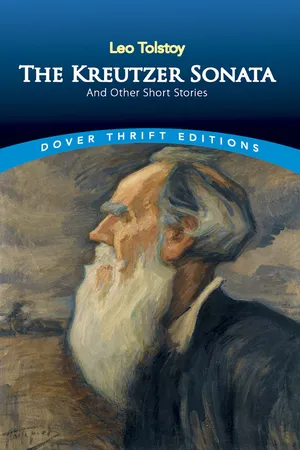
- 144 pages
- English
- ePUB (mobile friendly)
- Available on iOS & Android
eBook - ePub
The Kreutzer Sonata and Other Short Stories
About this book
Information
Topic
LiteraturaSubtopic
ClásicosThe Kreutzer Sonata
CHAPTER I
PASSENGERS
IT WAS EARLY SPRING. We had passed two weary days and a night in the train. Passengers riding for short distances were continually coming in and getting out, but there were three others besides myself who had come the whole way from the terminus at which the train had started: a lady, no longer young or attractive, addicted to smoking, attired in a man’s great-coat, and wearing a little soft hat on her head, and whose face spoke of long and profound suffering; an acquaintance of hers, a talkative gentleman of forty, faultlessly attired in brand-new clothes; and another gentleman, short of stature, and of fitful, nervous movements, not yet old, although his curly hair was prematurely gray. His eyes wandered rapidly from object to object as he sat aloof from all the other passengers.
He wore an old great-coat made evidently by an expensive tailor, with Astrakhan collar and Astrakhan cap to match. Underneath his great-coat, when unbuttoned, a jacket could be seen and an embroidered shirt, of the kind known as “Russian” shirts. It was characteristic of this person that he uttered from time to time peculiar sounds resembling short coughs or laughter just begun and suddenly broken off. During the journey he sedulously avoided making the acquaintance of, or communicating with, his fellow-passengers: to all their attempts at conversation he gave curt and churlish replies, and would either take to reading or to smoking, looking out through the window in the latter case, or else would draw forth his provisions from an old bag and make tea for himself, or eat a little. It seemed to me that his loneliness oppressed him, and I made more than one effort to enter into conversation with him, but each time our eyes met—and it happened pretty frequently, for he sat on the further end of the seat opposite to me—he always turned away, burying himself in his book or looking out through the window.
During the stop we made at a large station on the evening of the second day, this nervous passenger went out to fetch boiling water to make himself some tea. The gentleman with the brand-new clothes—-a lawyer, as I afterward gathered—went to the refreshment-room to have tea with the lady smoker in the man’s great-coat. While they were away several new passengers entered the carriage, among them a tall, clean-shaven old man—evidently a merchant—his face full of the wrinkles of age, wearing an ample fur coat, made from the skins of American skunks, and a cloth cap with a huge peak. He sat down on the seat opposite to that occupied by the lady and the lawyer, and without more ado entered into a conversation with a young man, apparently a merchants clerk, who had got in at this same station.
I was sitting on the further end of the seat opposite, and, as the train was standing still, I could distinguish snatches of their conversation, whenever there was no one walking along the passage. The merchant began by volunteering the information that he was bound for his estate, situated close by the next station. Then they spoke, as is always done in such cases, about prices, about trade, discussed the state of business in Moscow at that moment, and then went on to talk of the Fair of Nischny Novgorod. The clerk began to describe the drinking bouts and other wild pranks of a well-known rich merchant at the fair, but the old man did not allow him to tell his story to the end, but interrupted him with tales of revelries of by-gone times at the Fair of Kunavin, in which he himself took part. He took evident pride in his participation in these saturnalia, and with visible delight went on to relate how he and that same rich merchant had once in Kunavin, under the influence of liquor, played such a trick that it could not even be described otherwise than in a whisper; it made the clerk, when he heard it, roar with laughter till his voice resounded from one end of the carriage to the other, the old man also laughing the while and displaying two yellow teeth. Not expecting to hear anything interesting, I arose and moved toward the door with the intention of walking to and fro on the platform till the departure of the train. On the threshold I met the lawyer and the lady engaged in a lively conversation on their way back to their places. “You’ll not have time,” exclaimed the communicative lawyer, addressing me; “the second bell is about to be rung this moment.”
And he was right. Scarcely had I reached the end of the train, when the second bell was rung. I returned and found the lawyer and the lady continuing their lively discussion. The old merchant seated opposite them was looking straight before him, occasionally pursing his lips disapprovingly. “Then she told her husband right out,” the lawyer said, with a smile, as I was moving past him to my seat, “that she could not and would not live with him any longer, inasmuch as ...” The rest of the story I could not catch, for no sooner had I taken my place than other passengers came in; then the guard entered; soon afterward a luggage porter rushed in, and for a considerable time such a noise was kept up, that I could not hear the conversation.
When the din had subsided, and the lawyers voice again became audible, I noticed that the conversation had taken a new turn, and, from being private, had drifted into general topics. The lawyer was remarking that the question of divorce was now claiming and receiving the serious attention of the public in all Europe, and that even in Russia the cases in which it was granted were growing more and more frequent. Becoming suddenly aware that his was the only voice heard in the carriage, he ceased speaking, and turning to the old man: “In old times there was nothing like that, I am sure, was there?” he said, blandly, smiling. The merchant was about to make some reply, but at this moment the train started, and, taking off his cap, he began to make the sign of the cross, and to mutter his prayers in a low whisper. The lawyer, turning away his eyes, courteously waited till he had done. Having finished his prayer and crossed himself three times, the old man put his cap on, pressed it well on his head, made himself comfortable in his seat, and then began to speak.
“It used to happen in old times, too, sir,” he observed, “only not so often as it does now. But at present it could not be otherwise than it is. People have become so surprisingly enlightened.”
The train, moving faster and faster, groaned and clanked, and made it very difficult for me to hear what was being said, and, as the conversation interested me, I moved nearer to the speakers. My neighbor, the nervous passenger with the glowing eyes, was also, I could see, interested; and he, too, made a visible effort to catch what was being said, but without rising or leaving his place.
“In what respect is education an evil?” asked the lady, with a scarcely perceptible smile on her lips. “Surely it can not be contended that it is better to marry as they did in old times, the bride and bridegroom not having as much as seen each other before the wedding?” she continued, after the manner of many ladies, replying not to the words of her interlocutor but to the remarks which she supposed he would make. “They did not know whether they liked each other, whether they could possibly like each other, and yet they married they knew not whom, making themselves miserable for all their lives. And yet that is a better state of things, in your opinion?” she went on, unmistakably addressing her remarks to the lawyer and myself, and scarcely, if at all, to the old man with whom she was ostensibly talking.
“Nowadays people have become surprisingly enlightened,” repeated the merchant, contemptuously eyeing the lady and leaving her query unanswered.
“It would give me pleasure to hear how you explain the connection between education and discord in married life,” exclaimed the lawyer, smiling almost imperceptibly.
The merchant was about to say something, when the lady interrupted him, saving: “No, those times are gone for good.”
The lawyer, however, checked her, and exclaimed: “Pray allow him to explain his meaning!”
“Folly comes from education,” cried the merchant in a dogmatic manner.
“They join in marriage people who do not love each other, and then they are astonished that such couples do not live happily,” hurriedly exclaimed the lady turning round to look at the lawyer, at me, and even at the clerk, who, having risen from his place, was leaning on the back of the seat, smiling and listening to the discussion. “It is only animals that you can treat in that way,” she continued, with the evident intention of stinging the merchant, “pairing and coupling them as their owner thinks fit; but men and women have their own inclinations and attachments.”
“You ought not to talk in that way, ma’am,” observed the merchant; “an animal is a beast, but a law has been given to man.”
“Yes, but how are you to live with a man if you have no love for him?” cried the lady, apparently in haste to give utterance to thoughts which she probably believed to be very original.
“In former times no heed was given to such things,” said the merchant in a solemn, peremptory manner; “it is only in our days that they have come into vogue. The moment the slightest hitch occurs, the wife bristles up with her ‘I’ll not live with you.’ The very peasants have adopted the new fashion, and are conducting themselves accordingly. ‘Here,’ cries a countryman’s mate, ‘here, take your blouses and your drawers, I’ll go off with Jack. He has a finer curly head than you have.’ Talk about wonders happening after this! The first and chief thing that should be looked for in a woman is fear.”
The clerk looked at the lawyer, the lady, and at me, keeping back his smile in reserve, and ready either to ridicule or to approve the merchant’s discourse, according to the reception it met with.
“What kind of fear?” asked the lady.
“The kind meant by the words: ‘And she shall fear her husband.’ That’s the kind of fear.”
“Those days are long since past and gone, my good man,” exclaimed the lady, with a certain touch of bitterness.
“No, ma’am, those days can not pass away. As Eve, the woman, once was created from the man’s rib, so she will remain till the end of time.” These words the old man uttered solemnly, shaking his head so triumphantly the while that the clerk at once decided that the victory would be on his side, and consequently he burst out laughing.
“Yes, that’s the way you men reason out the question,” exclaimed the lady, reluctant to surrender, and looking away from us. “You give yourselves liberty, while you want to keep us women behind bolts and bars. You take very good care, I am sure, to allow yourselves every liberty.”
“Nobody accords us permission; a man, you know, brings no increase into the house by misconduct outside it. But a woman, a wife, you see, is a frail vessel.”
The emphasis and gravity with which the merchant delivered himself of these judgments had evidently a powerfully persuasive effect on his hearers. Even the lady was conscious of defeat: still, however, she refused to give in.
“Yes, but I think for all that you will admit that a woman is a human being, endowed with feeling, just as a man is. Now what is she to do if she does not love her husband?”
“If she does not love her husband?” angrily repeated the merchant, moving his brows and his lips simultaneously. “Don’t you fear, she’ll learn to love him!”
This unlooked-for argument especially tickled the clerk’s fancy, and he uttered an inarticulate sound significative of approval.
“Oh, but she will not learn to love him,” declared the lady; “and if love is lacking, it is not force that can engender it.”
“Well, but suppose a woman has proved unfaithful to her husband; how then?” asked the lawyer.
“That has not to be taken into account at all,” replied the old man. “One should always take effective measures to prevent it.”
“Yes, but suppose it should occur in spite of your measures; it’s a fact that it does take place; what then?”
“Wherever else it happens, it is unknown in our circles,” was the merchant’s reply.
All became silent. The clerk shifted his position, moved a little nearer, and apparently not wishing to be behind the others, began with a smile as follows:
“Yes, here now is a scandalous affair that took place among our people, and a hard one to disentangle, too! She was a queer woman, a loose sort, you know. And she did go in for games, I tell you! Her husband was a well enough sort of man in his way, and had all his wits about him. She began tricks with the shop-boy. Her husband tried to bring her round, and get her to keep straight by soft talk and advice. But she wouldn’t knuckle down. She did no end of queer things, that woman. She got to such a pitch that she made no bones of stealing his money. He beat her then. Well, and what do you think came of it? Why, she got worse and worse, and at last she went off with an unbaptized fellow—a Jew! Now, what was her husband to do, I ask you? He shook her off altogether; and now he’s living like a bachelor, and she’s going from bad to worse.”
“Because he’s a fool!” exclaimed the old man. “If he had put a spoke in her wheel from the very outset; if he had given her a thorough good taming, I’ll go bail she’d be living with him to-day. Never let them have their way from the very beginning. ‘Don’t trust your horse in the field nor your wife in your home,’ as the saying is.”
At this point in the conversation the guard came in to collect the tickets for the next station. The old man gave up his. “Yes, sir, women must be tamed in time, or else all’s lost.”
“Well, but how do you reconcile that with what you yourself related a short time ago about what the men did at the Fair of Kunavin?” I asked, unable to keep silent any longer.
“Oh, that’s a different thing altogether,” he answered, and relapsed immediately into silence.
Shortly afterward the shrill whistle of the engine was heard, and he rose, dragged out a bag from under the seat, pulled his fur coat closer about him, and, slightly raising his cap, left the carriage to take his place on the little platform near the break.
CHAPTER II
LOVE DEFINED
SCARCELY HAD HE left the carriage when the conversation began again, several voices being heard simultaneously.
“There goes a patriarchal old grandfather!” exclaimed the clerk.
“The incarnation of tyrannical home government,” ejaculated the lady. “What a barbarous conception of women and of marriage he has!”
“Yes, we are still far off from European views on marriage,” observed the lawyer.
“The strangest thing of all about such people,” resumed the lady, “is that they do not understand that marriage without love is not marriage at all; that the only thing that can hallow marriage is love, and that the only genuine marriage is that which is hallowed by love.”
The clerk listened and smiled, desirous of impressing on his memory for future use as many enlightened remarks as possible. In the middle of the lady’s talk a noise was heard as of suppressed laughter or a smothered sob, and, turning round, we beheld my neighbor, the gray-haired, lonely man with the lustrous eyes, who during the course of the conversation, which evidently interested him, had moved quite close to us, without being observed. He was standing with his arms resting on the back of the seat, and he appeared very excited, his face being quite red, and the nervous twitching of the facial muscles being painfully visible.
“What kind of love do you mean—the love that hallows marriage?” he asked, stammering.
Noticing the state of agitation in which her interlocutor addressed her, the lady put as much gentleness and thoroughness into her reply as was possible.
“Real, genuine love,” she explained; “if such love exists between the man and the woman, marriage is possible.”
“Yes; but what are we to understand by real, genuine love?” insisted the man with the glowing eyes, smiling awkwardly, and displaying great timidity as he put the question.
“Surely, every one knows what is meant by love!” exclaimed the lady.
“I do not,” objected her questioner; “you should define what you mean by—”
“What? Why, it’s very simple,” replied the lady, who, nevertheless, became thoughtful and silent for a few moments. Then resuming, “What is love?” she repeated, “love is the preference of one person for another, to the exclusion of every one else.”
“Preference for what period of time? For a month? For two days? Or for half an hour?” queried the passenger, with a laugh.
“No: it is clear you have something else in mind,” said the lady.
“No; I am speaking of the same thing as you are.”
“The lady maintains,” said the advocate, interposing, “that marriage should be the outcome in the first place of an attachment (or call it love, if you will), and that if such a sentiment exists, then, and not otherwise, is marriage hallowed, so to say. In the next place, that every marriage not based upon this natural predilection (or love, if you prefer the term), is devoid of the element that makes it morally binding. Have I interpreted you aright?” he asked, turning to the lady.
The lady by a nod of her head signified her approval of the lawyer’s exposition.
“In the next place—” the lawyer went on; but the nervous gentleman, with the glowing eyes, which now resembled two coals of fire, was evidently unable any longer to control himself, for breaking in on the lawyer’s speech, he began:
“No, I am speaking of exactly the same thing, the predilection of one person for another, only I ask how long is this predilection to last?”
“How long? A long time, sometimes a whole life-time,” answered the lady, shrugging her shoulders.
“Yes, but that is only in novels. In life it is never so. In life this predilection of one person for another lasts in very rare instances for years; generally for months, and sometimes for weeks, for days, for hours,” he exclaimed, obviously conscious that he was startling us all by this expression of opinion, and satisfied that it should be so.
“Oh, how can you! No, but—Pardon me, but—” all three of us began simultaneously. Even the clerk uttered some sound of disapproval.
“Yes, I know,” he exclaimed, in a high voice, “you are talking of that which is supposed to be, whereas I was speaking of that which is. Every man feels what you call love toward every pretty woman. ”
“Oh, that’s horrible—to say such things. It is certain that there is such a sentiment as love—love that is given us not for months or years, but for our life-time. Is not that so?” asked the lady.
“Certainly not. Even if we admit that a man may conceive a predilection for a certain woman, and that it lasts all his life, it is most highly probable that the woman’s predilection will be for some one else. So it has ever been, and so it will ever continue to be in this world of ours.” Having delivered himself of this opinion, he took out his cigarette-case and began to smoke.
“It may be reciprocal,” urged the lawyer.
“No, it can not be,” he answered; “just as in a cartload of peas...
Table of contents
- Title Page
- Copyright Page
- Note
- Table of Contents
- How Much Land Does a Man Need?
- The Death of Ivan Ilych
- The Kreutzer Sonata
Trusted by 375,005 students
Access to over 1.5 million titles for a fair monthly price.
Study more efficiently using our study tools.
Frequently asked questions
Yes, you can cancel anytime from the Subscription tab in your account settings on the Perlego website. Your subscription will stay active until the end of your current billing period. Learn how to cancel your subscription
No, books cannot be downloaded as external files, such as PDFs, for use outside of Perlego. However, you can download books within the Perlego app for offline reading on mobile or tablet. Learn how to download books offline
We are an online textbook subscription service, where you can get access to an entire online library for less than the price of a single book per month. With over 1.5 million books across 990+ topics, we’ve got you covered! Learn about our mission
Look out for the read-aloud symbol on your next book to see if you can listen to it. The read-aloud tool reads text aloud for you, highlighting the text as it is being read. You can pause it, speed it up and slow it down. Learn more about Read Aloud
Yes! You can use the Perlego app on both iOS and Android devices to read anytime, anywhere — even offline. Perfect for commutes or when you’re on the go.
Please note we cannot support devices running on iOS 13 and Android 7 or earlier. Learn more about using the app
Please note we cannot support devices running on iOS 13 and Android 7 or earlier. Learn more about using the app
Yes, you can access The Kreutzer Sonata and Other Short Stories by Leo Tolstoy in PDF and/or ePUB format, as well as other popular books in Literatura & Clásicos. We have over 1.5 million books available in our catalogue for you to explore.