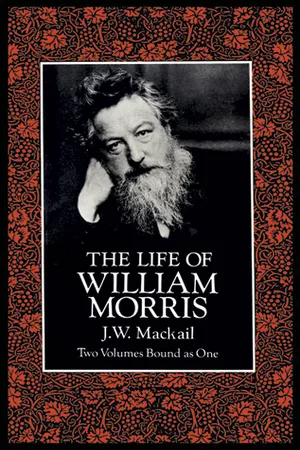
Classic biography of the great Victorian poet, designer and socialist. Published a few years after Morris’ death, it chronicles his childhood, days at Oxford, forays into art and literature, embrace of socialism, involvement with the Arts and Crafts movement, founding of the Kelmscott Press, much more. 22 black-and-white illus.
POET, artist, manufacturer, and socialist, author of “ The Earthly Paradise” :—this terse unimpassioned entry in the “ Fasti Britannici ” sums up, in a form of words which he would himself have accepted as substantially accurate, the life and work of a remarkable man. What place he may finally occupy in the remembrance of the world, how long or how distinctly his unique personality may stand out above the smooth surface of oblivion under which, sooner or later, the greatest names are overwhelmed together with the least, it does not rest with his contemporaries to determine. But those who knew him unite in desiring that some record may descend of one who, in an age of transition and confusion, set a certain ideal before him and pursued it, through the many paths by which it led him, with undeviating constancy; the impulse of whose life had before his death wrought a silent revolution in those arts which he practised and transfigured ; and the whole of whose extraordinary powers were devoted towards no less an object than the reconstitution of the civilized life of mankind.
William Morris, the eldest son and third child of William Morris and Emma Shelton, was born at Elm House, Clay Hill, Walthamstow, on the 24th of March, 1834. His ancestry was on neither side in any way remarkable, and family records in the undistinguished middle class, whether commercial or professional, to which both his parents belonged, are generally scanty in amount and do not go far back. Such facts as have been preserved may be briefly set down, without laying any stress on what is known or what is unknown in the history of the family.
The Morrises were originally of Welsh descent, and their native country was the valley of the upper Severn and its tributaries, where the mixture or antagonism of two races in a country of exceptional natural beauty has bred a stock of fine physical quality, but of no remarkable gift either of intellect or imagination. “The quietest places under the sun,” so a local proverb describes that countryside; and so they have been and still are, ever since the Welsh Marches were reduced to outward peace. Morris’s grandfather (the first of the family, it is said, who dropped the Welsh Ap from his surname) settled in business in Worcester in the latter part of last century, and throve there as a burgess, “ a man excellent in every relation of life, and very religious.” He married Elizabeth, daughter of Dr. Charles Stanley, a naval surgeon, who had retired from the service and was in practice at Nottingham. She is remembered and described by her grandchildren—she lived to the age of eighty-five—as a tall fine-looking woman. At Worcester their second son, William Morris, was born on the 14th of June, 1797. About 1820, his father having then removed his business to London, he was entered as a clerk in the firm of Harris, Sanderson & Harris, discount brokers, of 32, Lombard Street. It was a newly-founded London house. The Harrises were Quakers, and between them and the Morrises there was some family connexion. When a little over thirty, William Morris became a partner in the firm, which was now known as Sanderson & Co., and some years afterwards removed its place of business to 83, King William Street. Bill and discount broking, then even more than now, was a class of business carried on by a comparatively limited number of persons, whose status and social consideration approached those of private bankers. Competition was not keen, and the members of established firms lived in ease and even opulence.
Mr. Morris married soon after his admission to partnership in the firm. His wife, who long outlived him, and died in her ninetieth year so recently as 1894, was the daughter of a Worcester neighbour, Joseph Shelton. The Sheltons were a family with some history. The line can be traced back directly to a Henry Shelton, mercer, of Birmingham, in the reign of Henry VII. The Sheltons were prosperous merchants and landed proprietors in the sixteenth and seventeenth centuries, and contributed a number of members to the Church and the Bar. John Shelton, Proctor of the Consistory Court of the diocese of Worcester, Mrs. Morris’s grandfather, had a family in whom a taste for music was very strongly developed. Two of his sons became singing canons of Worcester Cathedral and Westminster Abbey; a third, Joseph, was equally devoted to the art, of which he became a teacher in Worcester. The families of the Sheltons and Morrises, between whom there was some distant connexion by marriage, were intimate with one another, and the marriage of William Morris to Emma Shelton, Joseph Shelton’s youngest daughter, was a natural arrangement. It was then still customary that one of the members of a City firm should live at their place of business. Mr. and Mrs. Morris when married set up house in Lombard Street, where the two eldest children, both daughters, were born in 1830 and 1832. The next year they ceased to live in the City, and took a house at Walthamstow, in the pleasant Essex country overlooking the Lea Valley and within a mile or so of Epping Forest. Like many of his neighbours in what was then a favourite residential neighbourhood for City men, Mr. Morris travelled daily to his business by the stage coach.
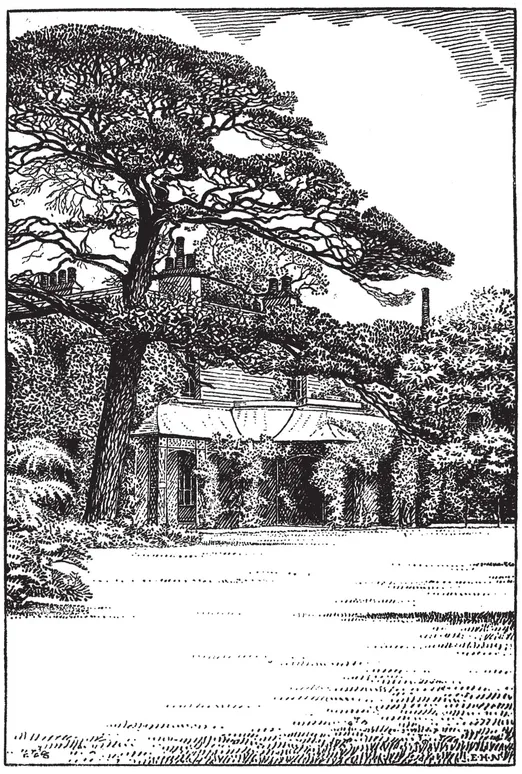
The modern outgrowth of London has nowhere had more devastating effects than in Walthamstow proper, where the rows of flimsily-built two-storied houses, in all the hideousness of yellow brick and blue slate, stretch in a squalid sheet over the Lea Valley. Clay Hill, a slight rising ground projecting into the flats from the higher Forest country, is now just on the edge of the brick and mortar wilderness. Looking northward from it, however, one sees the face of the country much as it was sixty years ago : a flattish heavily-timbered valley of the familiar Eastern County type, neither beautiful nor ugly, with the line of the Forest stretching along the horizon to the north-east, towards Chingford and High Beach. Elm House till quite recently remained unchanged; it was a plain roomy building of the early years of this century, the garden front facing south on to a large lawn surrounded by shrubberies and kitchen gardens, with a great mulberry tree leaning along the grass. Within the last twelve months the advancing tide of building has swept over it, and house and garden, like many others in the neighbourhood, have wholly disappeared.
William, the eldest son, was the first of the children born at Elm House. There were six younger children, four boys and two girls.
The Shelton stock was long-lived and of powerful physique. But the Morrises do not seem to have been a very robust family. Both Morris’s father and grandfather died comparatively young; and he himself, though he afterwards developed unusual physical strength, was delicate in infancy and early childhood. He had to be kept alive, his mother used to say, by calves’ feet jelly and beef tea. Perhaps it was on account of this delicacy that he learned to read unusually young. At four years old he was already deep in the Waverley novels; and he formed as a child, not only the love of reading, but the habit of reading with extraordinary swiftness, only equalled by the prodigious grasp of his memory. The knowledge of books came to him almost by instinct. “ We never remember his learning regularly to read,” his sisters say, “though he may have had a few lessons from our governess: ” and he himself could not remember a time when he was unable to read.
ELM HOUSE, WALTHAMSTOW, THE BIRTHPLACE OF WILLIAM MORRIS.
Meanwhile the business of the bill-broking firm, and Mr. Morris’s own private commercial undertakings, grew and prospered. He was now a wealthy man ; and in 1840, when his eldest boy was six years old, the family left Elm House, and moved across the Forest to Woodford Hall, a large spacious mansion of Georgian date, standing in about fifty acres of park, on the high road from London to Epping. The park was only separated by a fence from the Forest itself; and the estate included about a hundred acres of farm land, sloping down to the little river Roding. Behind lay the pathless glades and thickets of hornbeam and beech which still, in spite of all encroachments, and of the nearer and nearer approach of London, remain in all essentials a part of primæval England, little changed in the course of hundreds, perhaps thousands of years. From the Hall the course of the Thames might be traced winding through the marshes, with white and ruddy-brown sails moving among cornfields and pastures. The little brick Georgian church of Woodford (since enlarged and modernized), stood alongside of the Hall, which had a private doorway into the churchyard. On the roadside nearly opposite, on a green space now enclosed, were the pound and the stocks. “ When we lived at Woodford,” Morris wrote to his daughter half a century later, “ there were stocks there on a little bit of wayside green in the middle of the village : beside them stood the cage, a small shanty some twelve feet square, and as it was built of brown brick roofed with blue slate, I suppose it had been quite recently in use, since its style was not earlier than the days of fat George. I remember I used to look at these two threats of law and order with considerable terror, and decidedly preferred to walk on the other side of the road; but I never heard of anybody being locked up in the cage or laid by the heels in the stocks.”
The outgrowth of Eastern London had not then overflowed the line of low hills which shut off the Lea Valley. The picture which Morris draws, in “News from Nowhere,” of this Essex country in the restored and recivilized England of a distant future, substantially represents the scene of his own boyhood. “ Eastward and landward,” he says in that description, “ it is all flat pasture, once marsh, except for a few gardens, and there are very few permanent dwellings there, scarcely anything but a few sheds and cots for the men who come to look after the great herds of cattle. What with the beasts and the men, and the scattered red-tiled roofs and the big hayricks, it does not make a bad holiday to get a quiet pony and ride about there on a sunny afternoon of autumn, and look over the river and the craft passing up and down, and on to Shooter’s Hill and the Kentish uplands, and then turn round to the wide green sea of the Essex marshland, with the great domed line of the sky, and the sun shining down in one flood of peaceful light over the long distance.”
The park abounded in wild birds and beasts from the neighbouring Forest. It was an ideal home for a boy with healthy outdoor tastes. There Morris, rambling with his brothers on foot or on Shetland ponies through the Forest, formed his intense love of nature and his keen eye for all sorts of woodland life. He never ceased to love Epping Forest, and to uphold the scenery of his native county as beautifully and characteristically English. The dense hornbeam thickets, which even in bright weather have something of solemnity and mystery in their deep shade, and which are hardly found elsewhere in England, reappear again and again in his poetry and his prose romances. Fifty years later, when the treatment of the Forest by the Conservators had been the subject of much public criticism, he went over the familiar ground and reported on the changes which had been made on it. “I was born and bred in its neighbourhood,” he then wrote, “and when I was a boy and young man knew it yard by yard from Wanstead to the Theydons, and from Hale End to the Fairlop Oak. In those days it had no worse foes than the gravel stealer and the rolling fence maker, and was always interesting and often very beautiful.
“ The special character of it was derived from the fact that by far the greater part was a wood of hornbeams, a tree not common save in Essex and Herts. It was certainly the biggest hornbeam wood in these islands, and I suppose in the world. The said hornbeams were all pollards, being shrouded every four or six years, and were interspersed in many places with holly thickets. Nothing could be more interesting and romantic than the effect of the long poles of the hornbeams rising from the trunks and seen against the mass of the wood behind. It has a peculiar charm of its own not to be found in any other forest.”
In this healthy country life he rapidly outgrew his early delicacy of constitution. The life indoors was equally happy. “When I was a little chap” was a phrase often in his mouth; and these allusions to childhood always implied the remembrance of perfect contentment. Among the little things that impressed themselves on his childish memory are mentioned “ a picture of Abraham and Isaac worked in brown worsted,” and Indian cabinets, and “a carved ivory junk with painted and gilded puppets in it in a glass case.” “Na
f or gross ghost stories, read long ago in queer little penny garlands with woodcuts,” long haunted his imagination; and as he grew bigger, he found and revelled in Lane’s “Arabian Nights.” Among the books of the house there was a copy of Gerard’s “Herbal.” In studying it as a naturalist, the boy’s eyes were led to examine the beautiful drawings, many of which later gave suggestions for his own designs in the flower-work of his earlier wall-papers, and in the backgrounds of designs for glass and tapestry. He continued an eager reader of novels. His eldest sister remembers how they used to read “ The Old English Baron” together in the rabbit warren at Woodford, poring over the enthralling pages till both were wrought up to a state of mind that made them afraid to cross the park to reach home. By the time he was seven years old he had read all the Waverley novels, and many of Marryat’s, besides others which were then in fashion. Reading can be acquired without regular teaching, but writing cannot; and he did not learn to write till much after the ordinary age. But his innate skill of hand made it easy of acquirement to him when he once took pains; and his handwriting became in later life one of remarkable beauty. The subsidiary art of spelling was always one in which he was liable to make curious lapses. “ I remember,” he once said, when speaking of his childhood, “being taught to spell and standing on a chair with my shoes off because I made so many mistakes.” In later years several sheets of “ The Life and Death of Jason” had to be cancelled and reprinted because of a mistake in the spelling of a perfectly common English word; a word indeed so common that the printer’s reader had left it as it was in the manuscript, thinking that Morris’s spelling must be an intentional peculiarity.
The life of an English country house, even of the second or third order of importance, still retained, sixty years since, much of the self-contained and self-sufficing system of the manor house of earlier times. A certain elaborateness of appliances was combined with what would now be thought a strange simplicity. At some points there were links with the habits of mediaeval England. Woodford Hall brewed its own beer, and made its own butter, as much as a matter of course as it baked its own bread. Just as in the fourteenth century, there was a meal at high prime, midway between breakfast and dinner, when the children had cake and cheese and a glass of small ale. Many of the old festivals were observed; Twelfth Night especially was one of the great days of the year, and the Masque of St. George was always then presented with considerable elaboration. Among Morris’s toys curiously enough was a little suit of armour, in which he rode on his pony in the park. He and his brothers were keen anglers—this taste remained one of his strongest throughout his life—and took the usual boys’ pleasure in shooting, not the regular game of seniors, but rabbits and small wild birds. The redwings and fieldfares which they shot on winter holidays they were allowed to roast for supper. It was one of his childish ambitions to shoot woodpigeons with a bow and arrow. Besides the range of the lawn and park the children had little gardens of their own. He writes in later life of “the beautiful hepatica which I used to love so when I was a quite little boy.” “ To this day,” he once said, “ when I smell a may-tree I think of going to bed by daylight;” and the strong sweet smell of balm always brought to his mind “very early days in the kitchen-garden at Woodford, and the large blue plums which grew on the wall beyond the sweet-herb patch.” One who shared this outdoor life at Woodford with Morris told me, in a phrase of accurate simplicity, that as a boy he “knew the names of birds.” There was, indeed, little that he ever saw of which he did not know the name.
The love of the Middle Ages was born in him. Any slight remnants of mediæval tradition in the daily life of Woodford did not go deep; and it was only some years later that the Oxford movement spread over England, and deepened or replaced the superficial mediævalism brought into fashion by Scott. The religion of the family was of the normal type of a somewhat sterile Evangelicalism, which cursorily dismissed everything outside itself as Popery on the one hand or Dissent on the other. The children were not allowed to mix with dissenters with the single exception of Quakers. But the old Essex churches within reach of Woodford, and their monuments and brasses, were known by Morris at a very early age; and a visit which he made with his father to Canterbury when only eight years old left on his mind an ineffaceable impression of the glory of Gothic architecture. On the same holiday they saw the church of Minster in Thanet. It is characteristic of his extraordinary eye and even more extraordinary memory, that just fifty years later, never, having seen the church in the interval, he described it in some detail from that recollection. No landscape, no building, that he had once seen did he ever forget, or ever confuse with another.
Nor were the splendid Essex country houses which survived from the fifteenth and sixteenth centuries less known or loved by him than the Essex churches. “Well I remember as a boy,” he wrote in his lecture on The Lesser Arts of Life, in 1882, “my first acquaintance with a room hung with faded greenery at Queen Elizabeth’s Lodge by Chingford Hatch in Epping Forest (I wonder what has become of it now ?), and the impression of romance that it made upon me! a feeling that always comes back on me when I read, as I often do, Sir Walter Scott’s ‘Antiquary,’ and come to the description of the Green Room at Monkbarns, amongst which the novelist has with such exquisite cunning of art imbedded the fresh and glittering verses of the summer poet Chaucer : yes, that was more than upholstery, believe me.”
When Morris was nine years old, the casual ministrations of his sisters’ governess gave place to a more regular education. He was sent to a “ preparatory school for young gentlemen” in Walthamstow, kept by the Misses Arundale. This was a couple of miles off, and he rode over to it on his pony. A year or two later the Misses Arundale removed with their school to George Lane, Woodford, within a few hundred yards of Woodford Hall. He remained there first as a day scholar, and afterwards for some time as a boarder, until the death of his father in the autumn of 1847.
For a number of years before his death Mr. Morris had held a position of some consequence in the district, and was a well-known name in the City. In 1843 he obtained a grant of arms from the Herald’s College: “Azure, a horse’s head erased argent between three horseshoes or, and for crest, on a wreath of the colours, a horse’s head couped argent, charged with three horseshoes in chevron sable.” The boy of nine was already of an age to be keenly interested in heraldry ; and whatever may have been the reasons which induced Garter and Clarenceux to assign these bearings, they became in his mind something deeply, if obscurely, associated with his life. He considered himself in some sense a tribesman of the White Horse. In the house which he built for himself afterwards the horse’s head is pictured on tiles and glass painted by his own hand. To the White Horse of the Berkshire downs, which lies within a drive of his later home at Kelmscott, he made a regular yearly pilgrimage. “Not seldom I please myself,” he wrote many years afterwards, “ with trying to realize the face of mediaeval England; the many chases and great woods, the stretches of common tillage and common pasture quite unenclosed; the rough husbandry of the tilled parts, the unimproved breeds of c...
Table of contents
Title Page
Copyright Page
DIVO PATRI
PREFACE
Table of Contents
THE LIFE OF WILLIAM MORRIS - VOLUME I
THE LIFE OF WILLIAM MORRIS - VOLUME II
INDEX
A CATALOG OF SELECTED DOVER BOOKS IN ALL FIELDS OF INTEREST
Trusted by 375,005 students
Access to over 1.5 million titles for a fair monthly price.
Study more efficiently using our study tools.
Frequently asked questions
Yes, you can cancel anytime from the Subscription tab in your account settings on the Perlego website. Your subscription will stay active until the end of your current billing period. Learn how to cancel your subscription
No, books cannot be downloaded as external files, such as PDFs, for use outside of Perlego. However, you can download books within the Perlego app for offline reading on mobile or tablet. Learn how to download books offline
Perlego offers two plans: Essential and Complete
Essential is ideal for learners and professionals who enjoy exploring a wide range of subjects. Access the Essential Library with 800,000+ trusted titles and best-sellers across business, personal growth, and the humanities. Includes unlimited reading time and Standard Read Aloud voice.
Complete: Perfect for advanced learners and researchers needing full, unrestricted access. Unlock 1.5M+ books across hundreds of subjects, including academic and specialized titles. The Complete Plan also includes advanced features like Premium Read Aloud and Research Assistant.
Both plans are available with monthly, semester, or annual billing cycles.
We are an online textbook subscription service, where you can get access to an entire online library for less than the price of a single book per month. With over 1.5 million books across 990+ topics, we’ve got you covered! Learn about our mission
Look out for the read-aloud symbol on your next book to see if you can listen to it. The read-aloud tool reads text aloud for you, highlighting the text as it is being read. You can pause it, speed it up and slow it down. Learn more about Read Aloud
Yes! You can use the Perlego app on both iOS and Android devices to read anytime, anywhere — even offline. Perfect for commutes or when you’re on the go. Please note we cannot support devices running on iOS 13 and Android 7 or earlier. Learn more about using the app
Yes, you can access The Life of William Morris by J. W. Mackail in PDF and/or ePUB format, as well as other popular books in Art & Artist Monographs. We have over 1.5 million books available in our catalogue for you to explore.