An unabridged republication of the classic 1911 edition, this volume constitutes both a great historical contribution to mathematical literature and a basic reference book in its field. Suitable for advanced undergraduates and graduate students in mathematics as well as historians of mathematics, the introductory treatment was hailed by International Mathematical News as "more easily comprehensible than most other books on the subject," and as "a classic work, extraordinarily rich," by Elemente der Mathematik.
After introducing permutation notation and presenting the definition of a group, author William Burnside discusses the simpler properties of groups that are independent of their modes of representation; composition-series of groups; isomorphism of a group with itself; Abelian groups; groups whose orders are the powers of primes; and Sylow's theorem. Permutation groups and groups of linear substitutions receive an extensive treatment; two chapters are devoted to the graphic representation of groups, and the closing chapter examines congruence groups. Forty-five pages of notes at the back of the book offer ample treatment of special topics.
- 544 pages
- English
- ePUB (mobile friendly)
- Available on iOS & Android
eBook - ePub
Theory of Groups of Finite Order
About this book
Information
CHAPTER I.
ON PERMUTATIONS.
1. AMONG the various notations used in the following pages, there is one of such frequent recurrence that a certain readiness in its use is very desirable in dealing with the subject of this treatise. We therefore propose to devote a preliminary chapter to explaining it in some detail.
2. Let a1, a2,..., an be a set of n distinct letters. The operation of replacing each letter of the set by another, which may be the same letter or a different one, when carried out under the condition that no two distinct letters are replaced by one and the same letter, is called a permutation performed on the n letters. Such a permutation will change any given arrangement
a1, a2,...., an
of the n letters into a definite new arrangement
b1, b2,..., bn
of the same n letters.
3. One obvious form in which to write the permutation is
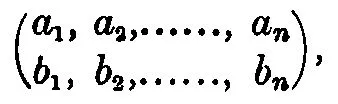
thereby indicating that each letter in the upper line is to be replaced by the letter standing under it in the lower. The disadvantage of this form is its unnecessary complexity, each of the n letters occurring twice in the expression for the permutation; by the following process, the expression of the permutation may be materially simplified.
Let p be any one of the n letters, and q the letter in the lower line standing under p in the upper. Suppose now that r is the letter in the lower line that stands under q in the upper, and so on. Since the number of letters is finite, we must arrive at last at a letter s in the upper line under which p stands. If the set of n letters is not thus exhausted, take any letter p′ in the upper line, which has not yet occurred, and let q′, r′,... follow it as q, r,... followed p, till we arrive at s′ in the upper line with p′ standing under it. If the set of n letters is still not exhausted, repeat the process, starting with a letter p″ which has not yet occurred. Since the number of letters is finite, we must in this way at last exhaust them; and the n letters are thus distributed into a number of sets
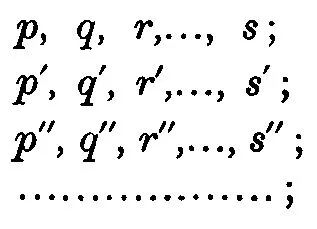
such that the permutation replaces each letter of a set by the one following it in that set, the last letter of each set being replaced by the first of the same set.
If now we represent by the symbol
(pqr...s)
the operation of replacing p by q, q by r,..., and s by p, the permutation will be completely represented by the symbol
(pqr...s) (p′q′r′...s′) (p″q″r″...s″).......
The advantage of this mode of expressing the permutation is that each of the letters occurs only once in the symbol.
4. The separate components of the above symbol, such as (pqr...s), are called the cycles of the p...
Table of contents
- Title Page
- Copyright Page
- PREFACE TO THE SECOND EDITION
- PREFACE TO THE FIRST EDITION
- Table of Contents
- CHAPTER I. - ON PERMUTATIONS.
- CHAPTER II. - THE DEFINITION OF A GROUP.
- CHAPTER III. - ON THE SIMPLER PROPERTIES OF A GROUP WHICH ARE INDEPENDENT OF ITS MODE OF REPRESENTATION.
- CHAPTER IV. - FURTHER PROPERTIES OF A GROUP WHICH ARE INDEPENDENT OF ITS MODE OF REPRESENTATION.
- CHAPTER V. - ON THE COMPOSITION-SERIES OF A GROUP.
- CHAPTER VI. - ON THE ISOMORPHISM OF A GROUP WITH ITSELF.
- CHAPTER VII. - ON ABELIAN GROUPS.
- CHAPTER VIII. - ON GROUPS WHOSE ORDERS ARE THE POWERS OF PRIMES.
- CHAPTER IX. - ON SYLOW’S THEOREM.
- CHAPTER X. - ON PERMUTATION-GROUPS: TRANSITIVE AND INTRANSITIVE GROUPS: PRIMITIVE AND IMPRIMITIVE GROUPS.
- CHAPTER XI. - ON PERMUTATION-GROUPS: TRANSITIVITY AND PRIMITIVITY: (CONCLUDING PROPERTIES).
- CHAPTER XII. - ON THE REPRESENTATION OF A GROUP OF FINITE ORDER AS A PERMUTATION-GROUP.
- CHAPTER XIII. - ON GROUPS OF LINEAR SUBSTITUTIONS; REDUCIBLE AND IRREDUCIBLE GROUPS.
- CHAPTER XIV. - ON THE REPRESENTATION OF A GROUP OF FINITE ORDER AS A GROUP OF LINEAR SUBSTITUTIONS.
- CHAPTER XV. - ON GROUP-CHARACTERISTICS.
- CHAPTER XVI. - SOME APPLICATIONS OF THE THEORY OF GROUPS OF LINEAR SUBSTITUTIONS AND OF GROUP-CHARACTERISTICS.
- CHAPTER XVII. - ON THE INVARIANTS OF GROUPS OF LINEAR SUBSTITUTIONS.
- CHAPTER XVIII. - ON THE GRAPHICAL REPRESENTATION OF A GROUP.
- CHAPTER XIX. - ON THE GRAPHICAL REPRESENTATION OF GROUPS: GROUPS OF GENUS ZERO AND UNITY; CAYLEY’S COLOUR GROUPS.
- CHAPTER XX. - ON CONGRUENCE GROUPS.
- NOTE A. - ON THE EQUATION N= h1 + h2 + ... + hr.
- NOTE B. - ON THE GROUP OF ISOMORPHISMS OF A GROUP.
- NOTE C. - ON THE SYMMETRIC GROUP.
- NOTE D. - ON THE COMPLETELY REDUCED FORM OF A GROUP OF MONOMIAL SUBSTITUTIONS.
- NOTE E. - ON THE IRREDUCIBLE REPRESENTATIONS OF A GROUP WHICH HAS A SELF-CONJUGATE SUB-GROUP OF PRIME INDEX.
- NOTE F. - ON GROUPS OF FINITE ORDER WHICH ARE SIMPLY ISOMORPHIC WITH IRREDUCIBLE GROUPS OF LINEAR SUBSTITUTIONS.
- NOTE G. - ON THE REPRESENTATION OF A GROUP OF FINITE ORDER AS A GROUP OF LINEAR SUBSTITUTIONS WITH RATIONAL COEFFICIENTS.
- NOTE H. - ON THE GROUP OF THE TWENTY-SEVEN LINES OF A CUBIC SURFACE.
- NOTE I. - ON THE CONDITIONS OF REDUCIBILITY OF A GROUP OF LINEAR SUBSTITUTIONS OF FINITE ORDER.
- NOTE J. - ON CONDITIONS FOR THE FINITENESS OF THE ORDER OF A GROUP OF LINEAR SUBSTITUTIONS.
- NOTE K. - ON THE REPRESENTATION OF A GROUP OF FINITE ORDER AS A GROUP OF BIRATIONAL TRANSFORMATIONS OF AN ALGEBRAIC CURVE.
- NOTE L. - ON THE GROUP-CHARACTERISTICS OF THE FRACTIONAL LINEAR GROUP.
- NOTE M. - ON GROUPS OF ODD ORDER.
- NOTE N. - ON THE ORDERS OF SIMPLE GROUPS.
- NOTE O. - ON ALGEBRAIC NUMBERS.
- INDEX OF TECHNICAL TERMS. - (The numbers refer to sections.)
- INDEX OF AUTHORS QUOTED. - (The numbers refer to pages.)
- GENERAL INDEX. - (The numbers refer to sections.)
- DOVER PHOENIX EDITIONS
Trusted by 375,005 students
Access to over 1.5 million titles for a fair monthly price.
Study more efficiently using our study tools.
Frequently asked questions
Yes, you can cancel anytime from the Subscription tab in your account settings on the Perlego website. Your subscription will stay active until the end of your current billing period. Learn how to cancel your subscription
No, books cannot be downloaded as external files, such as PDFs, for use outside of Perlego. However, you can download books within the Perlego app for offline reading on mobile or tablet. Learn how to download books offline
Perlego offers two plans: Essential and Complete
- Essential is ideal for learners and professionals who enjoy exploring a wide range of subjects. Access the Essential Library with 800,000+ trusted titles and best-sellers across business, personal growth, and the humanities. Includes unlimited reading time and Standard Read Aloud voice.
- Complete: Perfect for advanced learners and researchers needing full, unrestricted access. Unlock 1.5M+ books across hundreds of subjects, including academic and specialized titles. The Complete Plan also includes advanced features like Premium Read Aloud and Research Assistant.
We are an online textbook subscription service, where you can get access to an entire online library for less than the price of a single book per month. With over 1.5 million books across 990+ topics, we’ve got you covered! Learn about our mission
Look out for the read-aloud symbol on your next book to see if you can listen to it. The read-aloud tool reads text aloud for you, highlighting the text as it is being read. You can pause it, speed it up and slow it down. Learn more about Read Aloud
Yes! You can use the Perlego app on both iOS and Android devices to read anytime, anywhere — even offline. Perfect for commutes or when you’re on the go.
Please note we cannot support devices running on iOS 13 and Android 7 or earlier. Learn more about using the app
Please note we cannot support devices running on iOS 13 and Android 7 or earlier. Learn more about using the app
Yes, you can access Theory of Groups of Finite Order by William S. Burnside in PDF and/or ePUB format, as well as other popular books in Mathematics & Group Theory. We have over 1.5 million books available in our catalogue for you to explore.