Comprehensive study of armed conflict, based on contemporary accounts and accompanied by illustrations and maps from rare sources, vividly describes dramatic changes in the art of war over 1,500 years — from Roman rule through 565 AD, to war tactics during the Crusades. Fighting methods, supply systems, tactical organization, and more. 15 black-and-white illustrations.
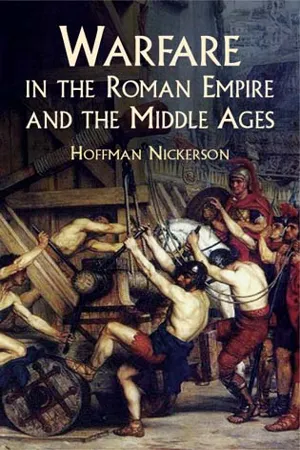
- 240 pages
- English
- ePUB (mobile friendly)
- Available on iOS & Android
eBook - ePub
Warfare in the Roman Empire and the Middle Ages
About this book
Information
CHAPTER I
THE IMPERIAL ROMAN ARMY
(FROM AUGUSTUS TO HADRIAN—29 B. C. TO 117 A. D.)
CÆSAR was assassinated (March 15, B. c. 44) almost exactly a year after Munda, and his death was followed by fifteen years of renewed civil war. Not until 29 B. C. was Cæsar’s nephew Augustus the sole master of the Roman state.
That state was in imperative need of repose. After seventy years of foreign conquest and internal strife, no man alive in 29 B. C. could remember an era of political stability or of peace.
Augustus was himself a statesman rather than a soldier. In military affairs he depended upon advisers, particularly upon Tiberius who afterward succeeded him as Emperor. However, since Augustus was head of the state when the army reforms were put in operation, and since the army reforms themselves were a part of his general scheme of consolidation, it is fitting that they should bear his name. For the sake of brevity and convenience they can be treated as a single programme—if we remember that different items of this programme were conceived and applied at different times throughout Augustus’ forty-three years of ascendancy.
First of all, what was the nature of the Roman state, and what was its general policy? From immemorial time the shores all around the Mediterranean had been covered with city-states each enjoying high civilization but without lasting political union between one city-state and another. Now one city—Rome—had conquered all the others and had carried the frontiers of civilization to the Atlantic and the Rhine. In this achievement the Roman governing class had been, and still was, sustained by the sense of a great mission. On the other hand the Roman temper was severely practical. The Roman had no silly love of conquest for its own sake. Hence he was utterly unwilling to invade territories whose subjugation would be of no material benefit to the state. He would, of course, occupy small districts of barren land when their pacification was necessary for the sake of public order in rich agricultural territories near by.
With the purely political side of Augustus’ arrangements this book is little concerned. It is enough to note that his problem was to replace the institutions normal to a city-state with others fitted to administer so vast an empire, and that he solved it by creating a centralized, bureaucratic, civil service taking its orders from the commander-in-chief of the army. This commander-in-chief or “Imperator,” from which title our word emperor is derived, was appointed for life by the Senate, and once appointed became the lawful head of the government.
Only on one tiny fraction of its circumference did the Empire border upon another civilized state. That was in northern Syria where the Euphrates marked the boundary with Parthia. South and southeast were deserts inhabited by a few nomads; north were forests thinly peopled with shifting tribes whose small numbers, lack of organization, and total lack of national or racial solidarity made them contemptible antagonists. Still a certain slight pressure was always to be expected from these outer barbarians in the way of raiding parties intent upon enjoying the fruits of civilization, without the discipline which civilization must necessarily impose.
Since Mesopotamia (defended as it was by the far from contemptible Parthian army) was distant from the centre of Roman power, and since there was practically nothing worth conquering anywhere else, Augustus decided, in general, upon a defensive policy. The war weariness of the community made such a policy inevitable for the time being. Circumstances were to make it permanent.
On the other hand, Augustus’ policy, defensive though it was in its general purpose, was by no means purely defensive. Indeed, through its contrast with the strict strategic defensive begun by Hadrian in 117, the period from Augustus to the death of Trajan may be called the offensive phase of imperial strategy. In order that the frontiers might be defended with a minimum of force they must be established upon obstacles. Accordingly, the entire southern basin of the Danube was conquered so that the river itself, from its source to its mouth, was the frontier. A methodical attempt was made to advance the frontier from the Rhine to the Elbe—although the attempt was abandoned after the defeat of Varus in 9 A. D. That disaster (though it was rightly considered shocking and disgraceful) in no way threatened the existence or even the general well-being of the state. Rome thought of it somewhat as America thought of the Custer massacre, or as England thought of the fall of Khartoum and the death of Gordon.
So much for the general military policy of Augustus. Let us now consider the army which was its instrument.
By 29 B. c. the Roman army had already become professional. Indeed Marius had taken the decisive step in this direction nearly eighty years before. Theoretically the old universal obligation to serve still remained, but it had become a dead letter. Ever since Marius’ time the soldier had taken an oath to his general (i. e., “Imperator”) as well as to the state, and had served for pay, booty, and a bonus or “donative” which he expected to get when discharged. The huge force of forty-five legions (from 162,000 to 270,000 men plus an equal or even greater number of auxiliaries) on foot at Augustus’ accession had been recruited and paid in haphazard fashion. There was no definite term of enlistment or rate of donative (i. e., bonus) upon discharge.1 In matters of organization all was chaos.
Augustus continued the professional army, but he greatly reduced its numbers and put the chaos in order.
Modern historians have shed so much ink in trying to prove that Augustus should have introduced conscription, universal service, and what not, that it may be well for us to consider the point. In general the situation was much like that of France after Napoleon or that of the United States after the Civil War and again in 1919: a large army in being, military problems of no great difficulty, and a thorough weariness of war. In the first place, Augustus was not an innovator except where innovation was absolutely necessary. The crying need of the time was consolidation and stabilization. In the second place, the thing would have been politically impossible. The whole force of public opinion would have been against it, for the community was sick and tired of the whole idea of military service, and a government much more strongly established than that of Augustus and the Senate would have had trouble in enforcing it. Finally conscription would have been both unnecessary and inexpedient; unnecessary because no formidable internal or external enemy threatened the Roman state (and no civilized community in all history has ever shouldered such a burden without the spur of evident necessity); inexpedient because the task of the imperial army was hardly more than constabulary work. For internal policing, and for campaigns in remote and thinly peopled theatres of war an army of short-term conscripts is an inefficient and enormously expensive instrument.
To-day the colonial troops of both England and France are professionals.
The one real military danger which menaced Rome—that of a general insurrection in some province—would have been all the greater if she herself had trained the mass of the provincials in arms. There was nothing she dreaded so much as internal disorder. In a third-century author, Dion Cassius (150-235), this factor of the problem is dwelt upon in the course of a discussion of the military policy put in the mouth of Maecenas, an Augustan statesman.2 Altogether then, Augustus’ decision to go on with a professional army is perhaps as nearly inevitable as anything in human affairs can be. So much for the pedants.
Augustus’ most important step was the reduction of the numbers of the army. All slaves, freedmen and criminals were discharged. Of those with good records who were anxious to leave the service, great numbers were settled in “colonies” upon public land given them by the state. One account says there were as many as 120,000 so favoured. Only 25 of the 45 existing legionary organizations were continued.
The strength of the 25 legions which remained seems to have been fixed at 6000; plus a detachment of mounted men serving (in our own military phraseology) as “divisional cavalry.” If we assume, as it seems we should, that this meant an increase in numbers per legion then that increase was provided for by raising the strength of the first and fifth cohorts to 1000 men each. At all events, the later distinction between quingenary (“quingenaria”) cohorts 500 strong, and miliary (“miliaria”) cohorts 1000 strong seems to date from this time. The possible change of formation involved in this change of organization will be discussed later.
I repeat that Augustus thought of himself as a consolidator, not an inventor. There seem to have been no changes in tactics or equipment. On the other hand, a regular training schedule was laid down and strictly adhered to, including strenuous practice marches three times a month in full field equipment. Sometimes the weight carried by the soldiers on these marches would be doubled—to increase their endurance.3 Modern soldiers bitterly resent “dummy packs” and since the Roman soldier equally resented them 4 there is some question whether the practice was judicious. At any rate it indicates a high standard of training and discipline. Furthermore, Roman discipline was more brutal than ours.
Good order and discipline were particularly promoted by Augustus through reform of military finance. Rates of pay had varied scandalously and the worst sort of abuses had grown up in connection with the “donative,” the bonus expected upon discharge. The Senate had played the fool by refusing to concede this bonus in principle, and then granting it over and over again when frightened by threats. Not to mention recent burning issues, our own Continental Congress had a similar experience with our Revolutionary army—and did about the same thing as the Roman Senate. Augustus now fixed a sum which the discharged soldier might lawfully claim. In the face of stubborn political opposition he created a fund, under control of the emperor alone and nourished by special taxes, from which all army expenses, pay, supply and bonuses, were met.5
The legions were usually stationed near the frontier. To serve as the Imperial body-guard and supplement the municipal police of Rome, ten miliary “prætorian” cohorts were raised.
Assuming 25 legions at 6000 per legion and 10 prætorian cohorts at 1000 per cohort, the total number of heavy infantry amounted to about 160,000 men. These troops were recruited from Roman citizens, who comprised the Italians plus the enfranchised communities outside Italy, i. e., the descendants of veterans’ colonies and the cities or tribes to whom citizenship had been granted as a favour. Whether enlistment was purely voluntary we do not know. There may have been legal machinery for drafting men if enough did not come forward. If so the draft must have borne very lightly on the communities involved.
The soldier was expected to spend his entire life in the army, which meant to leave him only “a little repose before old age comes on.”6 Exactly how long the term of service was is uncertain. The figure of twenty-five years given by some authorities is inconsistent with the information that replacements were sought every three years, unless we assume a one-year training period before being assigned to a unit, the training period not counted toward the enlistment. We know that there had been training units (tirocinia) ever since Marius’ time,7 but a one-year training period seems long. Maurice tells us in the “Strategicon” 8 that in the sixth century A. D., recruits were called in the spring, trained in the summer, furloughed home for the winter and assigned to units in the following spring.
Besides the legions, the Roman army at Augustus’ accession comprised non-citizen forces at least equal and probably superior to them in numbers. These troops, the auxiliaries, were recruited from the more warlike of the unenfranchised inhabitants of the Empire. Their units were incorporated in the Roman army and served as cavalry and light infantry under Roman officers. Although they were considered less important than the legions, nevertheless an auxiliary contingent about equal in number to that of the legionary troops formed a part of all armies. Without auxiliaries and especially without cavalry the legions would have been at a grave disadvantage.
Under Augustus the auxiliaries were supplemented by allied units from the little states theoretically independent of but practically dependent upon the Empire. As time went on, however, and these states in Morocco, Thrace, Northeastern Asia Minor, and elsewhere in the East were one by one painlessly absorbed by the Imperial system, their contingents were assimilated to the other auxiliaries. For our purpose, therefore, we may treat them as such from the first.
The pay in the auxiliaries was less than in the legions. Nevertheless, since their recruiting ground was so much larger than that for legionary troops, and since the average level of culture in the populations from which they came was often lower than that of Roman citizens, their enlistment seems to have been entirely voluntary. One of the inducements to serve as an auxiliary was that such service carried with it the grant of full Roman citizenship to soldiers honourably discharged. The term of service, like that of the legionaries, was long, apparently twenty-five years.
There was no permanent auxiliary unit higher than the infantry cohort and the cavalry “ala” (literally “wing” as we should say “squadron”). In general such troops served with the equipment best suited to their capacity and local habits. Thus the Gauls were famous as cavalry, the Cretans and most of the Orientals were archers, etc. A sentence in Hadrian’s speech to the army of Africa indicates that all auxiliaries were trained to use the sling.9 Most had helmets although some had not. Some are represented with chain-mail or scale-mail shirts, which must have been lighter than the legionary cuirass of strap-metal, some with no armour at all. The greater number seem to have worn short leather tunics. Instead of the heavy legionary pilum they carried a light thrusting lance, to which the cavalry seem to have added a couple of javelins carried in a quiver slung on the back. On the other hand, in contradiction to the lightness of most of their equipment, the long broadsword, or “spatha” characteristic of all auxiliaries, was bulkier and must have been heavier than the short legionary thrusting sword or “gladius.”
The tactics of the Imperial Roman army are known only in a general way. In battle, the legionaries were the chief arm and were used to deal the decisive blow. The auxiliaries, organized as cavalry and light infantry, were usually posted on the flanks. They might be used to begin an attack, for instance in working over difficult ground to which light infantry were particularly suited. The mobility of the auxiliaries, especially of the cavalry, made them useful in pursuit.
The legions were officered partly by young men of the upper classes, partly by promotion from the ranks. For the auxiliaries, officers were sometimes found among their own tribal chiefs. Sometimes an old legionary centurion would be promoted to command an auxiliary cohort or ala—we may reasonably guess that this was done when the troops in question proved hard to discipline. Usually the auxiliaries, like the legions, were officered by upper-class young men from civil life. What training these last received to fit them to hold a commission, we do not know.
Obviously, in the service of a world-state like Rome, no strong patriotism such as that inspired by the ancient free cities and (more fitfully perhaps) by our modern nations, could be expected of the rank and file. Morale was assured through esprit de corps and an elaborate system of rewards and punishments. Esprit de corps could easily be fostered, thanks to the permanence of the organized units, and rewards could be generously distributed, since, as in most professional armies, there was a large proportion of noncommissioned officers and extra-pay men.
Siege works were elaborate and skilful, and the number of catapults used in sieges was large; at the siege of Jerusalem in 70 A. D., the besieged had 340, which would be a high proportion of guns for a considerable force to-day.10
To what extent, if at all, catapult-artillery was used in mobile warfare we do not know. Indeed we know almost no details of the tactical method and the campaigns of the Roman Imperial army for over four centuries. On minor tactics we get only scraps, such as Josephus’ statement that the legions marched in columns of sixes.11 It so happens that from Cæsar’s African campaign, culminating at Thapsus in 46 B. c., to Julian the Apostate’s victory near Strassburg in 357 A. D., not one single account of a campaign in the field, written by a good military historian, has survived. We might be morally certain that a technical literature existed, even had its existence not been referred to by one of the historians of the time,12 but the books which have come down to us (including that of the great Tacitus) do not pretend to interest themselves in the art of war as such. Even Cæsar’s last campaign, in Spain in 45 B. c., has many obscure points: for instance, the site of the battle of Munda has been endlessly disputed in vain. From Munda to Strassburg we must content ourselves with outlining our subject and filling in the details within that outline only faintly and timidly because of our insufficient equipment in facts.
The first question to be asked of any military policy is, did it succeed? That is, did it avoid disaster at an expense in men and money which was reasonable in view of the problem to be solved?
Even if we take the entire Roman period, the Roman army succeeded. Leaving so general a statement for later discussion, let us (for the moment) confine ourselves to the period from 29 B. c. to 380 A. D. Throughout these four centuries, the Imperial armies suffered no general disaster at the hands of foes from without. Naturally through the chances of war over so long a period, there were severe local disasters, but they were surprisingly few, and in every case the general military position was soon re-established. These results were obtained at a minimum expenditure in men, and (as far as we can judge) at a cost in money not out of proportion to the budget as a whole. Unquestionably, therefore, the Roman Imperial army of the first four centuries succeeded.
While always willing to fight, the Romans were intensely practical. Accordingly, their strategy was that typical of a long-service professional army, that is of a highly trained force whose replacements can arrive only slowly and in small numbers, since those replacements take a long time to train and are expensive to hire. Such an army is a most keen and easily managed weapon. On the other hand, when opposed to great numbers it is, as it were, brittle like other highly tempered weapons; for its commander cannot undertake violent action which necessarily implies a high rate of wastage unless he can hope to get a decision at once. If he accept battle in the open field (or have it forced upon him) and then fail to finish off his campaign then and there, he may find himself impotent through the reduction of his numbers. It is true that under the ancient and mediaeval conditions of short-range weapons the losses of the victor were usually small, whereas for want of artillery to cover a retreat the loser was usually wiped out unless he could take refuge in a near-by fortress. It is also true that the total population of the empire was much larger than that of its opponents. On the other hand, the numbers of the Roman army (as distinguished from population as a whole) were deliberately kept low to save expense, and because a comparatively small force possessed of civilized organization...
Table of contents
- Title Page
- Copyright Page
- Table of Contents
- ACKNOWLEDGMENTS
- CHAPTER I - THE IMPERIAL ROMAN ARMY
- CHAPTER II - THE IMPERIAL ROMAN ARMY
- CHAPTER III - THE IMPERIAL ROMAN ARMY
- CHAPTER IV - THE EAST–ROMAN ARMY
- CHAPTER V - GENERAL DISCUSSION OF FEUDAL WARFARE, TOGETHER WITH THE CAMPAIGN OF HASTINGS, 1066 A. D.
- CHAPTER VI - CRUSADING TACTICS AND MURET
- CHAPTER VII - CULMINATION OF MEDIÆVAL WARFARE
- CHAPTER VIII - THE DECLINE OF MEDIÆVAL CAVALRY AND THE REAPPEARANCE OF INFANTRY
- BIBLIOGRAPHY
- INDEX
Trusted by 375,005 students
Access to over 1.5 million titles for a fair monthly price.
Study more efficiently using our study tools.
Frequently asked questions
Yes, you can cancel anytime from the Subscription tab in your account settings on the Perlego website. Your subscription will stay active until the end of your current billing period. Learn how to cancel your subscription
No, books cannot be downloaded as external files, such as PDFs, for use outside of Perlego. However, you can download books within the Perlego app for offline reading on mobile or tablet. Learn how to download books offline
Perlego offers two plans: Essential and Complete
- Essential is ideal for learners and professionals who enjoy exploring a wide range of subjects. Access the Essential Library with 800,000+ trusted titles and best-sellers across business, personal growth, and the humanities. Includes unlimited reading time and Standard Read Aloud voice.
- Complete: Perfect for advanced learners and researchers needing full, unrestricted access. Unlock 1.5M+ books across hundreds of subjects, including academic and specialized titles. The Complete Plan also includes advanced features like Premium Read Aloud and Research Assistant.
We are an online textbook subscription service, where you can get access to an entire online library for less than the price of a single book per month. With over 1.5 million books across 990+ topics, we’ve got you covered! Learn about our mission
Look out for the read-aloud symbol on your next book to see if you can listen to it. The read-aloud tool reads text aloud for you, highlighting the text as it is being read. You can pause it, speed it up and slow it down. Learn more about Read Aloud
Yes! You can use the Perlego app on both iOS and Android devices to read anytime, anywhere — even offline. Perfect for commutes or when you’re on the go.
Please note we cannot support devices running on iOS 13 and Android 7 or earlier. Learn more about using the app
Please note we cannot support devices running on iOS 13 and Android 7 or earlier. Learn more about using the app
Yes, you can access Warfare in the Roman Empire and the Middle Ages by Hoffman Nickerson in PDF and/or ePUB format, as well as other popular books in History & Military & Maritime History. We have over 1.5 million books available in our catalogue for you to explore.