The profoundly original ideas introduced by Nobel laureate Max Planck in this endeavor to reconcile the electromagnetic theory of radiation with experimental facts have proved to be of the greatest importance. Few modern introductions to the theory of heat radiation can match this work for precision, care, and attention to details of proof.
Although Planck originally intended the book to be simply the connected account of ten years of study, he soon expanded it to a treatise which could serve as an introduction to the study of the entire theory of radiant heat in terms of the recently discovered principle of quantum action. He states his point of view in the introduction: "The hypothesis of quanta … may be reduced to the simple proposition that the thermodynamic probability of a physical state is a definite integral number, or, what amounts to the same thing, that the entropy of a state has quite a definite positive value, which, as a minimum, becomes zero, while in contrast therewith, the energy may, according to the classical thermodynamics, decrease without limit to minus infinity." Although several other points of fundamental value in thermodynamics are included, the book is basically a rigorous elaboration of this fundamental idea.
The treatment starts from the simple known experimental laws of optics and advances, by gradual extension and the addition of the results of electrodynamics and thermodynamics, to the problems of spectral distribution of energy and of reversibility.
- 256 pages
- English
- ePUB (mobile friendly)
- Available on iOS & Android
eBook - ePub
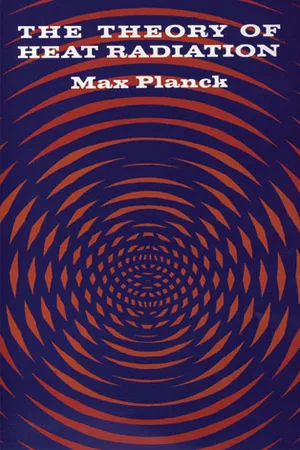
The Theory of Heat Radiation
About this book
Information
PART I
FUNDAMENTAL FACTS AND DEFINITIONS
RADIATION OF HEAT
CHAPTER I
GENERAL INTRODUCTION
1. Heat may be propagated in a stationary medium in two entirely different ways, namely, by conduction and by radiation. Conduction of heat depends on the temperature of the medium in which it takes place, or more strictly speaking, on the nonuniform distribution of the temperature in space, as measured by the temperature gradient. In a region where the temperature of the medium is the same at all points there is no trace of heat conduction.
Radiation of heat, however, is in itself entirely independent of the temperature of the medium through which it passes. It is possible, for example, to concentrate the solar rays at a focus by passing them through a converging lens of ice, the latter remaining at a constant temperature of 0°, and so to ignite an inflammable body. Generally speaking, radiation is a far more complicated phenomenon than conduction of heat. The reason for this is that the state of the radiation at a given instant and at a given point of the medium cannot be represented, as can the flow of heat by conduction, by a single vector (that is, a single directed quantity). All heat rays which at a given instant pass through the same point of the medium are perfectly independent of one another, and in order to specify completely the state of the radiation the intensity of radiation must be known in all the directions, infinite in number, which pass through the point in question; for this purpose two opposite directions must be considered as distinct, because the radiation in one of them is quite independent of the radiation in the other.
2. Putting aside for the present any special theory of heat radiation, we shall state for our further use a law supported by a large number of experimental facts. This law is that, so far as their physical properties are concerned, heat rays are identical with light rays of the same wave length. The term “ heat radiation,” then, will be applied to all physical phenomena of the same nature as light rays. Every light ray is simultaneously a heat ray. We shall also, for the sake of brevity, occasionally speak of the “color” of a heat ray in order to denote its wave length or period. As a further consequence of this law we shall apply to the radiation of heat all the well-known laws of experimental optics, especially those of reflection and refraction, as well as those relating to the propagation of light. Only the phenomena of diffraction, so far at least as they take place in space of considerable dimensions, we shall exclude on account of their rather complicated nature. We are therefore obliged to introduce right at the start a certain restriction with respect to the size of the parts of space to be considered. Throughout the following discussion it will be assumed that the linear dimensions of all parts of space considered, as well as the radii of curvature of all surfaces under consideration, are large compared with the wave lengths of the rays considered. With this assumption we may, without appreciable error, entirely neglect the influence of diffraction caused by the bounding surfaces, and everywhere apply the ordinary laws of reflection and refraction of light. To sum up: We distinguish once for all between two kinds of lengths of entirely different orders of magnitude—dimensions of bodies and wave lengths. Moreover, even the differentials of the former, i.e., elements of length, area and volume, will be regarded as large compared with the corresponding powers of wave lengths. The greater, therefore, the wave length of the rays we wish to consider, the larger must be the parts of space considered. But, inasmuch as there is no other restriction on our choice of size of the parts of space to be considered, this assumption will not give rise to any particular difficulty.
3. Even more essential for the whole theory of heat radiation than the distinction between large and small lengths, is the distinction between long and short intervals of time. For the definition of intensity of a heat ray, as being the energy transmitted by the ray per unit time, implies the assumption that the unit of time chosen is large compared with the period of vibration corresponding to the color of the ray. If this were not so, obviously the value of the intensity of the radiation would, in general, depend upon the particular phase of vibration at which the measurement of the energy of the ray was begun, and the intensity of a ray of constant period and amplitude would not be independent of the initial phase, unless by chance the unit of time were an integral multiple of the period. To avoid this difficulty, we are obliged to postulate quite generally that the unit of time, or rather that element of time used in defining the intensity, even if it appear in the form of a differential, must be large compared with the period of all colors contained in the ray in question.
The last statement leads to an important conclusion as to radiation of variable intensity. If, using an acoustic analogy, we speak of “beats” in the case of intensities undergoing periodic changes, the “unit” of time required for a definition of the instantaneous intensity of radiation must necessarily be small compared with the period of the beats. Now, since from the previous statement our unit must be large compared with a period of vibration, it follows that the period of the beats must be large compared with that of a vibration. Without this restriction it would be impossible to distinguish properly between “beats” and simple “vibrations.” Similarly, in the general case of an arbitrarily variable intensity of radiation, the vibrations must take place very rapidly as compared with the relatively slower changes in intensity. These statements imply, of course, a certain far-reaching restriction as to the generality of the radiation phenomena to be considered.
It might be added that a very similar and equally essential restriction is made in the kinetic theory of gases by dividing the motions of a chemically simple gas into two classes: visible, coarse, or...
Table of contents
- DOVER BOOKS ON PHYSICS
- Title Page
- Copyright Page
- TRANSLATOR’S PREFACE
- PREFACE TO SECOND EDITION
- PREFACE TO FIRST EDITION
- Table of Contents
- ERRATA
- PART I - FUNDAMENTAL FACTS AND DEFINITIONS
- PART II - DEDUCTIONS FROM ELECTRODYNAMICS AND THERMODYNAMICS
- PART III - ENTROPY AND PROBABILITY
- PART IV - A SYSTEM OF OSCILLATORS IN A STATIONARY FIELD OF RADIATION
- PART V - IRREVERSIBLE RADIATION PROCESSES
- AUTHOR’S BIBLIOGRAPHY
- APPENDIX I
- APPENDIX II
Trusted by 375,005 students
Access to over 1.5 million titles for a fair monthly price.
Study more efficiently using our study tools.
Frequently asked questions
Yes, you can cancel anytime from the Subscription tab in your account settings on the Perlego website. Your subscription will stay active until the end of your current billing period. Learn how to cancel your subscription
No, books cannot be downloaded as external files, such as PDFs, for use outside of Perlego. However, you can download books within the Perlego app for offline reading on mobile or tablet. Learn how to download books offline
Perlego offers two plans: Essential and Complete
- Essential is ideal for learners and professionals who enjoy exploring a wide range of subjects. Access the Essential Library with 800,000+ trusted titles and best-sellers across business, personal growth, and the humanities. Includes unlimited reading time and Standard Read Aloud voice.
- Complete: Perfect for advanced learners and researchers needing full, unrestricted access. Unlock 1.5M+ books across hundreds of subjects, including academic and specialized titles. The Complete Plan also includes advanced features like Premium Read Aloud and Research Assistant.
We are an online textbook subscription service, where you can get access to an entire online library for less than the price of a single book per month. With over 1.5 million books across 990+ topics, we’ve got you covered! Learn about our mission
Look out for the read-aloud symbol on your next book to see if you can listen to it. The read-aloud tool reads text aloud for you, highlighting the text as it is being read. You can pause it, speed it up and slow it down. Learn more about Read Aloud
Yes! You can use the Perlego app on both iOS and Android devices to read anytime, anywhere — even offline. Perfect for commutes or when you’re on the go.
Please note we cannot support devices running on iOS 13 and Android 7 or earlier. Learn more about using the app
Please note we cannot support devices running on iOS 13 and Android 7 or earlier. Learn more about using the app
Yes, you can access The Theory of Heat Radiation by Max Planck in PDF and/or ePUB format, as well as other popular books in Physical Sciences & Physics. We have over 1.5 million books available in our catalogue for you to explore.