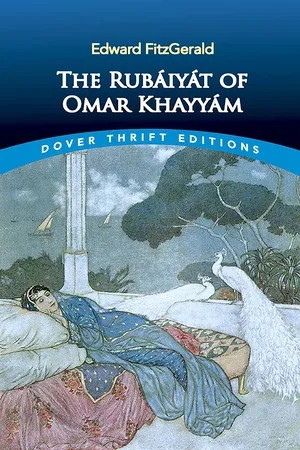
Omar Khayyám (1048–1122) was a Persian mathematician, astronomer, and a philosopher who was not known as a poet in his lifetime. Later, a body of quatrains became attached to his name, although not all were his works. These verses lay in obscurity until 1859, when Edward FitzGerald (1809–1883), an English country gentleman, published a free adaptation of this Persian poetry. After its discovery by D. G. Rossetti and others, the verse became extremely popular. Essentially a hedonist and a skeptic, Omar Khayyám, through FitzGerald, spoke with both an earthy and spiritual freedom that stirred a universal response. As a result, the Rubáiyát became one of the best-known and most often quoted English classics. The fifth edition, published posthumously in 1889, was based on FitzGerald's handwritten changes in a copy of the fourth edition, and is traditionally printed with the first edition.
- 64 pages
- English
- ePUB (mobile friendly)
- Available on iOS & Android
eBook - ePub
About this book
Information
Text of the Fifth Edition
(1889)

1
Wake! For the Sun, who scatter’d into flight
The Stars before him from the Field of Night,
Drives Night along with them from Heav’n, and strikes
The Sultan’s Turret with a Shaft of Light.
The Stars before him from the Field of Night,
Drives Night along with them from Heav’n, and strikes
The Sultan’s Turret with a Shaft of Light.
2
Before the phantom of False morning died,
Methought a Voice within the Tavern cried,
“When all the Temple is prepared within,
“Why nods the drowsy Worshipper outside?”
Methought a Voice within the Tavern cried,
“When all the Temple is prepared within,
“Why nods the drowsy Worshipper outside?”
3
And, as the Cock crew, those who stood before
The Tavern shouted—“Open then the Door!
”You know how little while we have to stay,
“And, once departed, may return no more.”
The Tavern shouted—“Open then the Door!
”You know how little while we have to stay,
“And, once departed, may return no more.”
4
Now the New Year reviving old Desires,
The thoughtful Soul to Solitude retires,
Where the WHITE HAND OF MOSES on the Bough
Puts out, and Jesus from the Ground suspires.
The thoughtful Soul to Solitude retires,
Where the WHITE HAND OF MOSES on the Bough
Puts out, and Jesus from the Ground suspires.
5
Iram indeed is gone with all his Rose,
And Jamshyd’s Sev’n-ring’d Cup where no one knows;
But still a Ruby kindles in the Vine,
And many a Garden by the Water blows.
And Jamshyd’s Sev’n-ring’d Cup where no one knows;
But still a Ruby kindles in the Vine,
And many a Garden by the Water blows.
6
And David’s Lips are lockt; but in divine
High-piping Pehleví, with “Wine! Wine! Wine!
”Red Wine!“—the Nightingale cries to the Rose
That sallow cheek of hers to incarnadine.
High-piping Pehleví, with “Wine! Wine! Wine!
”Red Wine!“—the Nightingale cries to the Rose
That sallow cheek of hers to incarnadine.
7
Come, fill the Cup, and in the fire of Spring
Your Winter-garment of Repentance fling:
The Bird of Time has but a little way
To flutter—and the Bird is on the Wing.
Your Winter-garment of Repentance fling:
The Bird of Time has but a little way
To flutter—and the Bird is on the Wing.
8
Whether at Naishápúr or Babylon,
Whether the Cup with sweet or bitter run,
The Wine of Life keeps oozing drop by drop,
The Leaves of Life keep falling one by one.
Whether the Cup with sweet or bitter run,
The Wine of Life keeps oozing drop by drop,
The Leaves of Life keep falling one by one.
9
Each Morn a thousand Roses brings, you say:
Yes, but where leaves the Rose of Yesterday?
And this first Summer month that brings the Rose
Shall take Jamshyd and Kaikobád away.
Yes, but where leaves the Rose of Yesterday?
And this first Summer month that brings the Rose
Shall take Jamshyd and Kaikobád away.
10
Well, let it take them! What have we to do
With Kaikobád the Great, or Kaikhosrú?
Let Zál and Rustum bluster as they will,
Or Hátim call to Supper—heed not you.
With Kaikobád the Great, or Kaikhosrú?
Let Zál and Rustum bluster as they will,
Or Hátim call to Supper—heed not you.
11
With me along the strip of Herbage strown
That just divides the desert from the sown,
Where name of Slave and Sultan is forgot—
And Peace to Mahmúd on his golden Throne!
That just divides the desert from the sown,
Where name of Slave and Sultan is forgot—
And Peace to Mahmúd on his golden Throne!
12
A Book of Verses underneath the Bough,
A Jug of Wine, a Loaf of Bread—and Thou
Beside me singing in the Wilderness—
Oh, Wilderness were Paradise enow!
A Jug of Wine, a Loaf of Bread—and Thou
Beside me singing in the Wilderness—
Oh, Wilderness were Paradise enow!
13
Some for the Glories of This World; and some
Sigh for the Prophet’s Paradise to come;
Ah, take the Cash, and let the Credit go,
Nor heed the rumble of a distant Drum!
Sigh for the Prophet’s Paradise to come;
Ah, take the Cash, and let the Credit go,
Nor heed the rumble of a distant Drum!
14
Look to the blowing Rose about us—“Lo,
“Laughing,” she says, ”into the world I blow,
“At once the silken tassel of my Purse
“Tear, and its Treasure on the Garden throw.”
“Laughing,” she says, ”into the world I blow,
“At once the silken tassel of my Purse
“Tear, and its Treasure on the Garden throw.”
15
And those who husbanded the Golden grain,
And those who flung it to the winds like Rain,
Alike to no such aureate Earth are turn’d
As, buried once, Men want dug up again.
And those who flung it to the winds like Rain,
Alike to no such aureate Earth are turn’d
As, buried once, Men want dug up again.
16
The Worldly Hope men set their H...
Table of contents
- Title Page
- Copyright Page
- Note to the Dover Edition
- Table of Contents
- Text of the First Edition - (1859)
- Text of the Fifth Edition - (1889)
- Notes
Trusted by 375,005 students
Access to over 1.5 million titles for a fair monthly price.
Study more efficiently using our study tools.
Frequently asked questions
Yes, you can cancel anytime from the Subscription tab in your account settings on the Perlego website. Your subscription will stay active until the end of your current billing period. Learn how to cancel your subscription
No, books cannot be downloaded as external files, such as PDFs, for use outside of Perlego. However, you can download books within the Perlego app for offline reading on mobile or tablet. Learn how to download books offline
Perlego offers two plans: Essential and Complete
- Essential is ideal for learners and professionals who enjoy exploring a wide range of subjects. Access the Essential Library with 800,000+ trusted titles and best-sellers across business, personal growth, and the humanities. Includes unlimited reading time and Standard Read Aloud voice.
- Complete: Perfect for advanced learners and researchers needing full, unrestricted access. Unlock 1.5M+ books across hundreds of subjects, including academic and specialized titles. The Complete Plan also includes advanced features like Premium Read Aloud and Research Assistant.
We are an online textbook subscription service, where you can get access to an entire online library for less than the price of a single book per month. With over 1.5 million books across 990+ topics, we’ve got you covered! Learn about our mission
Look out for the read-aloud symbol on your next book to see if you can listen to it. The read-aloud tool reads text aloud for you, highlighting the text as it is being read. You can pause it, speed it up and slow it down. Learn more about Read Aloud
Yes! You can use the Perlego app on both iOS and Android devices to read anytime, anywhere — even offline. Perfect for commutes or when you’re on the go.
Please note we cannot support devices running on iOS 13 and Android 7 or earlier. Learn more about using the app
Please note we cannot support devices running on iOS 13 and Android 7 or earlier. Learn more about using the app
Yes, you can access The Rubáiyát of Omar Khayyám by Edward FitzGerald in PDF and/or ePUB format, as well as other popular books in Literature & Personal Success. We have over 1.5 million books available in our catalogue for you to explore.