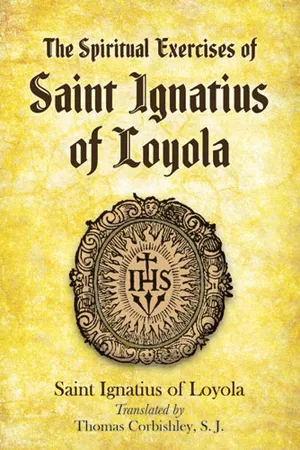
In this unique handbook of Christian literature, the founder of the Jesuits offers a way of "raising the mind and heart to God." Saint Ignatius of Loyola avoids setting a formula for prayer, providing readers with an extensive variety of meditative themes. Although originally intended for those making a retreat under the direction of an experienced master, the spiritual exercises have since become much more widely known and used, and they offer an excellent resource for private devotions.
eBook - ePub
The Spiritual Exercises of Saint Ignatius of Loyola
- 128 pages
- English
- ePUB (mobile friendly)
- Available on iOS & Android
eBook - ePub
The Spiritual Exercises of Saint Ignatius of Loyola
About this book
Information
Topic
Theology & ReligionSubtopic
Christian DenominationsFOURTH WEEK
FIRST CONTEMPLATION
218. Christ our Lord appears to our Lady [§ 299].
The usual preparatory prayer.
219. First preliminary. The story. Christ has died on the Cross, and His body, though still united with the Divinity, has remained separated from His soul. His soul, now in a state of happiness and also united with the Divinity, has been down to the lower regions where He has set free the righteous souls. He then returns to the sepulchre and, rising from the dead, appears, body and soul, to His Blessed Mother.
220. Second preliminary. The picture. See how the tomb was arranged. See also the place, that is, the house where our Lady was, studying it in detail, her room, oratory and the rest.
221. Third preliminary. Prayer for my special need. Now it will be grace to be filled with joy and happiness at the thought of Christ’s great glory and happiness.
222. The first, second and third headings. The usual ones, as in the Supper.
223. Fourth heading. Reflect how the Divinity, hidden, as it seemed, in the Passion, now, in the sacred Resurrection, reappears and shows its effects in truth and holiness.
224. Fifth heading. See Christ our Lord doing the work of consolation, comparing it with the way friends are accustomed to console one another.
225. Colloquy. End with one or more colloquies, according to circumstances, finally saying the Our Father.
NOTES
226. (1) THE following contemplations go through all the events from the Resurrection onwards, including the Ascension, in the way described below. For the rest of the retreat, throughout the fourth week, the same outline and method is to be strictly observed as during the whole week of the Passion. So, in this first contemplation on the Resurrection, the preliminaries are determined by the subject-matter; so also for the five headings and the additional practices, as given below. Again, everything that remains is controlled by the pattern of the week of the Passion, as to repetitions, application of senses, shortening or lengthening the events, and so on.
227. (2) As a rule, during this fourth week, it is more appropriate than in previous ones to have four exercises and not five: the first, immediately after getting up in the morning; the second at Mass-time or before the midday meal, in place of the first repetition; the third, about the time for Vespers, in place of the second repetition; the fourth before supper, making an application of the senses to the matter of the three exercises of the day, picking out and delaying over the more important sections, and those in which the retreatant has felt more moved and spiritually refreshed.
228. (3) Whilst it is true that in all the contemplations a definite number of headings (e.g., three or five) is given, this does not mean that the person making the contemplation may not take more or fewer, according as it helps. So, before beginning the contemplation, it is worth while to look ahead and settle on a definite number of headings to be used.
229. (4) During this fourth week, out of the ten Additional Practices, changes are to be made in the second, sixth, seventh and tenth.
The second: As soon as I wake up, I must call to mind the contemplation to be made, aiming at a feeling of loving joy in the great joy and happiness of our Lord Christ.
The sixth: I will call to mind and think of such things as arouse happiness, lightheartedness and spiritual joy, such as heavenly glory.
The seventh: I will enjoy the light and the pleasure appropriate to the season, in the warmer months the coolness of shade, and in winter the warmth of the sun or of a fire, according as I am led to believe that this will help me to share the joy of my Creator and Redeemer.
The tenth: Instead of penance, I will aim at temperance and moderation in everything, apart from the fasting and abstinence commanded by the Church, which must always be kept where there is no legitimate impediment.
CONTEMPLATION FOR ACHIEVING LOVE
230. Note. Two preliminary observations:
(1) Love should be expressed in doing rather than in protesting.
231. (2) Love consists in a reciprocal interchange, the lover handing over and sharing with the beloved his possessions, gifts and capacities, and vice versa. So, if one of them has learning, he gives it to the other who lacks it; so, too, with positions of honour or material possessions; and the other does the same.
The usual preparatory prayer.
232. First preliminary. The picture. I am standing in the presence of our Lord God, His angels and His saints, who are pleading for me.
233. Second preliminary. Asking for what I want. Here it will be to beg for a deep-felt appreciation of all the blessings I have been given, that out of the fullness of my gratitude I may become completely devoted to His Divine Majesty in effective love.
234. First heading. Recall the good things I have had from creation: my redemption, personal gifts. I will rouse myself to reckon how much our Lord God has done for me, how much that is His own He has shared with me; I will further consider the divine plan whereby this same Lord wants to give me all that it is in His power to give.
I then turn to myself and try to see what reason and justice demand that I offer, nay, give, His Divine Majesty in return—all that belongs to me, and with it all that I am in myself—in the spirit of one who makes a present out of a great love:
Take, Lord, into Your possession, my complete freedom of action, my memory, my understanding and my entire will, all that I have, all that I own: it is Your gift to me, I now return it to You. It is all Yours, to be used simply as You wish. Give me Your Love and Your grace; it is all I need.
235. Second heading. See God living in His creatures:
in matter, giving it existence,
in plants, giving them life,
in animals, giving them consciousness,
in men, giving them intelligence.
So He lives in me, giving me existence, life, consciousness, intelligence.
More, He makes me His temple, since I have been created wearing the image and likeness of God.
Again I will turn to myself, as indicated under the first heading, or in some other way that I prefer.
(This also applies to the following headings.)
236. Third heading. Think of God energizing, as though He were actually at work, in every created reality, in the sky, in matter, plants and fruits, herds and the like: it is He who creates them and keeps them in being, He who confers life or consciousness, and so on.
Then I turn to myself.
237. Fourth heading. Realize that all gifts and benefits come from above. My moderate ability comes from the supreme Omnipotence on high, as do my sense of justice, kindliness, charity, mercy, and so on, like sunbeams from the sun or streams from their source.
I will end, as was said above, by turning to myself.
In conclusion, a colloquy and an Our Father.
THREE WAYS OF PRAYING
I. ON THE COMMANDMENTS
238. THE first way of praying deals with the Ten Commandments, the seven deadly sins, the three powers of the soul and the five bodily senses. It is not meant to give a systematic method of prayer so much as to provide a systematic way of proceeding in certain exercises designed to prepare the soul to advance to a degree where its prayer becomes acceptable.
239. First of all, something like the second Additional Practice of the second week is to be performed; that is to say, before actually beginning to pray, my mind should rest for a time. Sitting down or walking about, as I find more helpful, I should reflect where I am going and what for. Every kind of prayer should start with this practice.
240. A preparatory prayer is to be made like this: I ask God our Lord to give me grace to recognize where I have sinned in the matter of the Ten Commandments, and so ask for the help of grace to do better for the future. I should ask for a complete understanding of them so that I may keep them better, thereby giving greater praise and glory to His Divine Majesty.
241. For this first way of praying it is useful to examine carefully the First Commandment, seeing how well I have kept it, where I have failed. As a rule, this examination ...
Table of contents
- Title Page
- Copyright Page
- Table of Contents
- INTRODUCTION
- NOTES
- 21. SPIRITUAL EXERCISES
- FUNDAMENTAL PRINCIPLE
- FIRST WEEK
- SECOND WEEK
- THIRD WEEK
- FOURTH WEEK
Trusted by 375,005 students
Access to over 1.5 million titles for a fair monthly price.
Study more efficiently using our study tools.
Frequently asked questions
Yes, you can cancel anytime from the Subscription tab in your account settings on the Perlego website. Your subscription will stay active until the end of your current billing period. Learn how to cancel your subscription
No, books cannot be downloaded as external files, such as PDFs, for use outside of Perlego. However, you can download books within the Perlego app for offline reading on mobile or tablet. Learn how to download books offline
Perlego offers two plans: Essential and Complete
- Essential is ideal for learners and professionals who enjoy exploring a wide range of subjects. Access the Essential Library with 800,000+ trusted titles and best-sellers across business, personal growth, and the humanities. Includes unlimited reading time and Standard Read Aloud voice.
- Complete: Perfect for advanced learners and researchers needing full, unrestricted access. Unlock 1.5M+ books across hundreds of subjects, including academic and specialized titles. The Complete Plan also includes advanced features like Premium Read Aloud and Research Assistant.
We are an online textbook subscription service, where you can get access to an entire online library for less than the price of a single book per month. With over 1.5 million books across 990+ topics, we’ve got you covered! Learn about our mission
Look out for the read-aloud symbol on your next book to see if you can listen to it. The read-aloud tool reads text aloud for you, highlighting the text as it is being read. You can pause it, speed it up and slow it down. Learn more about Read Aloud
Yes! You can use the Perlego app on both iOS and Android devices to read anytime, anywhere — even offline. Perfect for commutes or when you’re on the go.
Please note we cannot support devices running on iOS 13 and Android 7 or earlier. Learn more about using the app
Please note we cannot support devices running on iOS 13 and Android 7 or earlier. Learn more about using the app
Yes, you can access The Spiritual Exercises of Saint Ignatius of Loyola by Saint Ignatius of Loyola, Thomas Corbishley in PDF and/or ePUB format, as well as other popular books in Theology & Religion & Christian Denominations. We have over 1.5 million books available in our catalogue for you to explore.