Process Gas Chromatographs
eBook - ePub

Process Gas Chromatographs

Fundamentals, Design and Implementation

  1. English
  2. ePUB (mobile friendly)
  3. Available on iOS & Android
eBook - ePub

Process Gas Chromatographs

Fundamentals, Design and Implementation

About this book

A guide to the fundamentals of applied gas chromatography and the process gas chromatograph, with practical procedures for design and troubleshooting

This comprehensive resource provides the theory that underpins a full understanding of the fundamental techniques of gas chromatography and the process analyzer. Without relying on complex mathematics, the book addresses hands-on applications of gas chromatographs within process industries. The author – a noted expert on the topic – details both the scientific information needed to grasp the material presented and the practical applications for professionals working in the field.

Process Gas Chromatographs: Fundamentals, Design and Implementation comprises 15 chapters, a glossary of terms and a series of self-assessment questions and quizzes. This important resource:

  • Describes practical procedures for design and troubleshooting
  • Contains concise chapters that provide a structured course for advanced students in process engineering
  • Reviews the fundamentals of applied gas chromatography
  • Details the operation and maintenance of process gas chromatographs
  • Offers a summary, and self-assessment questions, for every chapter
  • Is written by an international expert in the field with extensive industry knowledge and teaching experience in courses on process sampling systems and gas chromatography

Written for process analyzer engineers and technicians, application engineers, and industrial environmental engineers, Process Gas Chromatographs: Fundamentals, Design and Implementation offers an essential guide to the basics of gas chromatography and reviews the applications of process gas chromatographs in industry today.
Frequently asked questions

Yes, you can cancel anytime from the Subscription tab in your account settings on the Perlego website. Your subscription will stay active until the end of your current billing period. Learn how to cancel your subscription.
At the moment all of our mobile-responsive ePub books are available to download via the app. Most of our PDFs are also available to download and we're working on making the final remaining ones downloadable now. Learn more here.
Perlego offers two plans: Essential and Complete
  • Essential is ideal for learners and professionals who enjoy exploring a wide range of subjects. Access the Essential Library with 800,000+ trusted titles and best-sellers across business, personal growth, and the humanities. Includes unlimited reading time and Standard Read Aloud voice.
  • Complete: Perfect for advanced learners and researchers needing full, unrestricted access. Unlock 1.4M+ books across hundreds of subjects, including academic and specialized titles. The Complete Plan also includes advanced features like Premium Read Aloud and Research Assistant.
Both plans are available with monthly, semester, or annual billing cycles.
We are an online textbook subscription service, where you can get access to an entire online library for less than the price of a single book per month. With over 1 million books across 1000+ topics, we’ve got you covered! Learn more here.
Look out for the read-aloud symbol on your next book to see if you can listen to it. The read-aloud tool reads text aloud for you, highlighting the text as it is being read. You can pause it, speed it up and slow it down. Learn more here.
Yes! You can use the Perlego app on both iOS or Android devices to read anytime, anywhere — even offline. Perfect for commutes or when you’re on the go.
Please note we cannot support devices running on iOS 13 and Android 7 or earlier. Learn more about using the app.
Yes, you can access Process Gas Chromatographs by Tony Waters in PDF and/or ePUB format, as well as other popular books in Technology & Engineering & Engineering General. We have over one million books available in our catalogue for you to explore.

Information

Part One
PGC fundamentals

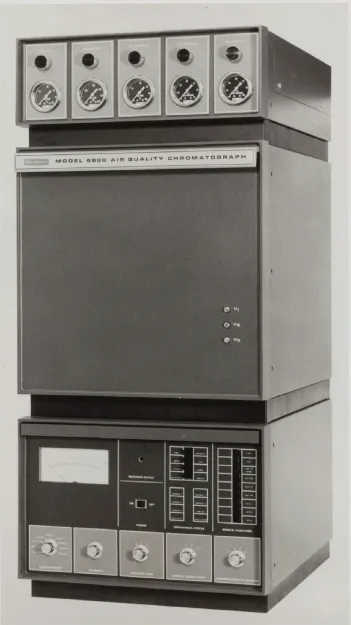
1975 Beckman Model 6800 Air Quality Chromatograph.
Photo depicts a Classic Process Gas Chromatograph1975 Beckman Model 6800 Air Quality Chromatograph.
Figure 1.1 A Classic Process Gas Chromatograph.
Source: Beckman Historical Collection, Box 58, Folder 28. Science History Institute, Philadelphia. https://digital.sciencehistory.org/works/474299142 Reproduced with permission of Rosemount, Inc.
ā€œWe cannot teach people anything; we can only help them discover it within themselves.ā€
Attributed to Galileo Galilei1564–1642

Why study this?

Part One introduces the art and science of gas chromatography (GC) as applied to the industrial process instrument.
These four chapters explain how a GC column works, why the compounds in the injected sample form the characteristic peak shape, how one peak becomes separate from another peak, and how we can predict the position and shape of peaks on a chromatogram from known patterns of peak timing and width.
The text presents this information in an easy‐to‐read and mostly non‐mathematical manner. Yet it shuns simplistic analogies of what happens inside a GC column because they tend to mislead rather than to inform. Instead, it offers a challenging insight into real chromatographic behavior.
The knowledge gained here is a necessary preparation for understanding the function of the hardware devices and software techniques introduced in later chapters of the book. For those who aspire to be proficient in the application or troubleshooting of process gas chromatographs, mastery of these concepts is not optional.

1
An introduction

ā€œBooks on gas chromatography, of which there are many, usually start by reviewing the historical development of the science, so we won't do that here. Instead, we'll start by understanding the basic technique: what a chromatograph does and how it does it. To read the fascinating history of chromatographic science, see the beautiful book by Ettre (2008)ā€.

Chromatographic separation

Let's start by looking briefly at the various forms of chromatography.
Chromatography by itself is not a complete analytical technique. It's just a way to separate one kind of molecule from another kind of molecule. Of course, for those reading this book, the reason for separating those molecules is to measure them alone, without interference from other molecules. This is the analytical use of chromatography.
While analytical measurement is the main use of chromatography, it is not the only one. Some laboratory‐scale and industrial‐scale processes use a chromatographic separation to isolate extremely pure batches of valuable chemicals. This usage is known as preparative chromatography, and it works with much larger quantities of material than analytical chromatography does. This textbook focuses on analysis, so it doesn't further discuss the preparative use of chromatography.
When used as part of an analytical technique, chromatography is a very effective way to separate the measured compounds from each other and from all the other chemical compounds present in the analyzed material. After all desired compounds have been isolated, another device measures each one independently.
Keep in mind, then, that chromatographic analysis is always a two‐stage process: first separation, then measurement.
There are many ways to produce a chromatographic separation, and they involve all possible combinations of gases, liquids, and solids. While quite different in practice, these various forms of chromatography share some common features. All practical chromatographic separations involve a fluid material moving across the surface of a stationary material.
In the formal terminology of chromatography, the moving material is the mobile phase, and the immobile material is the stationary phase.
The mobile phase may be a gas or a liquid, from which we derive the terms:
  • gas chromatography, in which the mobile phase is a gas.
  • liquid chromatography, in which the mobile phase is a liquid.
A few applications have used a supercritical fluid as the mobile phase.
This book is about the analytical use of gas chromatography for the online measurement of industrial processes. We won't be discussing liquid chromatography.
In gas chromatography, the mobile phase is always a gas, and it's common to call it the carrier gas.
The carrier gas flows through a long narrow tube called a chromatographic column, which contains the stationary phase. The stationary...

Table of contents

  1. Cover
  2. Table of Contents
  3. Copyright
  4. Preface
  5. Contributors
  6. Acknowledgments
  7. Part One: PGC fundamentals
  8. Part Two: PGC analytics
  9. Part Three: PGC control
  10. Answers to self‐assessment questions
  11. BibliographyBibliography
  12. Glossary
  13. Index
  14. End User License Agreement