As demand has increased for new types of equipment that are more suited to the ever-evolving world of industry, demand for both new and traditional types of actuators has soared. From automotive and aeronautical to biomedical and robotics, engineers are constantly developing actuating devices that are adapted to their particular needs in their particular field, and actuators are used in almost every field of engineering that there is.
This volume not only lays out the fundamentals of actuators, such as how they operate, the different kinds, and their various applications, but it also informs the engineer or student about the new actuators that are being developed and the state-of-the-art of actuators. Edited and written by highly experienced and well-respected engineers with a deep understanding of their subject, there is no other volume on actuators that is more current or comprehensive.
Whether as a guide for the latest innovations in actuators, a refresher reference work for the veteran engineer, or an introductory text for the engineering student, this is a must-have for any engineer's or university's library. Covering the theory and the practical applications, this breakthrough volume is a "one stop shop" for any engineer or student interested in actuators.
N. Suresh Kumar1*, R. Padma Suvarna1, K. Chandra Babu Naidu2†, S. Ramesh2, M.S.S.R.K.N. Sarma2, H. Manjunatha3, Ramyakrishna Pothu4 and Rajender Boddula5
1Department of Physics, JNTUA, Anantapuramu, India
2Department of Physics, GITAM Deemed to be University, Bangalore, India
3Department of Chemistry, GITAM Deemed to be University, Bangalore, India
4College of Chemistry and Chemical Engineering, Hunan University, Changsha, China
5CAS Center for Excellence in Nanoscience, National Center for Nanoscience and Technology, Beijing, China
Abstract Piezoelectric actuators (PEAs) are a type of microactuators which mainly use the inverse piezoelectric effect to produce small displacement at high speed by applying voltage. This chapter includes the detailed discussion on piezoelectric actuators in the direction of industrial benefits. In addition, the classification of piezoelectric actuators is made. Especially, the piezoelectric actuators showed the MEMS (microelectromechanical systems) applications at larger extent. We elaborated different piezoelectric materials such as lead and lead zirconium-based compounds for actuator applications. In view of this, few parameters like memory, domain rotation, etc., are considered for justifying the actuator applications. The importance of these actuators towards robotics is also elucidated.
A part of a device which moves or controls the mechanism is called an actuator. Example is an electric motor which converts a control signal to mechanical action. An actuator is one which converts energy into motion. This energy may be hydraulic, pneumatic, electric, thermal, mechanical, or even human power [1]. Whenever a control signal is received, actuator converts the energy of the signal into mechanical motion. The control system may be a fixed mechanical/electronic system or a software-based printer device/robot. Based on the type of control system or energy, actuators are classified into different types which are hydraulic, pneumatic, electrical, mechanical actuators, etc.
1.2 Types of Actuators
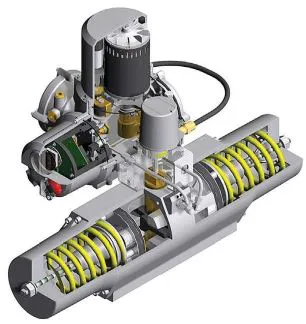
A hydraulic actuator uses hydraulic power for the mechanical process. Here, the output will be a linear, rotatory, or oscillatory motion. In hydraulic systems, energy is transmitted with the help of pressure of fluid in a sealed system. It has advantages like efficient power transmission, accuracy, and also flexible in maintenance. Usage of these systems is safe in chemical plants and mines as they do not produce any sparks. Here, leakage of the fluid is the major drawback. Because, once the fluid leaks, it may catch fire or leads to serious injuries when it bursts [2]. Examples are brakes in cars/trucks, wheelchair lifts, hydraulic jacks, and flaps on air-crafts, etc. Figure 1.1 represents one type of hydraulic actuator.
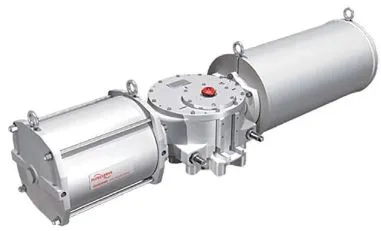
A pneumatic actuator rotation is shown in Figure 1.2. It uses energy in the form of compressed air at high pressure to produce motion. This actuator is mainly advisable in main engine controls for swift starting and stopping. These actuators are economical, lightweight, less maintenance, and simple when compared to other actuators. The disadvantage with this actuator is application-specific that is an actuator sized for a specific purpose cannot be used for other applications [3, 4].
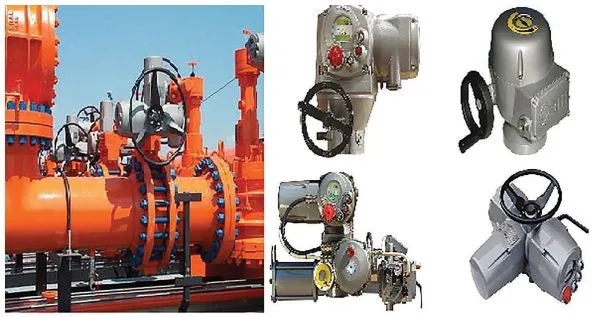
An electric actuator uses a motor for converting electrical energy into mechanical torque. This is used in multi-turn valves. Figure 1.3 shows different types of electric actuators. As there is no involvement of either fossil fuels or oils these actuators are the cleanest and easily available ones [5, 6]. Another type of actuator is supercoiled polymer (SCP) or twisted and coiled polymer (TCP) actuators which use electric power for actuating. These are made up of silver-coated nylon and gold and appear helical like a splicing. These are constructed by twisting like nylon thread such as fishing line. They serve as bicep muscle to control the motion of arms in robots. Because of electrical resistance, electrical energy gets converted into thermal energy also called Joule heating. When the temperature of this actuator is increased due to joule heating, counteraction of the polymer takes place resulting in contraction of the actuator [7].
Figure 1.1 Hydraulic actuator.
Figure 1.2 Pneumatic actuator.
Figure 1.3 Electric actuators.
Mechanical actuator converts one type of motion into another like rotatory into linear. Example for this type is rack and pinion. This type of actuators depends on constitutional components like gears and rails, pulleys, and chairs. In order to use actuators in the fields of agriculture for fruit harvesting and biomedicine in robotics soft actuators are being developed. Because of amalgamation of microscopic changes at the basic (molecular) level into a macroscopic distortion, soft actuators generate flexible motion. Figure 1.4 represents mechanical actuator.
Electromechanical actuators are nothing but mechanical actuators in which the control signal is given by an electric motor which converts the rotatory motion into linear displacement. These actuators work on the inclined plane concept. The required inclination is provided by the threads of a lead screw. It acts as a ramp and converts small rotational force into linear displacement. Based on parameters like operation, speed increased load capacity, mechanical efficiency, etc., different EM actuators are designed which are shown in Figure 1.5. The common design consists of a lead screw passing through the motor. The lead nut is the only moving part while the lead screw remains fixed and non-rotating. When the motor rotates, the lead screw either extends outwards or retracts inwards. By using alternating threads on the same shaft, different actuators are designed. Actuators begin on the lead screw and provide a higher adjustment capability between the starts and the nut thread area of contact, influencing the extension speed and load capacity.
The density of motion of the nut is determined by the lead screw and by coupling the linkages to the nut. Usually, in many cases, screw is connected to the motor. Based on the amount of the loads, the actuator is expected to move various motors like dc brush, stepper, induction motors, etc. Coming to its advantages, the person handling this actuator can have complete control over the movement. They can control the velocity and position accurately without switching off the device or when the device is in running state, the force and motion profile can be changed by changing its software. These actuators consume power only when they are in operation. Low maintenance, high efficiency, and being environmentally friendly make these actuators a potential candidate in hazardous areas. These are used in packaging, food, energy process control, construction, and automation indust...
Table of contents
Cover
Table of Contents
Preface
1 Piezoelectric Actuators and Their Applications
2 Design Considerations for Shape Memory Alloy-Based Control Applications
3 Actuators in Mechatronics
4 Actuators Based on Hydrogels
5 Smart Polymer-Based Chemical Sensors
6 Shape Memory Actuators
7 Stimuli-Responsive Conducting Polymer Composites: Recent Progress and Future Prospects
8 Fluid Power Actuators
9 Conducting Polymer/Hydrogel Systems as Soft Actuators
Index
Also of Interest
End User License Agreement
Trusted by 375,005 students
Access to over 1.5 million titles for a fair monthly price.
Study more efficiently using our study tools.
Frequently asked questions
Yes, you can cancel anytime from the Subscription tab in your account settings on the Perlego website. Your subscription will stay active until the end of your current billing period. Learn how to cancel your subscription
No, books cannot be downloaded as external files, such as PDFs, for use outside of Perlego. However, you can download books within the Perlego app for offline reading on mobile or tablet. Learn how to download books offline
Perlego offers two plans: Essential and Complete
Essential is ideal for learners and professionals who enjoy exploring a wide range of subjects. Access the Essential Library with 800,000+ trusted titles and best-sellers across business, personal growth, and the humanities. Includes unlimited reading time and Standard Read Aloud voice.
Complete: Perfect for advanced learners and researchers needing full, unrestricted access. Unlock 1.5M+ books across hundreds of subjects, including academic and specialized titles. The Complete Plan also includes advanced features like Premium Read Aloud and Research Assistant.
Both plans are available with monthly, semester, or annual billing cycles.
We are an online textbook subscription service, where you can get access to an entire online library for less than the price of a single book per month. With over 1.5 million books across 990+ topics, we’ve got you covered! Learn about our mission
Look out for the read-aloud symbol on your next book to see if you can listen to it. The read-aloud tool reads text aloud for you, highlighting the text as it is being read. You can pause it, speed it up and slow it down. Learn more about Read Aloud
Yes! You can use the Perlego app on both iOS and Android devices to read anytime, anywhere — even offline. Perfect for commutes or when you’re on the go. Please note we cannot support devices running on iOS 13 and Android 7 or earlier. Learn more about using the app
Yes, you can access Actuators and Their Applications by Rajender Boddula,Abdullah M. Asiri in PDF and/or ePUB format, as well as other popular books in Technology & Engineering & Mechanical Engineering. We have over 1.5 million books available in our catalogue for you to explore.