Polymers for Light-Emitting Devices and Displays provides an in-depth overview of fabrication methods and unique properties of polymeric semiconductors, and their potential applications for LEDs including organic electronics, displays, and optoelectronics. Some of the chapter subjects include:
• The newest polymeric materials and processes beyond the classical structure of PLED
• Conjugated polymers and their application in the light-emitting diodes (OLEDs & PLEDs) as optoelectronic devices.
• The novel work carried out on electrospun nanofibers used for LEDs.
• The roles of diversified architectures, layers, components, and their structural modifications in determining efficiencies and parameters of PLEDs as high-performance devices.
• Polymer liquid crystal devices (PLCs), their synthesis, and applications in various liquid crystal devices (LCs) and displays.
• Reviews the state-of-art of materials and technologies to manufacture hybrid white light-emitting diodes based on inorganic light sources and organic wavelength converters.
eBook - ePub
Polymers for Light-emitting Devices and Displays
- English
- ePUB (mobile friendly)
- Available on iOS & Android
eBook - ePub
Polymers for Light-emitting Devices and Displays
About this book
Information
1
Applications of Polymer Light-Emitting Devices and Displays
D. Prakash Babu1, S. Naresh Kumar1, N. Suresh Kumar2, K. Chandra Babu Naidu3* and D. Baba Basha4
1School of Applied Sciences, REVA University, Bangalore, India
2Department of Physics, JNTUA, Anantapuramu, India
3Department of Physics, GITAM Deemed to be University, Bangalore, India
4Department of Physics, College of Computer and Information Sciences, Majmaah University, Al’Majmaah, Saudi Arabia
Abstract
This chapter gives information of polymer light-emitting diodes (PLEDs) and their applications. Besides, background, types, and the development of PLEDs also discussed. Further, the behavior of different PLEDs has been discussed with respect to various parameters, brightness, color purity, light conversion efficiency, and color stability are discussed.
This chapter gives information of polymer light-emitting diodes (PLEDs) and their applications. Besides, background, types, and the development of PLEDs also discussed. Further, the behavior of different PLEDs has been discussed with respect to various parameters, brightness, color purity, light conversion efficiency, and color stability are discussed.
Keywords: Polymer, light-emitting diodes, efficiency, color purity
1.1 Introduction
In the past one decade, the display technology has undergone several technological advancements and industries and household are looking for low cost, flexible, power efficient, and durable displays. Polymer light-emitting diodes (PLEDs), which convert electric energy into light, are promising devices with aforementioned features to convert electrical energy to light energy, which is the necessary component of any display technology. High temperature resistance, short response time, smooth brightness, and a large viewing angle are the additional advantages with PLEDs [1]. These special characteristics of PLEDs give the scope to use them in the applications where a large array of displays is required [2]. At present, inorganic light-emitting diodes are widely used. The advancement of technology demands advancement of display also, some times, the display device needs to be flexible, this flexibility can be easily provided by PLEDs. In this chapter, the basic structure of PLED, the mechanism of light emission, and different applications are discussed.
1.2 Background
In 1990, an article was first published in Nature on “Light-emitting polymers” by J. H. Burroughes, Richard Friend, and others [3].
Basic structure of PLED
The basic structure of a PLED is illustrated in Figure 1.1. It consists of thin layers of light-emitting polymers film sandwiched between a transparent electrode which is anode and a non-transparent electrode which is cathode. Indium tin oxide (ITO) layer coated on glass substrate is most commonly used as the transparent anode. The glass provides the mechanical support for the PLED. ITO being transparent to light allows the light photon created inside the diode to escape from the device. There are two polymer layers in a typical PLED structure; among them is the hole transporting layer and the other is the light-emitting layer. Generally, the metal cathode is deposited over of the polymers by means of thermal evaporation.
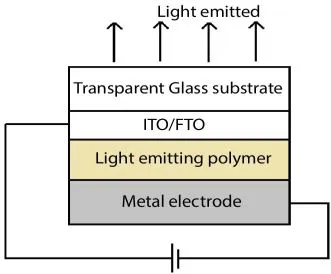
Figure 1.1 The basic structure of a PLED.
1.3 The Mechanism of Light Emission
Electron-hole recombination causes emission of a photon in visible region. Electrons are injected from the cathode to the LUMO (lowest unoccupied molecular orbit) and the holes are injected from the anode to the HOMO (highest occupied molecular orbit) of a conducting polymer. The reliability and the efficiency of the diode are strongly influenced by the materials which form the cathode, anode, and the emissive layers. A typical PLED may either be a single- layer device or a multilayer device. One example of PLED is the one fabricated from conjugated polymers including polyacetylene, polythiophene polypyrrole (PPy), poly (para-phenylene vinylene), and polyaniline (PANI) [4]. Another example of the active element used in PLED is the poly (p-phenylene vinylene) (PPV).
PLEDs like polymer light-emitting diodes and polymer light-emitting electrochemical cells gain huge interests owing to their high capabilities to serve as next generation illuminants and displays. Contrasted to inorganic light-emitting materials, conducting polymers possess very good film-forming behavior enabling the deposition uniformly by solution-based techniques, for example, screen printing and spin-coating that are competent of upscaling to industrial scale manufacturing. Polyfluorene, poly(p-phenylene vinylene), polycarbazole, and poly(p-phenylene) are widely researched; their solubility, morphology, stability, doping, etc., are proved to increase the device performance.
For example, poly(p-phenylene) films are widely synthesized by precursor methods because of its insolubility in commonly used organic solvents. Its solubility can be increased by the preparation of conducting polymers (ladder type) which leads to improved co-planarity [5]. Furthermore, a complete color display may be achieved through adjusting the structure of the molecule to regulate the energy gap of the HOMO-LUMO. Also, small amount of molecule doping proved to give desired luminous properties. Other than light emitting, color changes (electrochromic devices) and strain (electromechanical actuator) can also be stimulated by applying electric energy. Further, the electromechanical actuators directly convert the electrical energy to mechanical energy. These materials find applications in fabricating robotics, artificial muscles, etc. Electrochromic devices produce revocable color variation in reaction to the applied electric field, which makes it suitable for electronic skins and smart windows.
Owing to the tunable redox states under electricity, the conducting polymers are the fascinating materials for high performance electrochromic devices and electromechanical actuators. Further enhancement of the electrochromic or actuating ability of the polymer and the response speeds is improved by incorporating the graphene and other nanocarbon materials. For example, the multiwalled carbon nanotubes incorporated with polyaniline through an electrochemical deposition technique to aid as composite electrodes which can exhibit large conductivity ranges from 100 to 1,000 S/cm−1 that enables reversible and rapid electrochromic developments within short time [6]. PLEDs are not loaded with only merits. They do have a main disadvantage of weathering of the polymers with time. The disadvantage of the PLED technology is the sensitivity of the organic light-emitting materials to the atmospheric oxygen and water vapor. Hence, to protect PLEDs, a weather proof transparent polymer which is chemically and physically stable must be used for encapsulation.
1.4 Widely Used Polymers in PLED Applications
Among wide choices of polymers, some particular polymers gained special attention owing to their processability and functionality advantages that are discussed below. The advancement of important polymer material groups has been discussed here. This report gives the group of materials which can exhibit utmost potential till date to be espoused as the emissive materials in PLED applications, for example, the poly(fluorene)s, the poly(phenylenevinylene)s, etc. Polyfluorene homo- and co-polymers are purposefully emphasized because they are not well re-viewed, much progress has been made only recently, and this group of polymers are rapidly developed as a most promising viable LED polymeric material of widespread commercial interest.
1.4.1 Polyfluorene-Based Luminescent Polymers
Fukuda et al. reported the first fluorene-based polymers, by ferric chloride oxidative polymerization of 9-alkyl-fluorene and 9,9-dialkylfluorene [7, 8]. Their molecular weight was relatively low, with some-extent of separating and non-conjugated connections across locations except 2 and 7 [7, 8]. By using the transition-met...
Table of contents
- Cover
- Table of Contents
- Preface
- 1 Applications of Polymer Light-Emitting Devices and Displays
- 2 Polymer Light-Emitting Devices by Solution Processing
- 3 DFT Computational Modeling and Design of New Cyclopentadithiophene (CPDT) Derivatives for Highly Efficient Blue Emitters in OLEDs
- 4 Conjugated Polymer Light-Emitting Diodes
- 5 Application of Electrospun Materials in LEDs
- 6 Luminescent Polymer Light-Emitting Devices and Displays
- 7 Polymer Liquid Crystal Devices and Displays
- 8 Hybrid Inorganic-Organic White Light Emitting Diodes
- Index
- Also of Interest
- End User License Agreement
Trusted by 375,005 students
Access to over 1.5 million titles for a fair monthly price.
Study more efficiently using our study tools.
Frequently asked questions
Yes, you can cancel anytime from the Subscription tab in your account settings on the Perlego website. Your subscription will stay active until the end of your current billing period. Learn how to cancel your subscription
No, books cannot be downloaded as external files, such as PDFs, for use outside of Perlego. However, you can download books within the Perlego app for offline reading on mobile or tablet. Learn how to download books offline
Perlego offers two plans: Essential and Complete
- Essential is ideal for learners and professionals who enjoy exploring a wide range of subjects. Access the Essential Library with 800,000+ trusted titles and best-sellers across business, personal growth, and the humanities. Includes unlimited reading time and Standard Read Aloud voice.
- Complete: Perfect for advanced learners and researchers needing full, unrestricted access. Unlock 1.5M+ books across hundreds of subjects, including academic and specialized titles. The Complete Plan also includes advanced features like Premium Read Aloud and Research Assistant.
We are an online textbook subscription service, where you can get access to an entire online library for less than the price of a single book per month. With over 1.5 million books across 990+ topics, we’ve got you covered! Learn about our mission
Look out for the read-aloud symbol on your next book to see if you can listen to it. The read-aloud tool reads text aloud for you, highlighting the text as it is being read. You can pause it, speed it up and slow it down. Learn more about Read Aloud
Yes! You can use the Perlego app on both iOS and Android devices to read anytime, anywhere — even offline. Perfect for commutes or when you’re on the go.
Please note we cannot support devices running on iOS 13 and Android 7 or earlier. Learn more about using the app
Please note we cannot support devices running on iOS 13 and Android 7 or earlier. Learn more about using the app
Yes, you can access Polymers for Light-emitting Devices and Displays by Rajender Boddula, Mohd Imran Ahamed, Abdullah M. Asiri, Rajender Boddula,Mohd Imran Ahamed,Abdullah M. Asiri in PDF and/or ePUB format, as well as other popular books in Technology & Engineering & Materials Science. We have over 1.5 million books available in our catalogue for you to explore.