eBook - ePub
Green Adhesives
Preparation, Properties, and Applications
- English
- ePUB (mobile friendly)
- Available on iOS & Android
eBook - ePub
Green Adhesives
Preparation, Properties, and Applications
About this book
Green Adhesives: Preparation, Properties and Applications deals with the fabrication methods, characterization, and applications of green adhesives. It also includes the collective properties of waterborne, bio, and wound-healing green adhesives. Exclusive attention is devoted to discussing the applications of green adhesives in biomedical coatings, food, and industrial applications.
Information
1
Anti-Adhesive Coatings: A Technique for Prevention of Bacterial Surface Fouling
Xiaohong Sun1*, Songyuan Zhang1, Hui Li2 and Nandika Bandara3
1 College of Food and Biological Engineering, Qiqihar University, Qiqihar, China
2 Institute of Quality Standard & Testing Technology for Agro-Products, Chinese Academy of Agricultural Sciences, Beijing, China
3 Department of Plant, Food & Environmental Sciences, Faculty of Agriculture, Dalhousie University, Truro, Canada
Abstract
Bacterial surface fouling (biofouling) causes many severe problems in a range of applications, such as biomedical field and food industry, which can result in enormous economic losses, pose threats to human health, and even lead to death. Protein adsorption on surfaces often serves as a conditioning layer for initial bacterial adhesion that is considered as the first and prerequisite step for biofouling. Therefore, anti-adhesive coatings have been designed as an effective approach to prevent biofouling. This chapter provides an overview of the current research progresses, major challenges and future perspectives on the developed and generated anti-adhesive coatings, including hydrophilic polymers, zwitterionic polymers, super-hydrophobic polymers, slippery liquid infused porous surfaces (SLIPS), and protein or glycoprotein-based coatings. Also, the working principles and efficacies of three bifunctional coatings with anti-adhesive and antibacterial activities are further discussed. Overall, anti-adhesive coatings show great potential to be used to minimize the negative impacts of biofouling on different practical applications, such as biosensors, biomedical implants, as well as pipes, equipment, and cooling systems in food industry. However, it is still demanding to develop safe, simple, economical, easily available, durable, and effective anti-adhesive coatings in future.
Keywords: Anti-adhesive coating, bacterial adhesion, protein adsorption, biofouling, antibacterial property, bifunctional coating, biofilm
1.1 Bacterial Surface Fouling (Biofouling)
Biofouling is an undesired accumulation of biomacromolecules (e.g., proteins) or organisms (e.g., bacteria) on material surfaces [1]. More than 99% of bacteria on earth are surface-attached cells and can form biofouling [2, 3]. The process of bacterial surface fouling mainly includes conditioning film development, initial adhesion, and subsequent biofilm formation. A layer of organic molecules (e.g., proteins and polysaccharides) adsorption on surfaces serves as a conditioning film for bacterial adhesion [1]. The initial bacterial adhesion to the surfaces is partially reversible since it can be more readily disrupted compared to the strongly adhering biofilms [4, 5]. Biofilms are defined as the communities of microorganisms embedded in extracellular polymeric substances (EPS), which can increase the resistance to host immune responses, mechanical removal, and antibiotic treatments compared to planktonic cells [6, 7].
Initial bacteria-surface attachment and adhesion are considered as the prerequisite step for biofilm formation, which involved several mechanisms, including hydrophobic and electrostatic interactions [1, 3]. Environmental conditions, such as pH, temperature, calcium ions, competing organisms and nutrition levels, and bacterial sizes, shapes, and surface structures such as pili, flagella, fimbriae, and adhesins, are demonstrated to significantly impact on this initial adhesion [8, 9]. Besides, the material surface properties play a vital role in this initial adhesion as well, including surface chemistry (e.g., functional groups and coatings), charge, energy (mainly related to the surface hydrophobicity), structure (size, spacing, aspect ratio, and roughness), stiffness, and topography. Compared to other factors, the influences of surface stiffness and topography on the bacterial adhesion have not been well studied [3, 4, 8, 10]. Overall, the process of bacterial adhesion is complicated, which governed by all of the factors discussed above.
1.2 Negative Effects of Biofouling by Bacteria on Practical Applications
Bacterial adhesion and formation of biofilm on medical implants (such as prosthetic joints or catheters) cause device-related infections, which has long been a significant problem in the biomedical field, both during and after implant surgery [11, 12]. Implant-related infections may result in a high occurrence rate of revision surgeries, and even fatality, placing a greater financial burden on the healthcare system of many countries [12–14]. Taking the United States as an example, the direct medical costs associated with such infections was estimated more than $3 billion annually about one decade ago, which is expected to increase nowadays [15].
In the food industry, biofouling formation, especially biofilm, in equipment, pipes, and cooling systems causes enormous economic losses through increasing maintenance costs and reducing equipment operational efficiencies [16, 17]. Biofilm can also be a source of microbial contamination, causing food-borne infectious diseases and posing a threat to human health. Food-borne diseases are still a global public health concern nowadays, and new ones continue to emerge [18, 19]. Also, microbial contamination negatively impacts on food storage, which results in undesirable changes to the sensory and quality of food [20]. Currently, it is estimated that 25% of the total food produced annually wasted due to microbial contamination [20].
1.3 Anti-Adhesive Coatings for Preventing Bacterial Surface Fouling
As discussed above, the initial bacteria adhesion to the surfaces is easier to be interfered compared to the strongly adhering biofilms. Therefore, many anti-fouling strategies were designed to prevent the initial bacterial adhesion and biofilm formation on surfaces instead of removal of the mature biofilms, for example, fabrication and identification of anti-adhesive coatings. Different types of polymers have been applied to prepare antiadhesive coatings, such as hydrophilic polymers, zwitterionic polymers, super-hydrophobic polymers, slippery liquid infused porous surfaces (SLIPS), and protein or glycoprotein-based coatings. This chapter will provide an insight into the current research progresses, major drawbacks, and future directions in the field of anti-adhesive coatings.
1.3.1 Hydrophilic Polymers
It is well accepted that the application of hydrophilic polymers as coatings on surfaces could resist adhesion of proteins and bacteria due to the formation of a hydration layer in an aqueous environment as a physical barrier [21]. Schematic diagram of anti-adhesive coatings based on hydrophilic polymers was given in Figure 1.1a. Two widely studied hydrophilic polymers will be introduced below, including polyethylene glycol (PEG) and poly(2-methyl-2-oxazoline) (PMOXA).
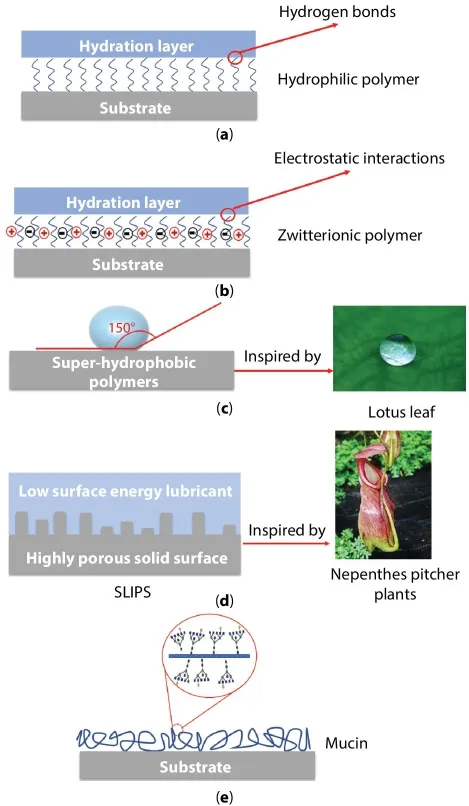
Figure 1.1 Schematic diagrams of five types of anti-adhesive coatings. (a) Hydrophilic polymers as coatings on the substrate resist biofouling due to the formation of a hydration layer in aqueous environment as a physical barrier and the surface hydration layer is formed by weak hydrogen bonds; (b) Forming a hydration layer on the substrate by strong electrostatic interactions is mainly responsible for the anti-biofouling property of zwitterionic coatings; (c) The major characteristic of super-hydrophobic surface is with a water contact angle of over 150°, which was inspired by the Lotus leaf in nature [72]. Super-hydrophobicity can reduce the adhesive force between bacterial and th...
Table of contents
- Cover
- Table of Contents
- Preface
- 1 Anti-Adhesive Coatings: A Technique for Prevention of Bacterial Surface Fouling
- 2 Lignin-Based Adhesives
- 3 Green Adhesive for Industrial Applications
- 4 Green Adhesives for Biomedical Applications
- 5 Waterborne Adhesives
- 6 Using Polyfurfuryl Alcohol as Thermoset Adhesive/Sealant
- 7 Bioadhesives
- 8 Polysaccharide-Based Adhesives
- 9 Wound Healing Adhesives
- 10 Green-Wood Flooring Adhesives
- 11 Synthetic Binders for Polymer Division
- Index
- Also of Interest
- End User License Agreement
Trusted by 375,005 students
Access to over 1.5 million titles for a fair monthly price.
Study more efficiently using our study tools.
Frequently asked questions
Yes, you can cancel anytime from the Subscription tab in your account settings on the Perlego website. Your subscription will stay active until the end of your current billing period. Learn how to cancel your subscription
No, books cannot be downloaded as external files, such as PDFs, for use outside of Perlego. However, you can download books within the Perlego app for offline reading on mobile or tablet. Learn how to download books offline
Perlego offers two plans: Essential and Complete
- Essential is ideal for learners and professionals who enjoy exploring a wide range of subjects. Access the Essential Library with 800,000+ trusted titles and best-sellers across business, personal growth, and the humanities. Includes unlimited reading time and Standard Read Aloud voice.
- Complete: Perfect for advanced learners and researchers needing full, unrestricted access. Unlock 1.5M+ books across hundreds of subjects, including academic and specialized titles. The Complete Plan also includes advanced features like Premium Read Aloud and Research Assistant.
We are an online textbook subscription service, where you can get access to an entire online library for less than the price of a single book per month. With over 1.5 million books across 990+ topics, we’ve got you covered! Learn about our mission
Look out for the read-aloud symbol on your next book to see if you can listen to it. The read-aloud tool reads text aloud for you, highlighting the text as it is being read. You can pause it, speed it up and slow it down. Learn more about Read Aloud
Yes! You can use the Perlego app on both iOS and Android devices to read anytime, anywhere — even offline. Perfect for commutes or when you’re on the go.
Please note we cannot support devices running on iOS 13 and Android 7 or earlier. Learn more about using the app
Please note we cannot support devices running on iOS 13 and Android 7 or earlier. Learn more about using the app
Yes, you can access Green Adhesives by Rajender Boddula, Mohd Imran Ahamed, Abdullah M. Asiri, Rajender Boddula,Mohd Imran Ahamed,Abdullah M. Asiri in PDF and/or ePUB format, as well as other popular books in Physical Sciences & Chemistry. We have over 1.5 million books available in our catalogue for you to explore.