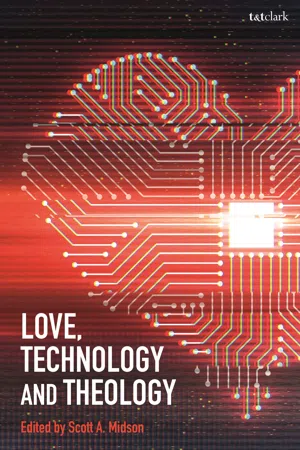
This volume explores love in the context of today's technologies. It is difficult to separate love from romanticist ideals of authenticity, intimacy and depth of relationship. These ideals resonate with theological models of love that highlight the way God benevolently created the world and continues to love it. Technologies, which are designed in response to our desires, do not necessarily enjoy this romanticist resonance, and yet they are now remodelling the world. Are technologies then antithetical to love?
In this volume, leading theologians have brought together themes of theology, technology and love for the first time, exploring different areas where notions of love and technology are problematized. In a world where algorithms and artificial intelligences interact with us and shape our lives in ever more intricate and even intimate ways, we might feel attachments to and through machines that suggest sentiments of love while also changing how we think about love. Does love always have to be reciprocal? How can we enact love and care for others with technologies? Whose desires do technologies serve – consumers, corporations, creatures? This volume offers a systematic review of the challenges of living in a technologically saturated world, by means of critical application of, as well as reflection on, theological discussions about love.
- 200 pages
- English
- ePUB (mobile friendly)
- Available on iOS & Android
eBook - ePub
Love, Technology and Theology
About this book
Information
Part One
Introducing love, technology and theology
1
Technoculture and technophilia
Techne, agape and eros
Scott A. Midson
I Textures of technoculture: Approaching love and technology
Technologies have always brought about significant changes to our lives, from the use of stone tools through to the rise of the steel leviathans and machine-driven factories of the Industrial Revolution. The exponential growth of computing power has meant that, within the past couple of decades alone, we have seen notable changes brought about by internet technologies, the massification of data and the rise of artificially intelligent (AI) algorithms and software that are driving the next so-called information revolution. Technologies have changed the ways we work and shop, the ways we access information and seek entertainment, and the ways we individuate and communicate. Indeed, they have impacted us so much that we cannot think about who we are without reference to the technologies that comprise, enable and define our everyday lives. As Don Ihde has noted, ‘our existence is technologically textured’.1
Our existence, of course, is understandable not just in relation to technologies. Here, Ihde’s words are careful and instructive: our existence is technologically textured rather than technologically determined. To insist upon the latter would be to totalize a technological worldview – and, as we shall see, there are some theorists and techno-sceptics who are cautious about such a worldview – whereas to insist upon the former, as Ihde and some other philosophers of technology do, is to acknowledge the roles that technologies play as important ways in which we experience the world, each other and ourselves. Technologies, in other words, are part of our everyday lives. They facilitate and enable much of our lifestyles, but they are not the only aspect of them. What else marks our existence in the world?
Power, as the product of inequalities, has been frequently referred to by philosophers and social theorists who have discussed and critiqued our existence in the world. Karl Marx famously wrote against unequal class-based power relations in societies, which included reference to the power that the bourgeoisie (ruling classes) have over the proletariat (working classes) as well as the power that money and capital have over people. In a similar vein, feminists have uncovered and importantly have begun to undermine androcentrism (male-centrism), which relates to gender politics and unequal distributions of social power.
In many ways, the history – and most likely the future – of technology replicates and re-narrates the history of power. Marx, for example, wrote during the Industrial Revolution, which was driven by capitalist interests and was facilitated by technological innovations. The rapid and radical changes that were brought about in this period were recognized by many as a transference of power from humans onto the machinic giants of the factories and workplaces. Countless sci-fi and cultural narratives since then have presented fears of technologies holding power over humans, including concerns about a dystopian robot uprising or techno-apocalypse. Daniel Dinello reveals how these exemplifications of technophobia relate back to Marxist critiques of power insofar as, in these sci-fi narratives, it is often large businesses and corporations like Skynet of James Cameron’s post-apocalyptic Terminator world that are the real threats, rather than technologies per se.2 In our own world, much controversy has been sparked about the power held by big players in the tech-industry, including Facebook, Google, Amazon and Apple. Similarly, technologies are revealed to replicate other power-based inequalities in society, including, for example, algorithms that perpetuate prejudices on the basis of gender, race or sexuality.3 It thus follows that the politics of power are inescapable when it comes to theorizing and critiquing technology in relation to human activity.
How do technologies impact unequal power relationships? Put differently, how much additional power do technologies provide to certain users and groups more specifically, as well as to humans more generally, over others? Responses to these questions are not only driven by empirical observations from archaeological, biological and social sciences – some of which are covered in this volume – but also notably textured by mythological narratives. With increased capabilities come the yearnings to be somehow more-than-human, perhaps even godlike, as though additional power were all that separates humans from gods. In Christian theology, the notion that humans are made in God’s image (imago dei) expresses this close link between humanity and divinity. This anthropological doctrine has been taken up by some Gnostic writers, who were also heavily influenced by Plato’s philosophies about the potential for humans to ascend towards the abstract form of The Good, to suggest that humans can transcend themselves and realize their divine essence by shedding their mortality. Other Greek mythologies corroborate these ideas: Prometheus, for example, stole fire from the gods and gave it to humans. This divine gift closes the gap between humans and divinity in terms of the capabilities and powers brought about by external tools and technologies.
Not only has power been discussed in relation to real social practices, then, but power is also an important motif in many mythological and cultural narratives. We find it in stories that involve tensions, conflicts and revenge between gods and humans, which reveal attitudes to our own humanness that are expressed in our contemporary lives. As such, it seems fair to say that these mythologies and their theologies continue to texture our existence today, even in spite of the alleged secularity of our context.4 The technological pursuit of enhancement and the drive to overcome present limitations on the human condition, as many writers have shown, draw on mythological, theological and metaphysical assumptions about humanness and that which transcends it, which is typically associated with notions of divinity.5
Such ideas can be identified in Mary Shelley’s infamous novel Frankenstein, which has the subtitle The Modern Prometheus.6 In Frankenstein, Shelley presents a critique of the new powers brought about through scientific and technological innovation, and she explicates the need for deeper reflection on the ethical ramifications of these advancements. Power, in other words, only gets us so far; we need additionally – and crucially – to consider the ethics and morality of our capabilities and actions. Indeed, power only has a limited function in mythological and theological understandings of divinity compared with the popular cultural concept of ‘playing God’: the God of the Christian tradition, as well as being omnipotent, is often characterized as omnibenevolent. Some theologians even argue that God’s omnibenevolence should take conceptual priority over God’s omnipotence, as God is necessarily self-limiting in order to construct and maintain a relationship with humans and with creation.7 As Sven Wagner notes in his literary study of the ‘playing God’ motif in literature, though, a ‘desire for divine power is never accompanied by a desire for divine love. Nor do the scientists [of the novels that are surveyed] show an awareness that in the traditional conception of God power and love are inextricably linked’.8 For Wagner – as well as for Shelley, whose monster was rejected by its creator and outcast by other humans – love can often be overlooked in our existence, but it is to our moral detriment to do so.
For many philosophers and theologians, love is paramount in our existence. Love is a broad term that incorporates (although is itself somewhat distinct from) aspects of desire, relationship, sex and sexuality, otherness, care, attachment, holism and partnership, and transcendence. Love can perhaps best be figured as residing at the fuzzy intersection of these different dimensions, although it is worth noting here that there are different loving styles that emphasize varying aspects of these dimensions. More will be said on these different loving styles shortly. For now, we can ascertain a broad definition of love that not only recognizes love’s complexity and its multifaceted composition but also highlights how love characterizes relations – real, idealized or imagined – between the self and other(s).
Love, thusly defined, textures our existence by impacting our motivations and our ethics. What we do and who we are, we might say, is about the movement of love and the (possible) connections among selves and others. As Tony Milligan writes of how lives are shaped by the (inter)personal entanglements of love, ‘we may often fail to notice it, but the places where we live, the jobs we do and the way we spend our time are all influenced by a concern for those we love’.9 Love here represents the push-and-pull factors that manifest in connections and relationships among people, and these forces exert an important influence in our lives. Like with technologies and with power, this is not to say that love determines our lives, but it is an inescapable part of our existence. Indeed, love textures technology and power and is concomitantly textured by them: love expresses power dynamics, power expresses the dynamics of desire and attraction, and technologies exemplify all of these aspects. Scrutinizing these tensions, and understanding how our existence is textured by a range of inseparable and non-isolatable attitudes – which also involves understanding how lov...
Table of contents
- Cover
- Half-title Page
- Title Page
- Contents
- Contributors
- Preface
- Acknowledgements
- Part One: Introducing love, technology and theology
- Part Two: Love and (non)humans
- Part Three: Love and bodies
- Part Four: Love and societies
- Bibliography
- Index
- Copyright Page
Trusted by 375,005 students
Access to over 1.5 million titles for a fair monthly price.
Study more efficiently using our study tools.
Frequently asked questions
Yes, you can cancel anytime from the Subscription tab in your account settings on the Perlego website. Your subscription will stay active until the end of your current billing period. Learn how to cancel your subscription
No, books cannot be downloaded as external files, such as PDFs, for use outside of Perlego. However, you can download books within the Perlego app for offline reading on mobile or tablet. Learn how to download books offline
Perlego offers two plans: Essential and Complete
- Essential is ideal for learners and professionals who enjoy exploring a wide range of subjects. Access the Essential Library with 800,000+ trusted titles and best-sellers across business, personal growth, and the humanities. Includes unlimited reading time and Standard Read Aloud voice.
- Complete: Perfect for advanced learners and researchers needing full, unrestricted access. Unlock 1.5M+ books across hundreds of subjects, including academic and specialized titles. The Complete Plan also includes advanced features like Premium Read Aloud and Research Assistant.
We are an online textbook subscription service, where you can get access to an entire online library for less than the price of a single book per month. With over 1.5 million books across 990+ topics, we’ve got you covered! Learn about our mission
Look out for the read-aloud symbol on your next book to see if you can listen to it. The read-aloud tool reads text aloud for you, highlighting the text as it is being read. You can pause it, speed it up and slow it down. Learn more about Read Aloud
Yes! You can use the Perlego app on both iOS and Android devices to read anytime, anywhere — even offline. Perfect for commutes or when you’re on the go.
Please note we cannot support devices running on iOS 13 and Android 7 or earlier. Learn more about using the app
Please note we cannot support devices running on iOS 13 and Android 7 or earlier. Learn more about using the app
Yes, you can access Love, Technology and Theology by Scott A. Midson in PDF and/or ePUB format, as well as other popular books in Theology & Religion & Christian Theology. We have over 1.5 million books available in our catalogue for you to explore.