The environment suffers enormously during armed conflicts and, despite the increasing awareness of the pressing need to protect the planet, devastating environmental damage can occur legally at times of war. This book suggests that – apart from the protection offered under law of armed conflict – environmental treaties or multilateral agreements (MEAs) can complement and strengthen environmental protection when war occurs.
Previous research has focused on the protection offered under the law of armed conflict (in particular international humanitarian law) and customary international environmental law concerning wartime environmental damage, or whether environmental treaties remain applicable at times of armed conflict. This book, however, is the first in-depth scholarly examination of how environmental treaties can apply in wartime and how they can contribute to the protection of the environment in relation to armed conflict. It also offers an updated study of environmental protection under the law of armed conflict, including the latest developments in the International Law Commission's work on this underexplored topic.
eBook - ePub
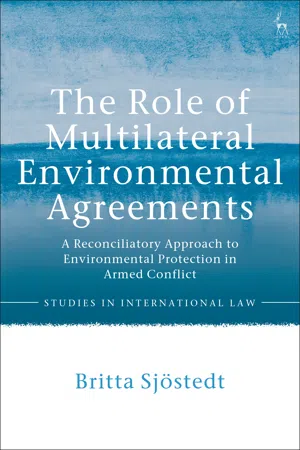
The Role of Multilateral Environmental Agreements
A Reconciliatory Approach to Environmental Protection in Armed Conflict
- 336 pages
- English
- ePUB (mobile friendly)
- Available on iOS & Android
eBook - ePub
The Role of Multilateral Environmental Agreements
A Reconciliatory Approach to Environmental Protection in Armed Conflict
About this book
Information
1
Setting the Scene
I.INTRODUCTION
This book examines how environmental treaties, also referred to as multilateral environmental agreements (MEAs), can add to the protection of the environment during armed conflicts of international and non-international character. The examination also covers the immediate aftermath of armed conflicts, ie, the blurry transition phase between armed conflict and peace (post-conflict).1 I argue that MEAs can apply both in peacetime and wartime, as well as in international and non-international armed conflicts to strengthen environmental protection in all times, albeit to a degree adjusted to the circumstances.
The analysis will encompass the law of armed conflict and international environmental law – both treaty-based as well as customary law – in order to provide a broad description of the existing mechanisms under international law to address wartime environmental damage. Most of the previous research addressing the issue of environmental protection during war has focused on the application of the law of armed conflict (also referred to as the international humanitarian law or laws of war),2 which is the body of international law specially designed to deal with situations of armed conflict. The law of armed conflict does not prioritise the environment and the environmental protection under this regime has been criticised for permitting substantial environmental damage despite the serious consequences.
Previous research has also explored how the application of international environmental law having customary law status can improve environmental protection during armed conflicts. However, what is missing in the scholarly analysis is the application of MEAs in times of war. What has been examined in previous research on this topic is the question of whether MEAs continue to apply during armed conflicts.3 Whereas little attention has been directed on how these apply in an armed conflict context. There are different presumptions regarding MEAs’ ability to provide environmental protection in such a context: either they are criticised for the vague formulations in their provisions and seen as unable to add any substantial protection,4 or they are viewed as having promising potential because they contain detailed rules specifically dealing with the environment.5 There is little explanation, however, on how such rules may substantially add to the protection.
Overall, there is a knowledge gap on how MEAs may contribute to protect the environment in relation to armed conflict because the environmental treaties’ potential in this context has not been explored. I claim that it is a missed opportunity for improving environmental protection during armed conflicts, in particular, because these treaties use innovative strategies to fulfil the treaty objectives that differ from treaties in other legal areas, such as the law of armed conflict. For instance, MEAs establish whole treaty systems in which the treaty bodies are able to launch projects and programmes to advance the treaty objectives. In many cases, these initiatives are focused on supporting institutionally weak states that are unable to fulfil their obligations under MEAs, which could include those affected by armed conflicts.6 In addition to the law of armed conflict and customary international environmental law, the study of MEAs may offer new paths to protect the environment during wartime. MEAs addressing specific environmental problems and operating in a broader international structure can strengthen environmental protection, both normatively as well as operationally.
II.SCOPE OF THE BOOK
Wartime environmental protection is located at the intersection of several legal areas, but mainly it concerns the law of armed conflict and international environmental law.7 Therefore, this book studies norms (rules and principles) under both in order to analyse the ability of contemporary international law to deal with the issue. The book will (A) analyse the ability of the law of armed conflict to protect the environment adopting an evolutionary approach when interpreting its norms; and (B) assess how the application of environmental treaties could advance the protection under the law of armed conflict. Throughout this book, I argue that rules and principles of international environmental law should continue to apply in wartime. My arguments are based on the understanding that international law is a single albeit diversified legal system striving for coherence.8 The idea of coherence is inherent in the concept of a legal system, in the sense that the rules must be understood as having a normative meaning and be coordinated to function together.9 International environmental law addresses complex problems that often permeate various areas of international law, such as the rights of future generations, the need to protect ecosystems and endangered species as well as prevent irreparable environmental damage. Therefore, these values protected under international environmental law must remain protected even when applying other areas of international law. To this end, many MEAs have incorporated provisions that allow for consideration of other concerns, such as human rights, sustainable development, or international trade.10 This enables the adoption of what I refer to as a ‘reconciliatory approach’. Such an approach opens up for the harmonisation of the obligations of international environmental law and the law of armed conflict, which also contributes to achieving coherence in the international legal system.
Regarding part A, I argue that the existing provisions under the law of armed conflict should be interpreted in the light of customary international environmental law. This corpus of law has developed new concepts and principles on the basis of new scientific discoveries when assessing and preventing environmental damage that also need to be taken into account in wartime. As wartime environmental protection falls under the scope of both the law of armed conflict and international environmental law, normative tensions between the two legal frameworks may arise. In such a case, the law of armed conflict applies as the lex specialis during armed conflicts and prevails over an incompatible environmental (peacetime) rule. Nevertheless, peacetime law continues to have a normative influence during armed conflicts. The law of armed conflict and international environmental law may therefore become a challenging marriage of two distinct legal areas striving towards different aims. In particular, there is no uniform practice on how to apply the lex specialis rule, as I will discuss in chapter six.
In regard to part B, I will scrutinise how the application of MEAs can contribute to safeguarding the environment in war-torn states. As there are over 1,300 MEAs,11 I have restricted the focus of this study to the Convention Concerning the Protection of the World Cultural and Natural Heritage12 (World Heritage Convention), and the Convention on Wetlands of International Importance, and Especially the Waterfowl Habitat13 (Ramsar Convention). Both conventions provide protection for environmental areas that are of interest to the international community. The World Heritage Convention, negotiated under the United Nations Educational, Scientific and Cultural Organization (UNESCO),14 protects both natural and cultural world heritage sites of outstanding value to humankind. The Ramsar Convention protects wetlands of international significance. The conventions permit their state parties to nominate sites to be protected under the conventions through inscription on certain lists: the World Heritage List and the List of Wetlands of International Importance (Ramsar List). The designation of protected environmental areas is an important tool for nature conservation at an international level.15 The safeguarding of internationally important environmental areas, as identified under the Ramsar Convention and the World Heritage Convention, contributes to preserve endangered species, sensitive ecosystems, and prevent biodiversity loss. Therefore, ensuring the protection of these areas can advance environmental protection in relation to armed conflict. This is of particular importance because protected areas are often exposed during armed conflicts since they can offer hiding places, shelter, nutrition, firewood and revenues for armed groups, as well as for those displaced persons fleeing the hostilities.16 Thus, the area-based protection mechanisms under the World Heritage Convention and the Ramsar Convention could provide standards on how states should behave in relation to these protected sites during and after armed conflicts. In addition, new developments under international law strive to ensure that areas of major ecological importance also remain protected in wartime as will be discussed in chapter four.
The final chapter will include a normative analysis by generalising some of the findings from the case studies in B and linking these with the theoretical framework outline in A. Thus, the A- and B-part complement each other in order to determine the role of MEAs during and in the aftermath of armed conflicts by the adoption of the reconciliatory approach. The main contribution of this book is to show the possibilities of how MEAs and the law of armed conflict can support each other using different strategies to improve environmental protection in relation to armed conflict.
III.WHY READ THIS BOOK?
The destructive nature of armed conflict can cause large-scale damage within a short time period: an entire ecosystem that has taken decades or even centuries to create can be destroyed in one single attack, having implications for a larger region or even on a global scale. The exact consequences of much environmental damage remain uncertain. However, increasing knowledge shows that ecosystems are interconnected and the state of them can affect other ecosystems and accelerate environmental problems. As human life is dependent on a healthy environment, its destruction can have long-term effects on public health,17 affecting both present and future generations.18 Much of this damage is lawful under the law of armed conflict. However, new discoveries on how ecosystems connect and are interdependent on each other puts this legality into question, in particular given the new threats of climate change, biodiversity loss and environmental degradation.
International environmental law has developed as a response to tackle and prevent complex global environmental problems and risks.19 Safeguarding the environment mainly functions on the premise to take preventative and precautionary measures in order to manage the uncertain and sometimes irreversible environmental damage.20 For that reason, international environmental law advances new legal requirements, including the principle of prevention, the concept of common but differentiated responsibility, and the principle of cooperation to establish a holistic and long-term environmental protection for present and future generations.21 The principles enable approaches that take into account the particularities of the environmental problems, which are coupled with uncertainty with regard to their effects.22
The principle of prevention establishes a standard for states to act with due diligence in order to prevent and minimise the potential risks of transboundary harm and for harm occurring outside a state’s jurisdiction. The principle of prevention also implies a requirement for states to assess their obligations under the principle continuously in order to keep up-to-date with advancements in scientific knowledge.23 The introduction of the ecosystem approach stresses the need to provide a holistic protection of ecological processes as such and not solely the protection of certain species. The approach opts for protection of the complex interaction between different animals, plants and micro-organisms and their non-living environment.24 The principle of cooperation encourages states to collaborate to address environmental problems, which could include exchanging information and notifying and consulting states on activities that may have harmful effects on their environment.25 The concept of common but differentiated responsibility entails that states shall cooperate to protect and restore the environment, but it acknowledges that states have contributed differently to the global environmental degradation. It also looks at the differences in the ability of states to prevent, reduce and control environmental threats – where the more developed states must carry most of the burden in environmental actions and have a responsibility to support developing states by...
Table of contents
- Cover
- Title Page
- Contents
- Abbreviations
- Table of International Treaties, Resolutions, Decisions, etc
- 1. Setting the Scene
- 2. Wartime Environmental Damage
- 3. Special Protection under the Law of Armed Conflict
- 4. Special Environmental Protection under Customary International Law
- 5. General Protection under the Law of Armed Conflict
- 6. International Environmental Treaties: A Missed Opportunity
- 7. New Approach: Reconciling International Environmental Law and the Law of Armed Conflict
- 8. Protection of World Heritage in Relation to Armed Conflict: The Case of the DRC
- 9. Protection of the Ramsar Sites in Relation to Armed Conflict: The Case of Mali
- 10. The Way Forward
- Bibliography
- Index
- Copyright Page
Trusted by 375,005 students
Access to over 1.5 million titles for a fair monthly price.
Study more efficiently using our study tools.
Frequently asked questions
Yes, you can cancel anytime from the Subscription tab in your account settings on the Perlego website. Your subscription will stay active until the end of your current billing period. Learn how to cancel your subscription
No, books cannot be downloaded as external files, such as PDFs, for use outside of Perlego. However, you can download books within the Perlego app for offline reading on mobile or tablet. Learn how to download books offline
Perlego offers two plans: Essential and Complete
- Essential is ideal for learners and professionals who enjoy exploring a wide range of subjects. Access the Essential Library with 800,000+ trusted titles and best-sellers across business, personal growth, and the humanities. Includes unlimited reading time and Standard Read Aloud voice.
- Complete: Perfect for advanced learners and researchers needing full, unrestricted access. Unlock 1.5M+ books across hundreds of subjects, including academic and specialized titles. The Complete Plan also includes advanced features like Premium Read Aloud and Research Assistant.
We are an online textbook subscription service, where you can get access to an entire online library for less than the price of a single book per month. With over 1.5 million books across 990+ topics, we’ve got you covered! Learn about our mission
Look out for the read-aloud symbol on your next book to see if you can listen to it. The read-aloud tool reads text aloud for you, highlighting the text as it is being read. You can pause it, speed it up and slow it down. Learn more about Read Aloud
Yes! You can use the Perlego app on both iOS and Android devices to read anytime, anywhere — even offline. Perfect for commutes or when you’re on the go.
Please note we cannot support devices running on iOS 13 and Android 7 or earlier. Learn more about using the app
Please note we cannot support devices running on iOS 13 and Android 7 or earlier. Learn more about using the app
Yes, you can access The Role of Multilateral Environmental Agreements by Britta Sjostedt in PDF and/or ePUB format, as well as other popular books in Law & International Law. We have over 1.5 million books available in our catalogue for you to explore.