Despite growing academic interest in the Gulag, our knowledge of the camps as a lived experience remains relatively incomplete. Criminal Subculture in the Gulag, in its sophisticated analysis of crime, punishment and everyday life in Soviet labour camps, rectifies this.
From Gulag journals and song collections to tattoo drawings and dictionaries of slang, Mark Vincent draws on often-overlooked archival material from the Moscow Criminological Bureau to reconstruct a fuller picture of Gulag daily life and society. In thematic chapters, Vincent maps the Gulag 'penal arc' of prisoners across initiation tests, means of communication, the importance of card playing, punishment rituals and the notorious 1948-52 cyka ('bitches') internal prison war between military veterans and vory-v-zakone. Most importantly, this timely examination of crime and punishment in modern Russia also highlights the lines of continuity between the Gulag systems, late Imperial Katorga,and today's Russian mafia.
As such, this impressively interdisciplinary volume is important reading for all scholars of 20th-century Russia as well as those interested in international criminality and penology.
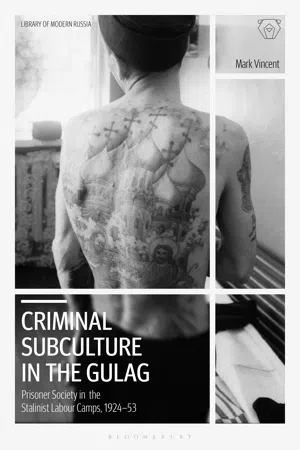
eBook - ePub
Criminal Subculture in the Gulag
Prisoner Society in the Stalinist Labour Camps
- 240 pages
- English
- ePUB (mobile friendly)
- Available on iOS & Android
eBook - ePub
About this book
Information
1
Criminal subculture before the Gulag
The twin nebulas of Ivan Osipov and Sheyndlya-Sura Solomoniak continue to shine bright amongst the Russian criminal cosmology. Better known by his alias ‘Vanka Kain’, Osipov – given his rugged and roguish physical appearance, along with his acrimonious and somewhat incendiary relationship towards state authorities – could have been crafted bespoke for a BBC television drama as he merged seamlessly from fearless leader of a gang of outlaws to a corrupt police super-informant. Taking advantage of an amnesty that followed Princess Elizabeth’s seizure of power in 1741, this alliance with the Investigators’ Bureau, however, merely provided Kain with legitimate cover to continue his nefarious acts with virtual immunity as he attempted to shake down and steal from anyone he decreed to be a potential suspect. Following a lengthy investigation into his continued criminal activities, Kain was finally apprehended and faced the full force of eighteenth-century criminal justice. Narrowly avoiding his original sentence of the death penality, Kain’s nostrils were ripped open, in keeping with the favoured punitive methods of the time, before he was flogged, branded and exiled to the icy plains of Rogervik in the Gulf of Finland.1
Unlike Vanka’s apparent self-appointed nom de guerre, Sheyndlya-Sura Solomoniak appears to have been anointed with the title of ‘Sonka – Golden Hand’ by criminal peers as a result of her highly prolific and daring escapades. Alongside this vilification by her contemporaries, Sonka was depicted by the emerging mainstream press in the guise of a classic femme fatale who was able to seduce her own personal guard before stealing from carriage to carriage as she escaped along the Warsaw railroad.2 The gravity of this public attention towards Sonka would far from dissipate, however, even after she was finally captured and incarcerated on the notorious tsarist penal colony of Sakhalin Island. Remaining on the island even after the completion of her sentence, the arch-criminal would receive visits from the eminent literary icon Anton Chekhov and the popular journalist Vlas Doroshevich, who joyfully depicted her fall from grace. In addition to these reports, photographs that showed a shackled Sonka surrounded by guards were sold to passengers passing by Sakhalin on steamer ships as rumours continued to swirl that the real-life criminal had absconded and replaced herself with a fake body double.
Although their professional activities necessitated the need to extend their criminal networks and retain mobility, both carried strong associations with specific geographical locations, with Kain reportedly running roughshod over Moscow’s notorious Kitay Gorod (Chinatown) district and Sonka achieving near-messianic status even amongst the maelstrom of criminality which characterised the fin-de-siècle port city of Odessa. Growing notoriety meant that Vanka and Sonka were soon granted membership in an exclusive cabal of marquee anti-heroes, including the bandits Anton Krechet and Vasili Churkin, names instantly recognisable from folk stories and songs circulated throughout the Empire.3 Further canonisation also occurred within the emerging field of mass-produced literature, which had blossomed from short pamphlets into multi-page novels whose trashy ‘underworld’ themes reflected the cheap pulp on which they were produced. These sensationalist tropes were often further reinforced by provocative cover images and titles designed to titillate their prospective readership.4 Despite Kain’s period of notoriety coming before the birth of a more specific penal-writing genre, which boomed around Fyodor Dostoevsky’s seminal The House of the Dead, the bandit was not entirely omitted from nineteenth-century texts, which remained engrossed with the criminal cause célèbre. This continued fascination with notorious individuals would, of course, be endorsed further by the hawkish caricatures sketched of Sonka by Doroshevich and Chekhov.
As ideologically barbed revolutions have a tendency of doing, the overthrow of the Provisional Government by the Bolsheviks in October 1917 led to profound shocks throughout the social body. One of these occurred in popular representations of criminality, as the notorious chthonic individuals who stole almost exclusively from the decadent and corrupt upper classes were replaced with characters now viewed as premium sites to be remoulded and integrated back into the Soviet collective. Criminal figures who followed Vanka and Sonka after 1917 were no longer afforded the ignominious ending of seeing out their remaining days isolated in remote penal colonies but were now sent to participate in large-scale construction projects before their assimilation back into mainstream society.5 Transition between the old and new worlds merely represented a simple set change, however, as prisoner and criminal ‘master plots’ remained almost entirely unaltered in the maintenance of key elements such as the traditional mantra of ‘honour among thieves’ and defiance in the face of authority. Prisoner songs, in particular, continued to be important carriers of inmate culture by helping to distribute a range of symbols which in turn looked to influence an individual’s decision-making process. In essence, these songs would suggest a range of behaviours that fell within the criminal/prisoner code alongside the suggested repercussions for breaking them.
Although the stories surrounding Vanka and Sonka have by now been mythologised and rebranded in multiple ways for a number of different audiences, their afterlives continue to provide important insights into the nefarious world of Russian criminal subculture. This peculiar alchemy of real and fictionalised criminality shows how the legacies of past figures can continue to influence contemporary criminals in a manner which Diego Gambetta has wonderfully termed ‘(low) life imitating art’.6 Not only do the various incarnations of Vanka and Sonka remain haunting and powerful spectres in setting out ways in which future criminals should behave (and not behave), but their activities as part of a wider group show the development of penal hierarchies and behavioural rituals which continued into the Stalinist labour camps. Despite the clear ideological shift in the relationship between state and citizen following 1917, penal folkways continue to pay homage to the original king and queen of the Russian criminal underworld.
Vanka Kain
Born in a small Rostov village named Bolgachinovo in 1722, young Ivan was transported away from his rural family at just ten years of age to the contrasting opulence of a Moscow manor house, where he began working as a domestic servant for the wealthy merchant Peter Filatiev, whose family represented the dominant land-owners in Osipov’s homeland.7 The popular story suggests that, after numerous failed escape attempts from Filatiev, during one of which he met his future mentor and close friend Peter Kamchatka in a downtrodden tavern, Kain was chained in the courtyard and guarded by a bear as punishment for his repeated indiscretions. This was where Vanka apparently remained until he was informed by a sympathetic female servant that someone in the Filatiev household had killed a soldier and stashed his body in a well as a way to cover up their crime. Kain allegedly then used this evidence against his master to emancipate himself, receiving a guarantee of his freedom in return. In reality, however, it appears that a mutual agreement was struck between Kain and his master, especially as Vanka continued to have business dealings with Filatiev and his servants throughout the following decades.8
Despite the suggested illiteracy of the bandit, he was thought to have dictated a number of first-person accounts which were circulated mainly by hand. These stories often drew direct links of criminal heredity between Vanka and the French thief Louis Dominique Garthousen, better known by his alias ‘Cartouche’. This comparison seemed appropriate enough for the Frenchman’s name to be evoked in the title of one of Kain’s early first-person accounts, whilst a biography of Cartouche was deemed to be so complementary that it was translated and attached to the second printing of a late eighteenth-century book on Kain by the pioneering lubok (cheap and simple books) writer Matvei Komarov.9 It was in 1779 that Kain’s story was brought to a wider audience, as Komarov compiled and adapted around 60 previously disparate tales into a work commonly regarded as Russia’s first literary bestseller.10 Following Komarov’s critical and commercial success, numerous abridged copies of this work began to appear on the street in the form of cheap, unlicensed bootlegs, sometimes written anonymously and almost always published under slight variations of the same titles.
Following this increased public and literary attention, Kain was deemed to be a figure of such historical importance that G. V. Esipov reconstructed parts of his biography for a nineteenth-century collection. Esipov’s treatment of his subject was remarkably different from Komarov’s more light-handed approach, as he pointed the finger at Kain for both his suggested participation in the killing of a border guard and his knowledge of the origins of a series of fires in Moscow in the spring of 1748 which had destroyed more than 2,000 buildings. Esipov also provided a detailed account of how in December 1744 Kain abused his policing jurisdiction to kidnap a group of pupils from a prestigious religious school and blackmail the parents into paying a ransom to ensure their safe return. Despite the school governors demanding an immediate enquiry, Kain was able to use his police connections to bribe the relevant legal clerks and ensure that the investigative process remained tied up in paperwork for the next four years.11
Suffice to say, these allegations were omitted from Kain’s other fictionalised accounts, which were all imbued with larger than life, comic-book style violence similar to the work of Frank Miller. Whilst retaining some elements of classic folklore stories regarding bandits such as Robin Hood, these accounts saw Vanka’s persona switch from unremorseful vigilante to an entirely reformed, law-abiding authority figure who reflected the Russian literary enthusiasm for British and American detective stories featuring Nat Pinkerton and Sherlock Holmes.12 As Kain became increasingly synonymous with a new wave of crime fiction, the mere use of his name now conjured up images of a shadowy, vigilante-style bogeyman whose activities could be easily reshaped in order to fit both the moral and amoral. Later incarnations of Vanka, such as a ten-part anonymous serial in 1918, carried no discernible association whatsoever with the real-life figure and wider tributes to him included a late imperial wrestler who competed under his name, although it is unclear whether he represented a babyface or a heel (wrestling parlance for ‘good guy’ or ‘bad guy’).13
Allowing for some creative and commercial latitude, one explanation of the malleable nature of these stories is that Vanka’s real-life activities do not sit comfortably within the traditional social bandit motif advanced most famo...
Table of contents
- Cover
- Half-Title Page
- Series
- Title Page
- Dedication
- Contents
- List of illustrations
- Acknowledgements
- A note on translation and transliteration
- Introduction: The world of the 49ers
- 1 Criminal subculture before the Gulag
- 2 Etap: The shaping of prisoner relations
- 3 Hierarchies: Arrival, socialisation and the prisoner code
- 4 Communication: Tattoos and slang
- 5 Gambling: Card playing and the structuring of prisoner society
- 6 Punishment and conflict: Urka courts and the ‘bitches’ war’
- Epilogue: Cult of the urka
- Glossary of commonly used terms
- Notes
- Bibliography
- Index
- Copyright
Trusted by 375,005 students
Access to over 1.5 million titles for a fair monthly price.
Study more efficiently using our study tools.
Frequently asked questions
Yes, you can cancel anytime from the Subscription tab in your account settings on the Perlego website. Your subscription will stay active until the end of your current billing period. Learn how to cancel your subscription
No, books cannot be downloaded as external files, such as PDFs, for use outside of Perlego. However, you can download books within the Perlego app for offline reading on mobile or tablet. Learn how to download books offline
Perlego offers two plans: Essential and Complete
- Essential is ideal for learners and professionals who enjoy exploring a wide range of subjects. Access the Essential Library with 800,000+ trusted titles and best-sellers across business, personal growth, and the humanities. Includes unlimited reading time and Standard Read Aloud voice.
- Complete: Perfect for advanced learners and researchers needing full, unrestricted access. Unlock 1.5M+ books across hundreds of subjects, including academic and specialized titles. The Complete Plan also includes advanced features like Premium Read Aloud and Research Assistant.
We are an online textbook subscription service, where you can get access to an entire online library for less than the price of a single book per month. With over 1.5 million books across 990+ topics, we’ve got you covered! Learn about our mission
Look out for the read-aloud symbol on your next book to see if you can listen to it. The read-aloud tool reads text aloud for you, highlighting the text as it is being read. You can pause it, speed it up and slow it down. Learn more about Read Aloud
Yes! You can use the Perlego app on both iOS and Android devices to read anytime, anywhere — even offline. Perfect for commutes or when you’re on the go.
Please note we cannot support devices running on iOS 13 and Android 7 or earlier. Learn more about using the app
Please note we cannot support devices running on iOS 13 and Android 7 or earlier. Learn more about using the app
Yes, you can access Criminal Subculture in the Gulag by Mark Vincent in PDF and/or ePUB format, as well as other popular books in History & 20th Century History. We have over 1.5 million books available in our catalogue for you to explore.