Rosemary's Baby is one of the greatest movies of the late 1960s and one of the best of all horror movies, an outstanding modern Gothic tale. An art-house fable and an elegant popular entertainment, it finds its home on the cusp between a cinema of sentiment and one of sensation. Michael Newton's study of the film traces its development at a time when Hollywood stood poised between the old world and the new, its dominance threatened by the rise of TV and cultural change, and the roles played variously by super producer Robert Evans, the film's producer William Castle, director Polanski and its stars including Mia Farrow and John Cassavetes.
Newton's close textual analysis explores the film's meanings and resonances, and, looking beyond the film itself, he examines its reception and cultural impact, and its afterlife, in which Rosemary's Baby has become linked with the terrible murder of Polanski's wife and unborn child by members of the Manson cult, and with controversies surrounding the director.
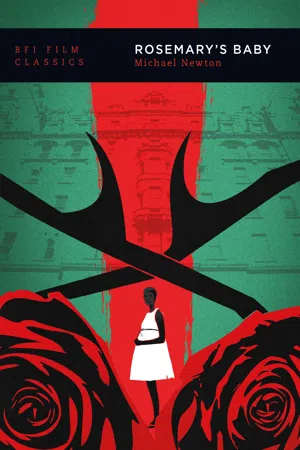
- 136 pages
- English
- ePUB (mobile friendly)
- Available on iOS & Android
eBook - ePub
Rosemary's Baby
About this book
Information
1. The Pledge
Hollywood in crisis?
In 1959, John Cassavetes wrote an article explaining ‘What’s Wrong With Hollywood’; it began, ‘Hollywood is not failing. It has failed.’1 In the early 1960s, the public, the critics, the film-makers themselves felt the movie business to be a moribund concern. Rosemary’s Baby emerged at a moment that saw a breaking up of the Hollywood consensus around censorship, as movies broke taboos, permitted swearing, were increasingly frank in their depiction of sex and violence, and were ready to forego or subvert the standing traditions of narrative coherence. As Polanski put it in an interview, it was the demise of ‘the Hitchcock audience’.2 1967 saw the release of The Fox, Point Blank, Bonnie and Clyde, all films that were in some regard provocations in a war between conservative values and progressive art. Film-makers defended the new frankness; asked about the violence in his movies, Polanski pointed to its prevalence in real life. The disputes over Bonnie and Clyde showed that films could become battlegrounds, pitched between those who were ‘hip’ to it and those who were not.
Many deplored cinematic violence and explicit sex. In September 1967, Jack Valenti, president of the Motion Pictures Association of America, worried about some in the young audience ‘of a psychedelic breed, hunkered up over pot and acid, and lurching off on supranatural romps and trips’.3 In 1967, President Lyndon B. Johnson ordered a National Commission on Obscenity and Pornography, designed to investigate the loosening of standards. In the fall of 1969, a new group, ‘A Pledge of Conscience’, declared their intention to censor and prevent violence in scripts. Yet pressure for greater censorship was parried by calls for Hollywood to take up the maturity and urgency of European film. Late in 1968, the Motion Picture Association of America brought in a ratings system, designed to sidestep direct censorship and palliate fears about content.
This new spirit in cinema took hold after a period of decline for the American movie business. The number of films released went down – from 332 in 1952 to a mere 143 in 1963, the low-point in terms of Hollywood production. The number of cinemas dwindled, from around 18 000 at the end of the Second World War to about 12 000 in 1962 (though there were also 5 000 new drive-in cinemas). There were certainly fewer films, but those few that did become hits made more money: from 1895 to 1960, only twenty films grossed more than $10 million, between 1960 and 1969, sixty films did. As young producer Robert Evans would realize, TV had ushered in the end of habitual film-going; the cinema trip was now an event.
The movies that Hollywood did make looked tired, products of ‘daddy’s cinema’ with a style and set of interests squarely set against those of the American young. From the late 1950s into the 1960s the average age of the cinema audience steadily rose. A youth market had emerged that was unimpressed by mainstream films. In part, the new violence and the new sexual frankness were motivated by a desire to boost the box office receipts: sex and violence was something that television did not (yet) do. Cinema positioned itself as the adult alternative to TV. In another sense, the explicitness was also doctrinal, an ideologically motivated candour. All the arts were busy freeing themselves of censorship and restraint.
Rosemary’s Baby, therefore, saw the light in a world caught up in a moment of cultural hesitation, a shift in values and understanding. Vitally, this confusion seeps into the movie itself, radically destabilizing its sense of what witches are. On one level, through Rosemary herself and her writer friend, Hutch, it clings to the ancient belief that witches are evil, perverse doers of harm through magic. The witches themselves tap into an increasingly popular twentieth-century reading in which they see themselves as victims of a life-denying religion. Most modern of all is the perspective taken by Guy, Rosemary’s husband, for whom witchcraft hardly matters one way or another, simply being a neat, and morally indifferent, way to attain your desires.
A look back at Ira Levin
Before anything else, Rosemary’s Baby was Ira Levin’s creation, the work of one of the most successful post-war American writers of popular fiction. He’s best remembered as the author of a mere seven highly successful novels, many of which went on to be adapted for film, most notably: A Kiss Before Dying (1953) (filmed in 1956 and again in 1991); Rosemary’s Baby (1967); The Stepford Wives (1972) (filmed in 1975 and 2004); The Boys From Brazil (1976) (filmed in 1978); and Sliver (1991) (filmed in 1993). Levin was the poet laureate of paranoia, a man dedicated to the dismantling of the apparent world to expose the plots beneath. Like Rosemary, the mechanized brides of Stepford and the Hitler clones of The Boys From Brazil were icons of a period tainted by Lee Harvey Oswald, Watergate and the Pentagon Papers. The truth was out there, concealed but discoverable, horrifying in its very certainty. For Levin, in his 1967 novel, Rosemary was the victim of a plot, a genuine sacrifice to a dark intrigue. His story would tap too into the 1960s sense of confusion over marriage and the life of the American housewife. These vogueish concerns were meant to catch on; this was a book reputedly designed to be a bestseller.4 It succeeded in its aim: by June 1968, it had sold 2.3 million copies.5 Even before the book was in print, the rights had already been sold to a movie producer, and the first step towards turning Levin’s tale into a movie had been taken.
The tingler
In the mid-1970s, talking to a psychiatrist at a dinner party, William Castle, Rosemary’s Baby’s producer, assured the man that he had no deeply hidden fears. Privately, he thought: ‘But I knew otherwise. My life had been built on fear.’6 Castle, né Schloss, a huckster of schlock horror, hardly looked the type to be afraid; Polanski described him as ‘a red-faced giant of a man with a thatch of close-cropped white hair and a cigar permanently clamped between his teeth’.7 Yet fear, and the evocation of fear, had indeed been his life. One of his earliest memories was wetting himself with fright during a visit with his dad to the horror play, The Monster.8 His mum died when he was ten, his dad (of a coronary) when he was eleven, and so he went to live with his much older sister in New York. There he became a stage-door Johnny, befriending Bela Lugosi and acting as stage manager to the touring play of Dracula. At the age of twenty-five, he inherited $10 000 from his dad and from then on, pursued a career that melded together creaky artistic endeavour with a showman’s flair for advertising.
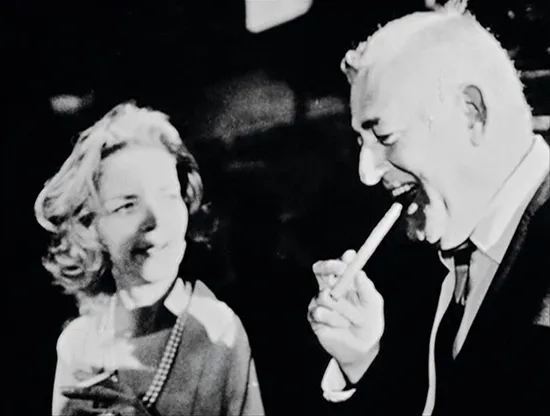
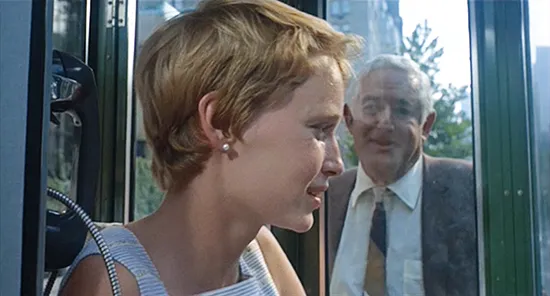
Lauren Bacall on set with William Castle; Castle’s presence outside the phone booth as Rosemary is on the run.
Castle was the king of the gimmick, with a hidden desire to win an Oscar. With one eye on the art of Welles and Hitchcock, he approached cinema in the beguiling spirit of ardency and vividness, linking back to vaudeville and the fairground. His life depended on the sparking of reactions in a room of strangers. He became famous for a series of carnivalesque horror flicks, each of them publicized by some novel promotional stunt. Not unjustly, Polanski saw Castle’s films as ‘plutôt minables’ (rather shabby).9 Yet the formula hit the spot: according to Castle, his movie Macabre (1958) cost $90 000 to make, and made $5 million; in 1968, The William Castle Fan Club had 150 000 members.10
Castle dealt in a weirdly immersive cinema experience, with gizmos and tricks that took the film beyond the screen, some given their own brand-name: skeletons flew over the audience (‘Emergo’); a chair sparked electric shocks for The Tingler (1959) (‘Percepto’); seats shook; people were hired to scream or ‘faint’; a ‘Coward’s Corner’ was built for Homicidal (1961), for those who, after a ‘Fright Break’, claimed their cash back on the basis of being too scared to watch to the end.11 The audiences for Macabre signed insurance policies against death by fright. All this manifested Castle’s own response to Hollywood’s falling audiences; like widescreen or 3-D, these gambits were a reason still to see films in the cinema, keeping it a ‘theatrical’ experience.
In 1967, Castle believed that the ‘bottom had fallen out of the horror films’.12 It was then that he received the galley proofs for a new novel – Levin’s Rosemary’s Baby. Castle understood that Hitchcock had been the first to read the galleys but had passed on the movie.13 Whether this was true or not, Castle immediately saw the story’s potential. Levin’s agent, Marvin Birdt, offered the film rights for $100 000, with another $50 000, if the book became a bestseller – and 5 per cent of the net profits. The deal was struck, but Castle was now left wondering how he’d raise the money. It was then that he heard from Bob Evans at Paramount.
The kid who stayed in the picture
Robert Evans was the man who brought Rosemary’s Baby together, the third fount of charisma, with Castle and Polanski, who would turn Levin’s novel into the great movie it would become. He was born Robert J. Shapers in New York in 1930, the son of a Harlem dentist. Young Evans ran a company making women’s slacks. He had been a child actor on the radio, but Hollywood must have seemed far off, until he was spotted, looking handsome, by Norma Shearer at a swimming pool, and was cast as her former husband, Irving Thalberg, in The Man With A Thousand Faces (1957). Soon after, Evans was discovered, again, this time by Darryl Zanuck in a New York nightclub, and picked to play a Spanish bullfighter opposite Ava Gardner in The Sun Also Rises (1957).
In Zanuck’s authority, Evans glimpsed the person he wanted to be, the work he wanted to do: he would remake himself as a studio executive and producer. He set about this task with customary verve. A piece by Peter Bart hyping him in The New York Times brought him to the attention of Charles Bluhdorn. The founder and chairman of Gulf & Western, Bluhdorn was an auto-parts tycoon who in 1966 had acquired majority stock at Paramount. This was the first buy-out of a major studio by a company outside the entertainment industry. Though mocked as an ignorant outsider to the business, Bluhdorn would prove a hands-on owner, eager to get involved. One quick way of stamping his authority on things was to replace the middle-aged Howard Koch, Paramount’s head of film production, with young Evans.
Evans’s appointment was part of a first wave of replacements of ageing studio bosses by the young: Evans was in his mid-thirties; at Fox, Richard Zanuck was thirty-four; and David Picker at United Artists was thirty-six. On the other hand, when Evans was appointed, Adolph Zukor, Paramount’s chairman emeritus, was ninety-six years old.
There were many who were sceptical of Evans’s ability to make a success of the failing Paramount Studios. He was soon nicknamed ‘Bluhdorn’s Folly’ (or, in Jack Rosenstein’s quip, ‘Bluhdorn’s Blowjob’). He needed a calling card film, a genuine hit that would secure his position at Paramount and help reverse the studio’s run of bad luck. He had the rights to The Detective (1968) in hand, and then began with two Neil Simon comedies, Barefoot in the Park (1967) and The Odd Couple (1968). Both were hits, but lacked the culture-defining power of the genuinely big movie. The property was the star and, hearing from Castle, Evans knew that Rosemary’s Baby was the...
Table of contents
- Cover
- Title Page
- Contents
- Acknowledgements
- An Initiation
- 1 The Pledge
- 2 The Turn
- 3 The Prestige
- Notes
- Credits
- Bibliography and Further Reading
- Imprint
Trusted by 375,005 students
Access to over 1.5 million titles for a fair monthly price.
Study more efficiently using our study tools.
Frequently asked questions
Yes, you can cancel anytime from the Subscription tab in your account settings on the Perlego website. Your subscription will stay active until the end of your current billing period. Learn how to cancel your subscription
No, books cannot be downloaded as external files, such as PDFs, for use outside of Perlego. However, you can download books within the Perlego app for offline reading on mobile or tablet. Learn how to download books offline
Perlego offers two plans: Essential and Complete
- Essential is ideal for learners and professionals who enjoy exploring a wide range of subjects. Access the Essential Library with 800,000+ trusted titles and best-sellers across business, personal growth, and the humanities. Includes unlimited reading time and Standard Read Aloud voice.
- Complete: Perfect for advanced learners and researchers needing full, unrestricted access. Unlock 1.5M+ books across hundreds of subjects, including academic and specialized titles. The Complete Plan also includes advanced features like Premium Read Aloud and Research Assistant.
We are an online textbook subscription service, where you can get access to an entire online library for less than the price of a single book per month. With over 1.5 million books across 990+ topics, we’ve got you covered! Learn about our mission
Look out for the read-aloud symbol on your next book to see if you can listen to it. The read-aloud tool reads text aloud for you, highlighting the text as it is being read. You can pause it, speed it up and slow it down. Learn more about Read Aloud
Yes! You can use the Perlego app on both iOS and Android devices to read anytime, anywhere — even offline. Perfect for commutes or when you’re on the go.
Please note we cannot support devices running on iOS 13 and Android 7 or earlier. Learn more about using the app
Please note we cannot support devices running on iOS 13 and Android 7 or earlier. Learn more about using the app
Yes, you can access Rosemary's Baby by Michael Newton in PDF and/or ePUB format, as well as other popular books in Media & Performing Arts & Film History & Criticism. We have over 1.5 million books available in our catalogue for you to explore.