This volume examines the 'counter-narratives' of the core Christian story, proposed by texts from Nag Hammadi and elsewhere. A noteworthy body of highly respected scholars examine material that is sometimes difficult and often overlooked, contributing to the ongoing effort to integrate Nag Hammadi and related literature into the mainstream of New Testament and early Christian studies. By retracing the major elements of the Christian story in sequence, they are able to discuss how and why each aspect was disputed on inner-Christian grounds, and to reflect on the different accounts of Christian identity underlying these disputes.
Together the essays in this book address a central issue: towards the end of the second century, Irenaeus could claim that the overwhelming majority of Christians throughout the world were agreed on a version of the core Christian story which is still recognisable today. Yet, as Irenaeus concedes and as the Nag Hammadi texts have confirmed, there were many who wished to tell the core Christian story differently. Those who criticized and rejected the standard story did so not because they were adherents of another religion, 'Gnosticism', but because they were Christians who believed that the standard account was wrong at point after point. Ranging from the Gospels of Judas and Mary to Galatians and Ptolemy's Letter to Flora, this volume provides a fascinating analysis of how the Christian story as we know it today developed against counter-readings from other early Christian traditions.
eBook - ePub
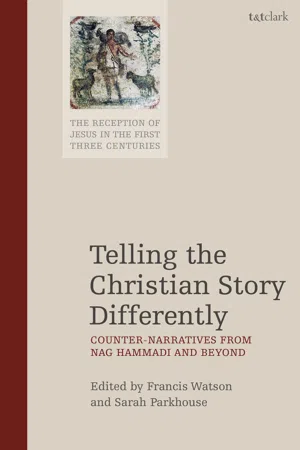
Telling the Christian Story Differently
Counter-Narratives from Nag Hammadi and Beyond
- 224 pages
- English
- ePUB (mobile friendly)
- Available on iOS & Android
eBook - ePub
Telling the Christian Story Differently
Counter-Narratives from Nag Hammadi and Beyond
About this book
Information
1
THE CURSE OF THE CREATOR: GALATIANS 3.13 AND NEGATIVE DEMIURGY
M. David Litwa
Of the many counter-narratives in early Christianity, one of the most scandalous is the various presentations of the creator as a hostile or evil being. For short, I will refer to these presentations by the term ‘negative demiurgy’.1 My proposal is that some early Christians arrived at negative demiurgy in part because they believed that the creator cursed the crucified Christ. In Galatians 3.13, Paul confessed that Jesus, when crucified, became a curse. The text he cited (Deut 21.23 LXX) says that the curse was effected ‘by god’ (ὑπὸ θεοῦ).2 Early reception history indicates that Marcion and his communities used Galatians 3.13 to show that Christ belonged to a different god, a solely good deity who did not – and could not – curse. Patristic writers tried to mitigate the curse or even deny it outright. In texts from Nag Hammadi, the curse against Jesus is acknowledged, but in several cases it applies only to his mortal part. His spiritual core escapes the curse. This pattern reflects a Christian hermeneutical framework which was applied to the early chapters of Genesis in which Adam, Eve and sometimes the serpent are said to be cursed, though their spiritual essence remains untouched.
History of research
There have been many theories about how negative demiurgy arose. Gilles Quispel traced the idea back to a Jewish group called the Magherians. But his source for their views was a tenth-century ce summary, and it is not clear from this document that the Magherians maintained a distinctly negative demiurgy.3
Elaine Pagels argued that negative demiurgy emerged out of hostility towards early Catholic authorities.4 Her argument may, however, reverse result for the cause. It is just as – if not more – likely that negative demiurgy ignited hostile attitudes towards ecclesiastical leaders.
Ugo Bianchi and Ingvild Saelid Gilhus attempted to explain negative demiurgy by the anthropological model of the trickster.5 The typical trickster, however, is ambiguous and playful, whereas the Sethian and Marcionite creator – as opposed to the Valentinian – is consistently hostile; malicious, not mischievous.
Jarl Fossum proposed that the demiurge originated in Samaritan theology. But his dependence on late Samaritan sources (from the fourth to the fourteenth century ce) resulted in strained and speculative interpretations of earlier texts. And once again it is not clear that his sources propound a distinctly negative demiurgy.6
Jaap Mansfeld explored demiurgical motifs from the philosophers Parmenides, Empedocles and Plato. But he admitted that philosophical ideas could not explain gnostic innovations.7 It is difficult to think of Empedocles’s Strife as a personal creator, in part because its main pursuit is to separate the elements of reality.8 Pursuing a similar tack, Einar Thomassen argued that negative demiurgy was not the child of Platonism.9
In 1992, Michael Williams urged that negative demiurgy cannot be attributed to a single cause or process of development (such as a sociopolitical crisis in the period of the Jewish uprisings between 66 ce and 135 ce). He emphasized various ‘problem passages’ in Jewish scripture, passages that seemed problematic in light of earnestly held theological and ascetical beliefs.10
In his later monograph, Rethinking Gnosticism, Williams showed that those who argued for the Jewish origins of gnostic thought often leaned on the interpretation of what they viewed as solely Jewish texts (mainly the first six chapters of Genesis).11 My twist on this proposal is to say that negative demiurgy was in part catalyzed by what is usually thought of as a Christian storyline (the curse inflicted on the Messiah) interpreted by Paul in Galatians 3.13.12
A Reading of Galatians 3.13
I begin by translating the relevant passage using the latest critical edition (the NA28):
As many people as are from works of the Law are under a curse [ὑπὸ κατάραν]. For it has been written that, ‘Every person is accursed [ἐπικατάρατος] who does not remain in everything written in this book of the Law to perform them’ (Deut 27.26). This is because by Law no one is justified before god, for ‘the righteous person will live from trust.’ But the Law is not based on trust; instead ‘the one who performed these things will live by them’ (Lev 18.5; Ezek 20.11). Christ has bought us back from the curse of the Law by becoming a curse on our behalf, for it has been written, ‘Accursed is every person hanging upon a tree’ [ἐπικατάρατος πᾶς ὁ κρεμάμενος ἐπὶ ξύλου]. (Gal 3.10–13)
Paul’s source text, Deuteronomy 21.23, records that every person hanging on a tree is cursed by god (κεκατηραμένος ὑπὸ θεοῦ πᾶς κρεμάμενος ἐπὶ ξύλου, LXX).13 The perfect tense of καταράομαι expresses the completeness and continuance of the curse. Paul replaced this word with the adjective ἐπικατάρατος, ‘accursed’ – perhaps taken from Deuteronomy 27.26 LXX.
Paul also omitted the words ὑπὸ θεοῦ (‘by god’) in Deuteronomy 21.23. Possibly this change was unintentional, since Deuteronomy 27.26 left the agent of cursing unmentioned. It is conceivable, however, that Paul already wanted to avoid the thought that the Jewish deity cursed his own son on the cross.14
Paul’s omission of ‘by god’ is important because a Gentile reader unfamiliar with Deut 21.23 would not conclude from Gal 3.13 that Christ was divinely cursed. Only someone independently familiar with Deut 21.23 could arrive at this conclusion. Those independently familiar with the latter verse were the traditional caretakers of the Hebrew Bible, or Jews. Jerome complained that ‘the Jews customarily raise the objection that our Lord and Saviour was under god’s curse’.15 This is precisely the charge made by the Jew Trypho in Justin’s mid-second century Dialogue with Trypho.16 Some scholars believe that Paul himself, when an anti-Christian Jew, opposed early Christians because they supported a crucified – thus accursed – Messiah.17 These developments suggest that the creator’s curse of Christ was originally – at least perceived to be – a Jewish charge deriving from Deut 21.23.18 The Didascalia (an early third-century ce document probably originating in Syria) even claims that Deut 21.23 was added to the Hebrew Bible in a deliberate attempt to blind the Jews by making them believe that their god cursed Christ.19
What does it mean to curse? In its most basic sense, to curse means to wish evil or harm on another person or thing. When the agent of a curse is a deity, the harm inflicted is often permanent. In this case, ‘to curse’ can mean ‘to damn’.20 For the Jewish god in particular, speech results in action (as we learn from the ‘Let there be’ refrain in Gen 1). Thus, when the Jewish deity pronounces his curse over the serpent, the ground and Cain (Gen 3.14–19; 4.11), it takes immediate effect – the snake eats dust, the ground bears thorns and Cain trembles upon the earth (Gen 4.12 LXX).
Paul spoke of the ‘curse of the Torah’. Yet the Torah was given by the Jewish deity, as Paul knew.21 His comments about the Torah thus raise the question, ‘If failure to obey the entire Law brings a curse, what does this say about the lawgiver?’22 To adapt the question in the Testimony of Truth (NHC IX,3), 47,15: ‘What kind of god is this?’ He curses people in and after a harsh method of ...
Table of contents
- Cover
- Title Page
- Contents
- Contributors
- Abbreviations
- Introduction
- 1 The curse of the creator: Galatians 3.13 and negative demiurgy
- 2 The Hypostasis of the Archons and reimagining Genesis
- 3 Jesus versus the Lawgiver: Narratives of apostasy and conversion
- 4 Why are the disciples ‘like the angels’? Redemption through Sin in the Gospel of Judas
- 5 ‘Surely these are heterodox teachings’: The Gospel of Mary and Tertullian in dialogue
- 6 Attempting the impossible? Ptolemy’s Letter to Flora as Counter-narrative
- 7 Counter-narratives or competing voices? Early Christians and the resurrection of the flesh
- 8 Resurrection in the Exegesis on the Soul (NHC II,6)
- 9 Losing the plot: Irenaeus, biblical narrative, and the rule of truth
- Bibliography
- Author Index
- Subject Index
- Copyright Page
Trusted by 375,005 students
Access to over 1.5 million titles for a fair monthly price.
Study more efficiently using our study tools.
Frequently asked questions
Yes, you can cancel anytime from the Subscription tab in your account settings on the Perlego website. Your subscription will stay active until the end of your current billing period. Learn how to cancel your subscription
No, books cannot be downloaded as external files, such as PDFs, for use outside of Perlego. However, you can download books within the Perlego app for offline reading on mobile or tablet. Learn how to download books offline
Perlego offers two plans: Essential and Complete
- Essential is ideal for learners and professionals who enjoy exploring a wide range of subjects. Access the Essential Library with 800,000+ trusted titles and best-sellers across business, personal growth, and the humanities. Includes unlimited reading time and Standard Read Aloud voice.
- Complete: Perfect for advanced learners and researchers needing full, unrestricted access. Unlock 1.5M+ books across hundreds of subjects, including academic and specialized titles. The Complete Plan also includes advanced features like Premium Read Aloud and Research Assistant.
We are an online textbook subscription service, where you can get access to an entire online library for less than the price of a single book per month. With over 1.5 million books across 990+ topics, we’ve got you covered! Learn about our mission
Look out for the read-aloud symbol on your next book to see if you can listen to it. The read-aloud tool reads text aloud for you, highlighting the text as it is being read. You can pause it, speed it up and slow it down. Learn more about Read Aloud
Yes! You can use the Perlego app on both iOS and Android devices to read anytime, anywhere — even offline. Perfect for commutes or when you’re on the go.
Please note we cannot support devices running on iOS 13 and Android 7 or earlier. Learn more about using the app
Please note we cannot support devices running on iOS 13 and Android 7 or earlier. Learn more about using the app
Yes, you can access Telling the Christian Story Differently by Francis Watson, Sarah Parkhouse, Francis Watson,Sarah Parkhouse in PDF and/or ePUB format, as well as other popular books in Theology & Religion & Biblical Studies. We have over 1.5 million books available in our catalogue for you to explore.