If we wish to understand ourselves and the world in relation to God, what contribution to our understanding should we expect from a Christian tradition with its roots in the Bible, and what should we expect from the natural sciences?
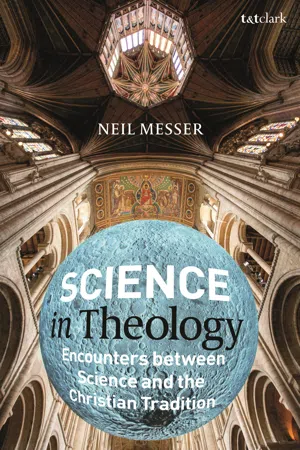
Neil Messer sets out five types of answer to that question. The responses range from the view that the Christian tradition has nothing to contribute, through various forms of dialogue, to the claim that science is irrelevant to theological understanding. This classification scheme is illustrated and tested by extended explorations of three topics in the science and theology field: how to think about God's action in the world, how to make theological sense of the suffering and destruction involved in the evolution of life, and how theology should respond to the scientific study of religion. The classification offers a way to understand and evaluate these debates, and the discussion of specific examples demonstrates the strengths and weaknesses of each type of approach.
The book concludes with suggestions for how readers might use this scheme to guide their own work on science and theology. For students and researchers in science and theology, this book offers three things: a tool for understanding specific debates in science and theology, critical surveys of some of the most important debates in the field, and a concise guide to ways of setting up encounters of theology with science.
- 208 pages
- English
- ePUB (mobile friendly)
- Available on iOS & Android
eBook - ePub
About this book
Information
1
Setting up the dialogue
Chapter summary
This book is based on a typology or classification of encounters between science and Christian theology. In this chapter I introduce the typology, which runs as follows. If we wish to understand ourselves and the world in relation to God, we can think of this as a conversation between two voices: a ‘voice of the Christian tradition’ and the voice of the relevant scientific discipline. In that case, what weight should be given to each voice in developing our understanding, and what kind of contribution should each voice make? Five types of answer can be imagined:
(1) Only the scientific voice contributes, and the contribution of the Christian tradition is denied or dismissed.
(2) Both voices contribute, but the scientific voice plays the predominant role in shaping the dialogue and addressing the questions. The claims of the Christian tradition must be adjusted where necessary to fit an account whose shape and content are determined by science.
(3) Both voices contribute, and neither predominates in shaping the dialogue or answering the questions.
(4) Both voices contribute, but the voice of the Christian tradition plays the predominant role in shaping the encounter and addressing the questions.
(5) Only the voice of the Christian tradition contributes, and the contribution of the scientific voice is denied or dismissed.
In later chapters, this typology will be tested out by analysing in detail three examples of important topics in the science and theology field: how to understand divine action in the light of contemporary physics, evolution and the problem of ‘natural evil’, and the significance of scientific studies of religion. This introductory chapter closes with some suggestions for how different kinds of readers might use the book.
1.1 Introduction
When theology and science encounter one another, how should this be done? That is broadly what this book is about. It has three main aims: (1) to set out a typology (or classification) of ways in which science–theology encounters might be set up, (2) to test the typology on three important debates in science and theology, and (3) to draw some conclusions about how science–theology encounters should be conducted. If I achieve these aims, I hope that will make the book interesting and useful to students and scholars designing research projects in science and theology. I hope it will also be of use to readers interested in the particular issues I shall use as examples, or in the field in general. At the end of this chapter, I make some more detailed suggestions about how these various kinds of readers might use the book.
Before introducing the typology, I need to define some terms and do a little groundwork.
1.2 ‘Science and religion’ or ‘science and theology’?
Sometimes this field is referred to as ‘science and religion’, at other times ‘science and theology’. The subject matter and the people involved are largely the same in either case, yet some scholars definitely prefer one term or the other.1 What do the different terms suggest?
The word ‘religion’ often names a human phenomenon that can be scientifically investigated (see Chapter 4). It is also used for particular faith traditions: Christianity, Judaism, Hinduism and so on are referred to as ‘religions’. Both uses have their problems. Indeed, within the field of religious studies, there is lively debate about what ‘religion’ might mean, and whether it is even a helpful category for academic study.2 ‘Theology’ literally means ‘God-talk’. More precisely, it describes some kind of intellectually rigorous, critical articulation and exploration of a faith tradition and its implications. It is most often used to describe this kind of thinking about Christian faith, though it is also used of some other religious traditions. As Philip Hefner points out, it is an inappropriate term for some faiths.3 Yet many of the topics identified as ‘religion and science’ issues4 would naturally be seen as theological, by Christians at least.
We should also keep in mind that the uses of both terms, ‘religion’ and ‘theology’, have changed greatly over time, so what we understand by them now may not be what was meant in earlier eras.5 ‘Science’ is another term whose meanings and uses have shifted over time,6 and it, too, is surprisingly tricky to define. The disciplines labelled sciences (in English) are diverse in their subject matter and methods. It is far from easy to say what they have in common, if anything, that identifies them as sciences. Those discussed in this book all rely in some way on gathering data about the natural world through observation and experiment, and constructing theories to account for the data and/or make testable predictions. However, the forms these activities take and the ways they relate to one another vary greatly from one science to another.
This book is about how science, understood in this way, interacts with Christian theology. One of my reasons for giving the book this focus is that I am a Christian theologian, so this is the tradition I am best qualified to write about. It was also where the contemporary field of science and theology/religion was mostly focused in its early days, though more recently there has been a welcome growth in the literature on science and other religious traditions.7 While this book focuses on Christian theology, I hope it will be interesting and useful to those working in, or on, other faiths – even if my specific arguments and proposals may not be directly transferable.
1.3 Kinds of questions in science and theology
We can ask various kinds of questions about the interaction of science and theology. Some are historical. For example: How have interactions between (what we call) science and theology changed over time? What is the history of particular debates and disputes? Others are methodological: How should we investigate issues in science and theology? Then there are substantive questions about particular topics in science and theology. For example: How should we think of God’s action in the world in light of contemporary physics (see Chapter 2)? What are the implications of evolutionary biology for Christian faith in an all-powerful, perfectly good Creator (Chapter 3)? Many interactions of science with theology also raise questions about ethics: the right, the good and how we ought to live and act in the world. These can operate at various levels: metaethics (including questions about the nature and meaning of moral concepts), normative ethics (how to make moral decisions) and practical ethics (how we should behave).
There is not much discussion of ethics in this book, though I have written extensively elsewhere about questions in ethics that arise from the interactions of science and theology.8 The present book is mostly about methodology: how to set up encounters between science and theology. This has some dangers. Michael Welker warns that prolonged discussions of methodology can become ‘stale and unproductive’.9 Or, as Jeffrey Stout once put it, ‘Preoccupation with method is like clearing your throat: it can go on for only so long before you lose your audience.’10 Furthermore, accounts of methodology can be counterproductive, distorting the investigations they are supposed to clarify and assist. As we shall see in the next section, a number of critics believe that methodological talk in science and theology has done just this. For this reason, John Perry and Sarah Lane Ritchie have gone so far as to propose a ‘moratorium’ on methodology in this field.11
I am sympathetic to these criticisms. However, as Welker emphasizes, in this interdisciplinary field, we cannot avoid methodological questions.12 In the next two sections I shall explain how my methodological proposal avoids the dangers highlighted by critics like Perry and Ritchie. As for Stout’s warning about losing one’s audience, to try and stop this book becoming too abstract and tedious, I link my methodological discussion to three important substantive topics. These focus on contemporary rather than historical debates, though in the next section I shall draw on critical historical perspectives to inform the way the discussion is set up.
1.4 Classifications, typologies and the problems of talking about ‘science and theology’
This book is based on a typology, or classification, of ways in which theology may interact with science. There have been numerous typologies of science and theology/religion before mine. The best known and most widely used was devised by Ian Barbour, who described four views of the relationship between science and religion: conflict, independence, dialogue and integration.13 Since Barbour produced his typology, a number of other leading scholars have proposed modifications and refinements of it and alternatives to it (see Box 1.1).
Box 1.1: Typologies in science and theology/religion
Several authors in the science and theology field have proposed typologies intended to modify, refine, complement or replace Barbour’s. Some of the leading examples are as follows:
• Philip Clayton’s book God and Contemporary Science lists ‘the sorts of ways’ in which different authors claim ‘scientific cosmology can contribute to theological conclusions … [and] scientific work stands in need of an interpretive framework of the sort that theology … offers’.14 These can be arranged along a continuum: (1) ‘science leads to theology’; (2) ‘science … supports one particular religious viewpoint’; (3) ‘science by itself amounts to a sort of religious perspective’; (4) science supports multiple religious perspectives’; (5) some authors ‘find spirituality in or implied by science … while resisting making any truth claims on this basis ’; (6) ‘science and theology [are] two distinct activities which have nothing to do with each other’; (7) ‘theology is a pure construct, and naturalism represents the best truth we have about the world’.15
• In the late 1990s, Niels Henrik Gregersen and J. Wentzel van Huyssteen assembled a volume in which six authors proposed different models for ‘rethinking’ the theology–science dialogue: postfoundationalism ‘beyond conflict and consonance’, critical realism, naturalism, pragmatism,...
Table of contents
- Cover
- Half-Title
- Dedication
- Title
- Contents
- Acknowledgements
- 1 Setting up the dialogue
- 2 Divine action and contemporary science
- 3 The problem of natural evil after Darwin
- 4 Evolutionary, cognitive and neuroscientific studies of religion
- 5 Concluding reflections: Using the five types
- Glossary and list of abbreviations
- Bibliography
- Index
- Copyright
Trusted by 375,005 students
Access to over 1.5 million titles for a fair monthly price.
Study more efficiently using our study tools.
Frequently asked questions
Yes, you can cancel anytime from the Subscription tab in your account settings on the Perlego website. Your subscription will stay active until the end of your current billing period. Learn how to cancel your subscription
No, books cannot be downloaded as external files, such as PDFs, for use outside of Perlego. However, you can download books within the Perlego app for offline reading on mobile or tablet. Learn how to download books offline
Perlego offers two plans: Essential and Complete
- Essential is ideal for learners and professionals who enjoy exploring a wide range of subjects. Access the Essential Library with 800,000+ trusted titles and best-sellers across business, personal growth, and the humanities. Includes unlimited reading time and Standard Read Aloud voice.
- Complete: Perfect for advanced learners and researchers needing full, unrestricted access. Unlock 1.5M+ books across hundreds of subjects, including academic and specialized titles. The Complete Plan also includes advanced features like Premium Read Aloud and Research Assistant.
We are an online textbook subscription service, where you can get access to an entire online library for less than the price of a single book per month. With over 1.5 million books across 990+ topics, we’ve got you covered! Learn about our mission
Look out for the read-aloud symbol on your next book to see if you can listen to it. The read-aloud tool reads text aloud for you, highlighting the text as it is being read. You can pause it, speed it up and slow it down. Learn more about Read Aloud
Yes! You can use the Perlego app on both iOS and Android devices to read anytime, anywhere — even offline. Perfect for commutes or when you’re on the go.
Please note we cannot support devices running on iOS 13 and Android 7 or earlier. Learn more about using the app
Please note we cannot support devices running on iOS 13 and Android 7 or earlier. Learn more about using the app
Yes, you can access Science in Theology by Neil Messer in PDF and/or ePUB format, as well as other popular books in Theology & Religion & Religion & Science. We have over 1.5 million books available in our catalogue for you to explore.