**Shortlisted for the 2021 BAAL Book Prize for an outstanding book in the field of Applied Linguistics**
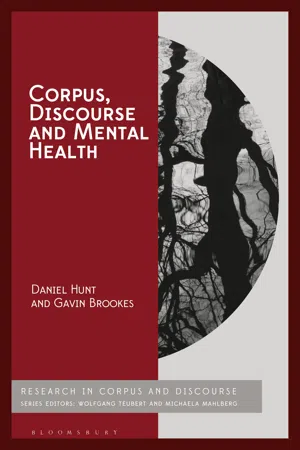
Situated at the interface of corpus linguistics and health communication, Corpus, Discourse and Mental Health provides insights into the linguistic practices of members of three online support communities as they describe their experiences of living with and managing different mental health problems, including anorexia nervosa, depression and diabulimia.
In examining contemporary health communication data, the book combines quantitative corpus linguistic methods with qualitative discourse analysis that draws upon recent theoretical insights from critical health sociology. Using this mixed-methods approach, the analysis identifies patterns and consistencies in the language used by people experiencing psychological distress and their role in realising varying representations of mental illness, diagnosis and treatment. Far from being neutral accounts of suffering and treating illness, corpus analysis illustrates that these interactions are suffused with moral and ideological tensions sufferers seek to collectively negotiate responsibility for the onset and treatment of recalcitrant mental health problems.
Integrating corpus linguistics, critical discourse analysis and health sociology, this book showcases the capacity of linguistic analysis for understanding mental health discourse as well as critically exploring the potential of corpus linguistics to offer an evidence-based approach to health communication research.
- 288 pages
- English
- ePUB (mobile friendly)
- Available on iOS & Android
eBook - ePub
Corpus, Discourse and Mental Health
About this book
Information
1
Mental health, discourse and corpus linguistics
1.1 Introduction
This book is about the language that people use to talk about mental distress. Focusing on the context of online support groups, the analysis presented over the forthcoming chapters examines the linguistic choices that people make when they disclose their experiences and understandings of different forms of emotional suffering. Mental distress can manifest in an extensive range of diagnosable mental disorders; the fifth and latest edition of the Diagnostic and Statistical Manual of Mental Disorders (DSM 5; American Psychiatric Association 2013), an authority on the classification of mental disorders, comprises a hefty 947 pages cataloguing 152 distinct psychiatric disorders (as well as various sub-types and unspecified disorders) (McCarron 2013). In this book we bring together two different research programmes which focus on three mental disorders in particular: (i) the eating disorder, anorexia nervosa (henceforth, anorexia); (ii) the mood disorder, depression; and (iii) an emergent, contested eating disorder known as diabulimia. While this book cannot therefore claim to be comprehensive in its coverage of mental health conditions, its focus on these particular disorders does at least provide insight into two prominent types of mental distress – mood disorders and eating disorders – as well as a currently non-diagnosable condition in diabulimia. These three disorders also enable us to account for language used in relation to conditions that are marked, respectively, by their rate of mortality (anorexia), prevalence (depression) and questions over their diagnostic legitimacy (diabulimia). Although all of these disorders are subject to contestation (explored in more depth in the next chapter), the last of these in particular brings to the fore questions over how people come to describe – or resist describing – themselves as suffering from a medical condition, how other people respond to such descriptions and how this shapes their beliefs about themselves and what they are experiencing.
In the following chapters, then, we are interested in exploring the ways in which members of online health-related support groups use language and discourse (a concept we introduce later) to represent these conditions, as well as themselves and others in relation to them, in the messages that they write. Understanding the experiences, attitudes and beliefs held about anorexia, depression and diabulimia by people who live with them is crucial to understanding the conditions themselves and to evaluating how those who suffer from them can be best treated and supported. To this end, we believe that detailed analysis of the language used by people when talking about their mental health problems offers a potent means of making sense of these experiences, attitudes and beliefs.
In this vein, a secondary aim of this book is to explore the opportunities and limitations of using corpus linguistic methods to analyse discourses of mental distress. The term corpus linguistics refers to a body of methods that uses specialist computer programs to study linguistic patterns in large collections of naturally occurring language data (McEnery and Wilson 2001). Corpus methods offer systematic means for pinpointing repeated and unique linguistic patterns in text and talk (Baker 2006) and hence for identifying common and more singular representations of anorexia, depression and diabulimia in this book. For example, corpus software can rapidly retrieve and present every instance of depression in a dataset and conduct statistical analyses based on the words that co-occur with it in order to understand how speakers typically (and atypically) talk about the condition and their relationship to it. Such affordances enable the mental health narratives of potentially thousands of individuals to be examined in ways that are not practical in purely qualitative studies. Despite the significant analytical opportunities offered by the ability to systematically analyse large amounts of data, to our knowledge there are few studies utilizing corpus techniques to examine online discussions of mental health issues (for exceptions, see Harvey 2012, 2013a; Harvey and Brown 2012; McDonald and Woodward-Kron 2016).
While our analysis places strong emphasis on the lexical and grammatical features of online support group messages, our intention in this book is not to provide a purely descriptive account of these texts. Our reasons for this are twofold: first, linguistic descriptions of computer-mediated communication are not in short supply (Baron 2000, 2008; Crystal 2001; Barton and Lee 2013). Secondly, for their participants and, we believe, the social scientist, the primary significance of these online interactions does not lie in their status as neutral language data. Rather, it lies in the rich, first-hand accounts of mental health knowledge and experience which they provide. To present a purely descriptive account of these texts would therefore disregard an opportunity to understand the subjective accounts of pernicious mental health conditions that the participants offer. This practical orientation places the present study squarely in the tradition of applied linguistics, memorably defined by Brumfit (1995: 27) as ‘the theoretical and empirical investigation of real-world problems in which language is a central issue’ (see also Cook 2003). To borrow Corder’s (1973: 10) terms, our study ‘is not a theoretical study [but] makes use of the findings of theoretical studies’ to illuminate issues in the ‘real world’. By its very nature, this makes applied linguistics an interdisciplinary endeavour, and the research in this book combines substantive aspects of linguistics, health sociology (Nettleton 2013) and medical humanities (Crawford et al. 2015) and orients as much to the two latter disciplines as it does to the former.
In keeping with this orientation, this book is intended for an audience drawn from a range of disciplinary backgrounds. In approaching questions about mental illness using methods from the field of linguistics, our intention is to show the value of attending closely to language even when dealing with issues more commonly associated with the disciplines of psychology and psychiatry. Likewise, attention to language can highlight the ways in which broad social changes are reproduced, negotiated and challenged at the micro level of interaction between individuals, and hence offer insights relevant to health sociologists.
We should also make it clear at this point that it is not our aim to compare or contrast the discourses associated with anorexia, depression and diabulimia, although we do flag up certain areas of similarity or difference where these are judged to support (or likewise problematize) our analytical points. Neither is it our aim to establish a general set of ‘mental health discourses’ that characterize online mental health support discussions. It is for this reason that we analyse online interactions related to anorexia, depression and diabulimia separately in the form of three case studies, rather than amalgamating our data and focusing primarily on the consistencies across these conditions. By first considering the data related to anorexia, depression and diabulimia discretely, we are able to examine topics that are particular to interactions around each condition – such as insulin use in relation to diabulimia – but which would have likely slipped into the analytical background had we combined the datasets together. In addition, it also enables us to consider the ways in which the representations of anorexia, depression and diabulimia that emerge during interactions in each support group are strongly related to, and best understood in relation to, the contextual norms of each forum itself.
Finally, we should also make clear that it is not our intention to identify any ‘linguistic markers’ of anorexia, depression, diabulimia or emotional distress more generally. Rather, we share the view of Galasiński (2008) who, writing in relation to depression, argues that the diverse ways in which people talk about emotional suffering means that it is ‘quite difficult to make definitive claims as to what affect in language is supposed to look like in depression or outside it’ (2008: 16–17). This is a point we will return to in Section 1.4.
In light of the interdisciplinary makeup of our intended readership, the remainder of this chapter elaborates on this general introduction with respect to the book’s three central elements: (i) mental health and distress, (ii) discourse, and (iii) corpus linguistics. The next section explores the constructed and contested nature of mental health and illness, a consideration which brings us to the phenomenon of medicalization – a key concept in this book’s analysis – and specifically to the processes by which some mental states come to be thought of and treated as ‘normal’ and others as ‘abnormal’ or ‘deviant’ and thus as requiring medical intervention. We then move on to the related topics of discourse and discourse analysis, sketching out the view of discourse we adopt in this book and the ontological assumptions this entails for our analysis. Following this, we provide a more detailed introduction to corpus linguistics as our primary methodology and approach to discourse analysis, acquainting readers with some of its key features and debates and comparing it against other approaches currently being applied in social scientific research of (mental) health language. The chapter then concludes with an overview of the remaining chapters of the book. Reflecting the diverse disciplinary perspectives from which the topic of mental health is approached in contemporary research, this book is written with a consciously interdisciplinary audience in mind. As such, we do not assume that readers have any prior knowledge of the topics of mental health and distress, discourse (analysis) or corpus linguistics.
1.2 Mental health and the medicalization of distress
An important starting point for the research in this book is our view of mental disorders as socially and discursively constituted. Epistemological debates around psychopathology have, as Pilgrim and Bentall (1999) point out, long been characterized by two polarized positions which they term ‘medical naturalism’ and ‘social constructionism’. Medical naturalism holds that psychiatric nosology ‘proceeds incrementally with a confidence that there exists a real and invariant external world of natural disease entities’ (Pilgrim and Bentall 1999: 261). From this perspective, these ‘natural disease entities’ have been observed and studied by diagnosticians with increasing sophistication over time, rendering psychiatry’s accounts of mental disorders ever more accurate – in other words, bringing them ever closer to the ‘reality’ of the natural disease entities they aim to describe. However, the medical naturalism position has been challenged, most notably by proponents of anti-psychiatry, an international movement inspired by the work of scholars such as Michel Foucault, Ronald David Laing, Thomas Szasz and Franco Basaglia, that is concerned with reframing the concept of ‘mental health’. Exponents of this movement problematize psychiatry’s explanatory and diagnostic frameworks, in many cases totally rejecting psychiatric explanations for mental distress (Szasz 1960). Some critics of psychiatry also go so far as to claim that it has yet to provide any convincing evidence of the biological ‘reality’ of mental illness, such as lesions or physical defects in the brain (Burstow 2015).
The second perspective, social constructionism, studies psychiatric diagnoses as ‘representations of a variegated and ultimately unknowable human condition’, with mental illnesses themselves viewed as ‘by-product[s] of the activity of mental health professionals’ (Pilgrim and Bentall 1999: 261). Influenced by the writing of Michel Foucault and Jacques Derrida, scholars and critics working in the social constructionist tradition are less concerned with studying psychopathology itself and more interested in studying how psychopathology is represented or socially constructed through different types of social practice. The social constructionist perspective has been adopted by countless discourse-based and social scientific studies of mental illnesses including, among others, anorexia (Hepworth 1999) and depression (Lewis 1996) (see Harper (1995) for a review of social constructionist research of mental health discourse).
As a means of negotiating these oppositional perspectives, Pilgrim and Bentall propose a critical realist view of mental health, which, they argue, sits somewhere in between medical naturalism and social constructionism. Associated most closely with the work of philosopher Roy Bhaskar (1975, 1979, 1990), critical realism is usefully defined by Archer and colleagues as
a series of philosophical positions on a range of matters including ontology, causation, structure, persons, and forms of explanation. Emerging in the context of the post-positivist crises in the natural and social sciences in the 1970s and 1980s, critical realism represents a broad alliance of social theorists and researchers trying to develop a properly post-positivist social science. Critical realism situates itself as an alternative paradigm both to scientistic forms of positivism concerned with regularities, regression-based variables models, and the ques t for law-like forms; and also to the strong interpretivist or postmodern turn which denied explanation in favour of interpretation, with a focus on hermeneutics and description at the cost of causation.
(Archer et al. 2016: n.p.)
When applied to the study of mental health and illness, critical realist approaches are sympathetic towards social constructionism’s concern with examining psychiatric concepts of mental illness in terms of the social and historical contexts that have given rise to them but, unlike social constructionism, does not reduce psychopathology to the level of discourse alone. From a critical realist perspective, it is not reality itself but human theories of and methods for investigating reality which are understood to be socially (and discursively) constructed. These constructions are not viewed as objective but rather as ‘shaped by social forces and informed by interests […] includ[ing] interests of race, class and gender as well as economic investment and linguistic, cultural and professional constraints in time and space’ (Pilgrim and Bentall 1999: 262). Critical realism therefore advocates a moderate social constructionism that ‘ensures a proper caution about historical and cultural relativism, without degenerating into the unending relativism and nihilism attending social constructionism’ (Pilgrim and Bentall 1999: 271).
For the purpose of this book, we take a critical realist view of mental illness. We are interested in understanding how members of online communities linguistically encode their experiences of mental illness and the socially and historically contingent explanations that they draw upon when doing so. Between the poles of medical naturalism and social constructionism, critical real...
Table of contents
- Cover
- Half-Title
- Series
- Dedication
- Title
- Contents
- List of illustrations
- Content notice
- Acknowledgements
- 1 Mental health, discourse and corpus linguistics
- 2 Anorexia, depression and diabulimia: Contested conditions and online support
- 3 Corpora and methods of analysis
- 4 Anorexia online: Pro-recovery in the ED community
- 5 Being ‘sick of it’: Depression, medication and self-injurious behaviour
- 6 Diabulimia: Discourses of chronic illness and mental distress
- 7 Discussion: Telling the right story; being the right self
- 8 Beyond the forum: Implications and reflections
- Notes
- References
- Index
- Copyright
Trusted by 375,005 students
Access to over 1.5 million titles for a fair monthly price.
Study more efficiently using our study tools.
Frequently asked questions
Yes, you can cancel anytime from the Subscription tab in your account settings on the Perlego website. Your subscription will stay active until the end of your current billing period. Learn how to cancel your subscription
No, books cannot be downloaded as external files, such as PDFs, for use outside of Perlego. However, you can download books within the Perlego app for offline reading on mobile or tablet. Learn how to download books offline
Perlego offers two plans: Essential and Complete
- Essential is ideal for learners and professionals who enjoy exploring a wide range of subjects. Access the Essential Library with 800,000+ trusted titles and best-sellers across business, personal growth, and the humanities. Includes unlimited reading time and Standard Read Aloud voice.
- Complete: Perfect for advanced learners and researchers needing full, unrestricted access. Unlock 1.5M+ books across hundreds of subjects, including academic and specialized titles. The Complete Plan also includes advanced features like Premium Read Aloud and Research Assistant.
We are an online textbook subscription service, where you can get access to an entire online library for less than the price of a single book per month. With over 1.5 million books across 990+ topics, we’ve got you covered! Learn about our mission
Look out for the read-aloud symbol on your next book to see if you can listen to it. The read-aloud tool reads text aloud for you, highlighting the text as it is being read. You can pause it, speed it up and slow it down. Learn more about Read Aloud
Yes! You can use the Perlego app on both iOS and Android devices to read anytime, anywhere — even offline. Perfect for commutes or when you’re on the go.
Please note we cannot support devices running on iOS 13 and Android 7 or earlier. Learn more about using the app
Please note we cannot support devices running on iOS 13 and Android 7 or earlier. Learn more about using the app
Yes, you can access Corpus, Discourse and Mental Health by Daniel Hunt,Gavin Brookes in PDF and/or ePUB format, as well as other popular books in Languages & Linguistics & Linguistics. We have over 1.5 million books available in our catalogue for you to explore.