Arguing that we only have democracy when systems of power are held to account, Kaufman examines the real work being done to challenge the operations of power that underlie four unruly social problems: climate change, sweatshop labour, police abuse, and economic deprivation.
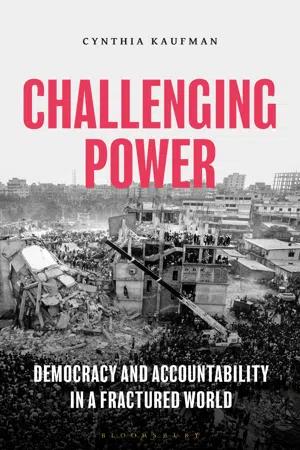
In Challenging Power, Kaufman pairs each of these issues with an operation of power -- the large scale influence of multinational corporations; the power of governments; the authority of financial markets; and the control inherent in systems of meaning -- and using case studies like the Rana Plaza disaster in Bangladesh and the killing of Eric Garner, forcefully demonstrates what is involved in challenging these operations of power.
Advancing a positive message, Kaufman maintains that these networks are not omnipotent and can be challenged if we develop 'mechanisms of accountability' which allow us to conceptualise the nature of these problems and the actions required to resist them. Kaufman provides then, a model for ethical action that allows us to investigate and appreciate our own connections to the powerful forces that control our world.
- 232 pages
- English
- ePUB (mobile friendly)
- Available on iOS & Android
eBook - ePub
About this book
Information
1
States of Irresponsibility
Rana Plaza, Accountability, and Power
When I shop, I do wonder who made the things I am buying. It takes so much of the pleasure out of it. But I really do think about it. Today I looked in my closet and none of it spoke to me. It all felt a bit drab, so I went to the mall. There I saw all sorts of beautiful things. When I tried them on, I felt much fresher. I bought a few shirts and a nice new purse to go with them. I wore the shirt out to dinner with a few friends and one of them said “Cute top!” I didn’t tell that friend that when I got home from the store, I had looked at the tag and it said “Made in Bangladesh.” I thought about the story I had read the day before about Rina Rehman, who died in the building collapse. I didn’t tell them that I sat on the bed and felt sick. What was I doing? Could Rina Rehman have made that shirt? I didn’t tell them, because I didn’t want to ruin the fun everyone was having, and I was embarrassed about being the one who always ruined people’s fun. And I am certainly not going to stop Rana Plazas from happening by not buying clothes or by becoming a social outcast. 1
No amount of dithering will take away the reality that you are, in the end, responsible for the people crushed to death in global factories. They were hired to make your clothes. And they died doing so.
Punish the companies that are destroying the environment; punish the politicians who sow hate; punish the greedy bastards who own sweatshops. Pretty simple really.
Well punishment, that makes sense to me….no one ever gets dinged for the stupid things they do. Don’t blame “the system.” But, if someone does something wrong, of course they should be punished. Throw the bastards in jail who broke the law. But I’d rather not hear about it. Those people don’t know how to run their countries. And no amount of bellyaching from you will make them stop treating each other like that.
As long as you blame the ones who are causing the problem, and leave me, and my clothes, and my car out of it, I wish you well. It’s easy for you to get all moralistic about what people wear. I am just trying to get by in this world. I buy cheap fashion because it’s what I can afford. And I need to look good for work. So, I hope all of you who have the time to worry about those things figure out a way to feel good about your clothes. In the meantime, I’m buying the best I can for the cheapest I can.
The language of “it’s all about supply and demand” covers the reality that we live in a world of human relations mediated by systems of power and privilege.
…
On April 24, 2013, the Rana Plaza garment factory collapsed in Dhaka, Bangladesh. Those accounting for the deaths have said that 1,129 people died, and 2,500 people were taken from the building alive.2 The world was horrified by the human tragedy, and simultaneously thrown into a state of introspection about who to hold to account. A sickening feeling took hold among many who feel that we are all in some sense a part of the web of relationships that caused this tragedy to happen. The tendrils of blame spread far and wide and reached all parts of the globe, leaving people in many parts of the world feeling impotent and frustrated.
…
“Lutfer Rahman, whose wife, Rina, worked at Rana Plaza, was sipping tea in their damp one-room home when a neighbor yelled through his doorway: The plaza was gone. Lutfer and Rina had married in their hard-bitten farming village and, like legions of people, moved to Dhaka for better prospects. They soon had two daughters, Arifa and Latifa, and Lutfer had supported the family by pulling a rickshaw until asthma forced him to quit. So, Rina had become the breadwinner, a factory helper passing materials to sewing operators for 5,000 taka ($62) a month. Now, for the first time since he’d given up his rickshaw, Lutfer ran: about half a mile through the winding labyrinth of dirt lanes and workshops, past blacksmiths and brick kilns, trailed by his daughters. They reached the site just as two bodies were pulled from the wreckage, neither of them Rina’s. Lutfer, overwhelmed by the rising din of sirens and shouting, bent over to catch his breath…
On May 10, after viewing well over 500 corpses, twelve-year-old Arifa Rahman found her mother. Her body was badly damaged; Arifa may have passed her by several times. But the newly added name on the body-bag tag read: Rina Rahman, husband: Lutfer Rahman, district: Rangpur, taken from a stained document… removed from a pocket. The family’s search had ended. It also secured them a 200,000-taka ($2,500) check from an ad hoc relief fund administered by the prime minister. They received another 20,000 taka for burial costs.
The Rahmans loaded Rina onto a rickshaw bed and headed home. In the family compound, relatives washed the body and cloaked it in a cotton shroud. That same day, Rina was buried in a small graveyard near their house. The land is overgrown and no headstone marks her plot, but Lutfer knows the place.” 3
…
If we look at who is responsible for the deaths caused by the Rana Plaza building collapse, at one peel of the onion we see the managers who had forced the employees back into the building, even after the workers had refused to enter because they had seen cracks in the building the previous day. But, of course, those managers were just doing their duty to their bosses, the factory owners. The owners were merely fulfilling the orders they had from the multinational corporations. The corporations were working to keep up with the pressures of the market.
It is easy to focus on Sohel Rana himself. Rana and his parents had engaged in bribery and illegal maneuvers to obtain the land that the factory was built on from small-scale land owners. When the disaster happened, Rana tried to flee the scene and was caught a few days later at the border with India. Initially, he was granted bail, but after protest from labor organizations, he was held in jail, where, as of this writing, he remains awaiting trial in five different cases. His mother, Morzina Begum, also ended up in jail.
Other standouts for blame were the building inspectors who approved a building constructed on a pond covered with sand, and who allowed Rana to add three floors of industrial production to a building that was designed to be residential.4 The chain of causality doesn’t stop there with the most egregious violations of law. Government ministers refused UN aid in the rescue effort because it might have hurt national pride. This left many people to die who would have been rescued alive in a well-run operation.
When they were ordered to go back into the building, even though they knew it was unsafe, most workers chose to go back because they were threatened with losing a month’s salary. A strong union would have provided a structure for collective resistance to that threat and probably would have saved people’s lives. There are unions in Bangladesh, but the environment for them is not very hospitable. Companies routinely hire thugs to beat and sometimes murder labor organizers.
Both major Bangladeshi parties are run by people who benefit from low-wage manufacturing. Corruption is endemic to the political system. There are many causes for that, having to do with ethnic rivalry, the ugly legacy of British colonialism, and the legacies of the Cold War.
And, of course, capitalism is an important part of this picture, and that’s the part that connects those of us outside of Bangladesh most strongly to this tragic story. This story is about more than an unfortunate thing that happened because of local corruption in a small and poor country.
The simple law of supply and demand says that people will buy more if the prices are lower, and companies will naturally look to where the prices are lowest. As unions fought and succeeded in moving the US garment industry past the sweatshop phase, companies raced to the bottom, and kept moving around the globe until they found places with the best environment for the cheapest production. Bangladesh is just a current holder of the honor of being a great deal for those looking for a cheap supply of labor.
Are the shoppers who buy cheap fashion to blame for playing the game of supply and demand? One of the most powerful aspects of pro-capitalist thinking is that we are encouraged to not ask that question. Consumers are supposed to look for the deals that suit them the best.
The questions then become: How do we hold ourselves and others accountable for the real operations of power that exist in this world? How do those operations of power create systems that are destructive? And how do we challenge the complex systems of power that we face?
Accountability
accountable: Liable to be called to account; responsible (to persons, for things).
account: Counting Reckoning, calculation, statement of moneys goods or services, Calculate compute, reckoning, and answer for.5
A system of accountability, or an accountability mechanism, works to hold agents to account for something that goes wrong. It does not necessarily involve punishment, but it does involve identifying those responsible for a problem in the hopes of preventing future problems.
If someone lets me down, and I don’t let them know, they are likely to do that thing again. If I give them feedback and let them know that a something bad happened, then there is more of a chance of the thing not happening again. If my child always leaves her dishes on the table and I don’t say anything about it, she is likely to keep doing it. I don’t need to punish her to get her to clear her dishes, but there needs to be some form of feedback from her action to my reaction, for me to get a different action. There are many forms of feedback, and many reasons that people do things that are negative to others. Accountability mechanisms create forms of feedback from the negative things that happen to ways to prevent those actions from happening in the future.
Theorists of accountability focus on ways to create mechanisms that make the negative impacts of an action become part of the decision-making process about whether or not that thing will happen again. A productive accountability mechanism creates cycles to constantly monitor, constrain, and limit the way social processes operate.6
One of the biggest problems with pro-capitalist ways of thinking is that they undermine these systems of feedback. One of the basic premises of pro-capitalist thinking is that people with resources should be able to do what they like with their resources, and the role of government is to interfere as little as possible to allow individuals to make those choices. The networks of relations which create a social fabric, that holds us all in complex relations with one another, become invisible. And the presumption becomes that we are not responsible for one another. Rather, each of us is merely responsible for doing what’s best for ourselves, limited by the requirement that we stay within the law, and we respect one another’s individual rights. Morally accountable social relations are undermined by claims that we are all free and independent and have no obligations to one another.
Accountability for the Rana Plaza Disaster
We can and should rely on traditional notions of morality and responsibility to blame Sohel Rana for his part in the Rana Plaza disaster. As a moral agent he had all kinds of power to make choices other than the ones he made. According to Kantian philosophy, we are supposed to treat all people as ends in themselves, worthy of human dignity. On this criterion Rana failed. He treated the workers as means to his ends of self-enrichment. On utilitarian grounds we can say he acted immorally because more unhappiness came out of his managers telling people to go back into the building than if they had not. And of course, our old-fashioned legal concepts also work: if anyone deserves to be in jail, Sohel Rana does. The building inspectors who accepted his bribes can also be sent to jail.
Those are helpful steps, but they are not enough to prevent disasters like this from happening in the future. Most of our thinking about accountability has its roots in legal thinking, where laws are supposed to protect the common good, and those who break the laws are held accountable through punishment, such as fines or jail time. Our legal systems were created to constrain the acts of individuals, and they are generally best when applied to actions taken with intent to do wrong.
Retributive justice, the dominant approach to law, where individuals or corporate entities are punished for wrong doing, can be used in many productive ways to constrain the destructive powers we face. But retributive justice needs to be supplemented to get at problems which don’t hit the high thresholds of responsibility required to trigger legal action. To develop effective ways to constrain the abuses we face, we also need to include ways to capture the social in our understanding; we need to be able to attend to the ways that we are all interconnected; we need to find ways to work prospectively to create accountability mechanisms that prevent harm. We need to supplement retributive justice with ways to heal the world to get at the roots of the problems we face. The linkages between my action of buying a shirt and the deaths at Rana Plaza are too weak to provoke traditional retributive forms of accountability.
In The Imperative of Responsibility: In Search of an Ethics for the Technological Age, Hans Jonas arg ued that in earlier periods of human history, the time and space horizons of our actions were much more limited than they are now. The move to more connected ways of living has led to the rise of new circumstances, and the ethical systems we have inherited are not designed to deal wi...
Table of contents
- Cover
- Half-Title
- Series
- Dedication
- Title
- Contents
- Acknowledgments
- Preface
- Introduction
- 1 States of Irresponsibility: Rana Plaza, Accountability, and Power
- 2 The Ethics of Accountability Democracy
- 3 Democracy in Crisis
- 4 Politics beyond the Polis, Democracy beyond Elections
- 5 The Destructive Powers That Need to be Held to Account
- 6 Accountability
- 7 Building Accountability Democracy
- 8 Acting Well in a Traumatized World
- Notes
- Bibliography
- Index
- Copyright
Trusted by 375,005 students
Access to over 1.5 million titles for a fair monthly price.
Study more efficiently using our study tools.
Frequently asked questions
Yes, you can cancel anytime from the Subscription tab in your account settings on the Perlego website. Your subscription will stay active until the end of your current billing period. Learn how to cancel your subscription
No, books cannot be downloaded as external files, such as PDFs, for use outside of Perlego. However, you can download books within the Perlego app for offline reading on mobile or tablet. Learn how to download books offline
Perlego offers two plans: Essential and Complete
- Essential is ideal for learners and professionals who enjoy exploring a wide range of subjects. Access the Essential Library with 800,000+ trusted titles and best-sellers across business, personal growth, and the humanities. Includes unlimited reading time and Standard Read Aloud voice.
- Complete: Perfect for advanced learners and researchers needing full, unrestricted access. Unlock 1.5M+ books across hundreds of subjects, including academic and specialized titles. The Complete Plan also includes advanced features like Premium Read Aloud and Research Assistant.
We are an online textbook subscription service, where you can get access to an entire online library for less than the price of a single book per month. With over 1.5 million books across 990+ topics, we’ve got you covered! Learn about our mission
Look out for the read-aloud symbol on your next book to see if you can listen to it. The read-aloud tool reads text aloud for you, highlighting the text as it is being read. You can pause it, speed it up and slow it down. Learn more about Read Aloud
Yes! You can use the Perlego app on both iOS and Android devices to read anytime, anywhere — even offline. Perfect for commutes or when you’re on the go.
Please note we cannot support devices running on iOS 13 and Android 7 or earlier. Learn more about using the app
Please note we cannot support devices running on iOS 13 and Android 7 or earlier. Learn more about using the app
Yes, you can access Challenging Power by Cynthia Kaufman in PDF and/or ePUB format, as well as other popular books in Philosophy & Ethics & Moral Philosophy. We have over 1.5 million books available in our catalogue for you to explore.