The culture of peace and non-violence is essential to human existence, development and progress. In 1999, the United Nations General Assembly adopted by consensus the norm-setting, forward-looking "Declaration and Programme of Action on a Culture of Peace". Governments, institutions, NGOs, other civil society entities and, in particular, individuals – all are encouraged therein to contribute to the global movement for the culture of peace.
Related to this vision, this rich and varied dialogue discusses how the culture of peace can be achieved in the world. Based on the extensive personal and professional experiences of two high-profile thinkers and activists, they analyse the challenges unfolding at local, national and global levels and how these relate to humanity's quest for peace, human security and happiness. Although coming from very different positions – one a Buddhist philosopher, educator and leader; the other a UN diplomat renowned for his international work in peace, development and human rights – these interlocutors are united in their search for justice and better quality of life for all and their conviction that women and young people are the most effective means to achieving positive change in the world.
The dialogue provides ideas on the key challenges that face our planet: poverty and deprivation, war and violence, nuclear weapons and small arms, climate change and environmental degradation, weak governance and financial crises, marginalization of women and alienation of youth and the relentless drive for materialism. They also invite us to consider how the culture of peace can be practically achieved through an individual, collective and institutional transformation.
Recognizing that global citizenship, multilateralism, women's equality and value-creating education are central and inter-linked themes, this dialogue also underscores the inherent strength of spirituality, compassion, empathy, forgiveness, respect for diversity and empowerment that comes from the trials and tribulations of life.
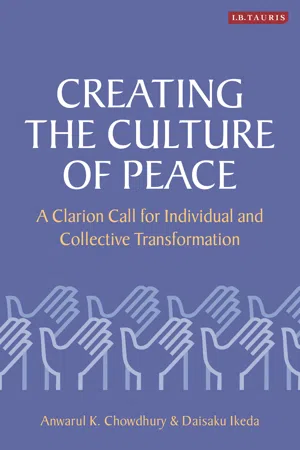
eBook - ePub
Creating the Culture of Peace
A Clarion Call for Individual and Collective Transformation
- 272 pages
- English
- ePUB (mobile friendly)
- Available on iOS & Android
eBook - ePub
Creating the Culture of Peace
A Clarion Call for Individual and Collective Transformation
About this book
Information
Table of contents
- Cover
- Half-Title
- Dedication
- Title
- Contents
- 1 Bangladesh Beginnings
- 2 The Struggle for Independence
- 3 Rabindranath Tagore, Poet of Humanity
- 4 Education of the Whole Person
- 5 Children’s Rights
- 6 A Constant Renewal of Strength
- 7 An Effective United Nations
- 8 The Congress of Humanity
- 9 To Protect the Vulnerable
- 10 Redefining Development
- 11 No Peace Without Women
- 12 The Road to Hope
- 13 The School of Life
- 14 Opening the Book of the World
- Epilogue
- Notes
- Index
- Plates
- Copyright
Trusted by 375,005 students
Access to over 1.5 million titles for a fair monthly price.
Study more efficiently using our study tools.
Frequently asked questions
Yes, you can cancel anytime from the Subscription tab in your account settings on the Perlego website. Your subscription will stay active until the end of your current billing period. Learn how to cancel your subscription
No, books cannot be downloaded as external files, such as PDFs, for use outside of Perlego. However, you can download books within the Perlego app for offline reading on mobile or tablet. Learn how to download books offline
Perlego offers two plans: Essential and Complete
- Essential is ideal for learners and professionals who enjoy exploring a wide range of subjects. Access the Essential Library with 800,000+ trusted titles and best-sellers across business, personal growth, and the humanities. Includes unlimited reading time and Standard Read Aloud voice.
- Complete: Perfect for advanced learners and researchers needing full, unrestricted access. Unlock 1.5M+ books across hundreds of subjects, including academic and specialized titles. The Complete Plan also includes advanced features like Premium Read Aloud and Research Assistant.
We are an online textbook subscription service, where you can get access to an entire online library for less than the price of a single book per month. With over 1.5 million books across 990+ topics, we’ve got you covered! Learn about our mission
Look out for the read-aloud symbol on your next book to see if you can listen to it. The read-aloud tool reads text aloud for you, highlighting the text as it is being read. You can pause it, speed it up and slow it down. Learn more about Read Aloud
Yes! You can use the Perlego app on both iOS and Android devices to read anytime, anywhere — even offline. Perfect for commutes or when you’re on the go.
Please note we cannot support devices running on iOS 13 and Android 7 or earlier. Learn more about using the app
Please note we cannot support devices running on iOS 13 and Android 7 or earlier. Learn more about using the app
Yes, you can access Creating the Culture of Peace by Anwarul K. Chowdhury,Daisaku Ikeda in PDF and/or ePUB format, as well as other popular books in Philosophy & Eastern Philosophy. We have over 1.5 million books available in our catalogue for you to explore.