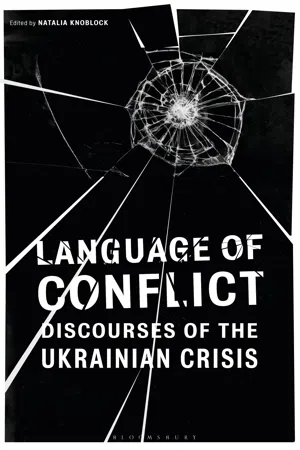
Exploring the ways in which language and conflict are intertwined and interrelated, this volume examines the patterns of public discourse in Ukraine and Russia since the beginning of the Ukrainian Crisis in 2014. It investigates the trends in language aggression, evaluation, persuasion and other elements of conflict communication related to the situation. Through the analysis of the linguistic features of salient discourses and prevalent narratives constructed by different social groups, Language of Conflict reflects competing worldviews of various stakeholders in this conflict and presents multiple, often contradictory, visions of the circumstances.
Contributors from Ukraine, Russia and beyond investigate discursive representations of the most important aspects of the crisis: its causes and goals, participants and the values and ideologies of the opposing factions. They focus on categorization, stance, framing, (de)legitimation, manipulation and coping strategies while analysing the ways in which the stress produced by social discord, economic hardship, and violence shapes public discourse. Primarily focusing on informal communication and material gathered from online sources, the collection provides insight into the ways people directly affected by the crisis think about and respond to it. The volume acknowledges the communicators' active role in constructing the (often incompatible) discursive images of the conflict and concentrates on the conscious and strategic use of linguistic resources in negative and aggressive communication.
- 296 pages
- English
- ePUB (mobile friendly)
- Available on iOS & Android
eBook - ePub
About this book
Information
1
Discourses of conflict
Cross-linguistic corpus-assisted comparative discourse study of Russian and Ukrainian parliamentary debates of 2014
Tatyana Karpenko-Seccombe
1 Introduction
The year 2014 was undeniably one of the most dramatic years in the history of Ukraine. It saw the annexation of Crimea by Russia; the proclamation of two pro-Russian republics – the Donetsk People’s Republic (DPR) and the Luhansk People’s Republic (LPR) – leading to full-scale armed conflict between Ukrainian government troops and pro-Russian forces; the failed attempt of a truce and a ceasefire; and continuing disputes between Russia and Ukraine over gas supplies and prices.
Against the backdrop of these events, this study focuses on the parliamentary debates of the two countries in conflict, examining discourses surrounding these contentious events. The aim of this paper is to investigate how these events are framed in debates in the Russian and Ukrainian parliaments. In particular, the following questions are addressed:
(1) How different are linguistic features used in the parliamentary debates of countries in conflict when representing the same events?
(2) Whawt implications do language differences have for constructing the same events in two diffe...
Table of contents
- Cover
- Half-Title
- Series
- Title
- Contents
- List of illustration
- Notes on contributors
- Introduction
- 1 Discourses of conflict: Cross-linguistic corpus-assisted comparative discourse study of Russian and Ukrainian parliamentary debates of 2014
- 2 Metaphor, identity and conflict in political discourse: A case study of President Poroshenko and President Putin’s speeches
- 3 The image of the Ukrainian crisis in the Polish-language media in Ukraine
- 4 Blended names in the discussions of the Ukrainian crisis
- 5 The antagonistic discourses of the Euromaidan: Kolorady, Sovki and Vatniki versus Jumpers, Maidowns and Panheads
- 6 The Ukrainian nation – stepmother, younger sister or stillborn baby?: Evidence from Russian TV debates and related political sources (2013–15)
- 7 Who are ‘they’ for Ukrainians in Ukraine and in the diaspora?: Othering in political discourse
- 8 Discursive practices in online media: Language ideologies in Ukraine in a time of crisis
- 9 Unrecognized holidays: Old and new ‘state’ traditions in the self-proclaimed republics in the east of Ukraine
- 10 Andriy Biletsky’s Ukrainian order: Discourse, actions and prospects of democracy in Ukraine
- 11 The art of the insult: (Re)creating Zaporizhian Cossacks’ letter-writing on YouTube as collective creative insurgency
- 12 Fighting fear with humour: The linguistic-pragmatic aspects
- 13 Assimilative representations of Ukrainian refugees in the Russian and Ukrainian press: A ‘burden’ or a ‘gain’?
- Index
- Copyright
Trusted by 375,005 students
Access to over 1.5 million titles for a fair monthly price.
Study more efficiently using our study tools.
Frequently asked questions
Yes, you can cancel anytime from the Subscription tab in your account settings on the Perlego website. Your subscription will stay active until the end of your current billing period. Learn how to cancel your subscription
No, books cannot be downloaded as external files, such as PDFs, for use outside of Perlego. However, you can download books within the Perlego app for offline reading on mobile or tablet. Learn how to download books offline
Perlego offers two plans: Essential and Complete
- Essential is ideal for learners and professionals who enjoy exploring a wide range of subjects. Access the Essential Library with 800,000+ trusted titles and best-sellers across business, personal growth, and the humanities. Includes unlimited reading time and Standard Read Aloud voice.
- Complete: Perfect for advanced learners and researchers needing full, unrestricted access. Unlock 1.5M+ books across hundreds of subjects, including academic and specialized titles. The Complete Plan also includes advanced features like Premium Read Aloud and Research Assistant.
We are an online textbook subscription service, where you can get access to an entire online library for less than the price of a single book per month. With over 1.5 million books across 990+ topics, we’ve got you covered! Learn about our mission
Look out for the read-aloud symbol on your next book to see if you can listen to it. The read-aloud tool reads text aloud for you, highlighting the text as it is being read. You can pause it, speed it up and slow it down. Learn more about Read Aloud
Yes! You can use the Perlego app on both iOS and Android devices to read anytime, anywhere — even offline. Perfect for commutes or when you’re on the go.
Please note we cannot support devices running on iOS 13 and Android 7 or earlier. Learn more about using the app
Please note we cannot support devices running on iOS 13 and Android 7 or earlier. Learn more about using the app
Yes, you can access Language of Conflict by Natalia Knoblock in PDF and/or ePUB format, as well as other popular books in Languages & Linguistics & Sociolinguistics. We have over 1.5 million books available in our catalogue for you to explore.