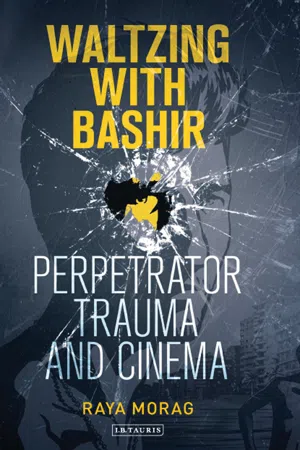
Waltzing with Bashir proposes a new paradigm for cinema trauma studies - the trauma of the perpetrator. Recognizing a current shift in interest from the trauma suffered by victims to that suffered by perpetrators, the book seeks to theorize this still under-studied field thus breaking the repression of this concept and phenomenon in psychoanalysis and in cinema literature. Taking as a point of departure the distinction between testimony given by the victim and confession made by the perpetrator, this pioneering work ventures to define and analyze perpetrator trauma in scholarly, representational, literary, and societal contexts. In contrast to the twentieth-century definition of the perpetrator based on modern wars and totalitarian regimes,Morag defines the perpetrator in the context of the twenty-first century's new wars and democratic regimes. The direct result of a drastic transformation in the very nature of war, made manifest by the lethal clash between soldier and civilian in a battlefield newly defined in bodily terms, the new trauma paradigm stages the trauma of the soldier turned perpetrator, thus offering a novel perspective on issues of responsibility and guilt.
Such theoretical insights demonstrate that the epistemology of the post-witness era requires breaking deep-seated psychological and psychiatric, as well as cultural and political, repression. Driven by the emergence of a new wave of Israeli documentary cinema, Waltzing with Bashir analyzes the Israeli film and literature produced in the aftermath of the second Intifada. As Ari Folman's Waltz with Bashir and other new wave films demonstrate, Israeli cinema, attached on one side to the legacy of the Holocaust and on the other to the Israeli Occupation, is a highly relevant case for probing the limits of both victim and perpetrator traumas, and for revisiting and recontextualizing the crucial moment in which the victim/perpetrator cultural symbiosis is dismantled.
- 296 pages
- English
- ePUB (mobile friendly)
- Available on iOS & Android
eBook - ePub
About this book
Information
PART I
VICTIM TRAUMA
CHAPTER 1
THE BODY AS THE BATTLEFIELD
The suicide bomber today is the ideal type of the terrorist, since in this figure several nightmares are condensed… He or she is a murderous martyr… being in some paranormal state of conviction, ecstasy, and purpose, often built up through quasi-religious techniques such as isolation [and] indoctrination… the victim of propaganda...the suicide bomber thrives in the spaces of civilian life, thus producing a form of permanent emergency. Arjun Appadurai1
A consideration of Israeli narrative films produced since the outbreak of the second Intifada (2000–4)2 reveals a perplexing phenomenon. Although the majority of Israeli filmmakers identify with the Left, which generally supports the Palestinians and opposes the injustice of the Occupation, as hinted above, fiction films never deal with the reality of the Occupation. It is denied. Further to this trend, despite the record number of terrorist attacks that took place during those years, most of these films repress the trauma of these attacks.3 There is nothing judgmental in this last observation. On the contrary, according to trauma theory, repression, or inherent latency, as Caruth calls it (1996, 17), is an inevitable, necessary stage in the reaction to trauma.
In Israeli narrative cinema, the trauma of the terror attack appears at most in only a few films, and then as a sort of distant background to the drama.4 In the only two films produced during these years that portray families in mourning – Nir Bergman’s Broken Wings (2002) and Sabi Gabizon’s Nina’s Tragedies (2003), both of which met with considerable commercial success – the reason for the mourning, namely, the death of a father or of a husband, involves displacement. In the case of Broken Wings, the death of the father is not an outcome of the Occupation or a terror attack, but from a bee sting. In the case of Nina’s Tragedies, why the husband died is of marginal importance; instead, romantic serendipity is central (a young man randomly joins the casualties department of the Israel Defense Forces and as part of a detail entrusted with informing a widow of her fresh loss, falls in love with her). In these two cases, the arbitrariness of the circumstances (the appearance of the bee, the appearance of the young man) “replaces” the tragic arbitrariness that typifies a terror attack. In all the cases, the Israeli fictional cinematic space remains shielded against any recognition of the trauma of the terror attack, and hence against its visibility. According to the mimetic paradigm approach within trauma studies, the trauma is still at the repression stage and has not reached that of post-trauma, which involves recognition that trauma has occurred.5
Narrative Cinema – False Mourning Work
The Human Resources Manager (Eran Riklis, 2010), made during the post-second Intifada period, attests to the ongoing denial of terror trauma in Israeli narrative cinema. Like Restless (made in 2008), this film uses a broad psycho-geographic space outside of Israel in which to discuss guilt and responsibility; however, its use of displacement to a different space and to family or quasi-family relationships as a substitute for relating to collective recognition of the terror is much more radical.
The Human Resources Manager tells the story of Julia Petracke, a non-Jewish foreign worker, an engineer, who was killed in a 2002 suicide terror attack in Jerusalem. Since no one came to look for her or identify her body, a salary slip found among her belongings motivates a local reporter nicknamed the Weasel (Guri Alfi) to publish her story. He writes about her being abandoned by her employer, a Jerusalem bakery where she worked as a cleaner. His criticism of this lack of compassion causes the bakery owner, called “the widow” in the film (Gila Almagor), to entrust the task of discovering how they failed to notice Julia was missing to the bakery’s human resources (HR) manager (Mark Ivanir). He locates the body, collects her belongings, and the widow assigns him the task of accompanying the body to Julia’s homeland somewhere in the former Soviet Union. There, instead of burying her in the city where her former husband (Bogda E. Stanoevitch) and her son (Noah Silver) live, he fulfills the son’s request and brings Julia to her birthplace for burial. They arrive at their destination after a long journey during which the HR manager is given a Soviet tank from what used to be a military post in which to make their way down the snow-piled road. After the funeral mass, Julia’s elderly mother asks him to take the body back to Jerusalem. The widow refuses to finance the return trip and the HR manager takes it upon himself. The last scene shows him driving through the snow in the old tank.

The funeral mass – The Human Resources Manager
(Courtesy of Haim and Esti Mecklberg – 2team Productions)
Riklis’s film seems to be exceptional among narrative films made during the post-second Intifada in that it deals with a terror attack (and is indeed dedicated to a woman who was murdered in one). From the plot and the emphasis on the funeral trip, it could be assumed that the film represents the repercussions of the trauma of the attack. In fact, however, like A.B. Yehoshua’s novel A Woman in Jerusalem (2006) on which it is based,6 it is clearly a reactionary text, the product of consensus regarding the pretense of ethical stands and responsibility: it de-politicizes terror and the Occupation.

The Journey: a moral façade – The Human Resources Manager
(Courtesy of Haim and Esti Mecklberg – 2team Productions)
This does not mean to say that the trauma represented in the text is unrepresentable, or that the film is a reflexive example of the difficulty in representing trauma; but rather that Riklis’s text avoids taking a clear ethical stand regarding the reality of trauma or the relation between the Occupation and terror. Displacing the trauma of a terror attack to a different country evades Israeli socio-political reality.7 The trauma of the Occupation or of terror is neither represented in the text nor in the subtext. The characters and places are never referred to by name (with the exception of Julia, who is only seen in photos, that is, as an image). Thus, the plot neither directly indicates a clear relation to the Israeli context nor invites a reflection on what A.B. Yehoshua called “a three part Passion” (referring of course to Jesus’ redemptive suffering and death by Crucifixion). The absence of names does not make the film an allegory of the human condition. Though the narrative takes place within the specific context of 2003 Jerusalem as the journey’s point of departure as well as of eventual return, the journey itself lacks context and is spurred by ambiguous psychological motivations.
Substituting real names with position or status (widow, manager, Weasel, divorcee, etc.) is, according to Judith Butler (1997), tied to subjectivization: “To be called a name is one of the first forms of linguistic injury that one learns. But not all name-calling is injurious. Being called a name is also one of the conditions by which a subject is constituted in language” (2). In Butler’s view, linguistic injury is a result not only of the words said, but the mode of reference, which creates interpellation and names the subject. In this film, nicknames and labels confer general recognition based mainly on familial or professional status, but are devoid of social positioning derived from subjectivity that is ethically involved in the tragedy. The nicknames signify subjectivity as it relates to the tragedy only through the false or twisted compassion of the HR manager, the widow, the daughter (Roni Koren), the consul (Rosina Kambus), and the vice consul (Julian Negulesco); and/or the false intimacy of those eager for benefits, like the widow, the divorcee (Raymond Amsalem), the driver (Papil Panduru), and the Weasel.

Displacement of Israeli terror – The Human Resources Manager
(Courtesy of Haim and Esti Mecklberg – 2team Productions)
The anonymity, on one hand, and emphasis on labels, on the other, are not aimed at emphasizing the arbitrariness of a suicide bombing (as in the films of the period mentioned earlier). The total lack of names makes the characters bearers of the sin of anonymity, or at least the sin of distance from the dead, despite their stated roles (divorcee, son, mother). But Riklis and Yehoshua persist in keeping the relatives anonymous: the text is not intimately familiar with any of the characters that surround Julia, and her family fails to reveal her in intimate terms. The only character the spectators do get to know and identify with is the HR manager, since the camera is close to his point of view.

Driving the Soviet tank – emotional necrophilia and false guilt in The Human Resources Manager
(Courtesy of Haim and Esti Mecklberg – 2team Productions)
Can the Passion of the journey be disconnected from the identity of the victim? Moreover, can it be carried out in her name, the other’s name? The only means the HR manager (and the spectators, who identify with his point of view) has to approach the trauma of the other is to fall in love with the dead woman, a kind of emotional necrophilia or compassion. Moreover, the ambiguous guilt of the HR manager towards his ex-wife and daughter is inexplicitly channeled into his decisions during the mission, especially to fulfill Julia’s son’s request to bury her at her place of birth.8 As the journey progresses, it seems that compassion has taken control of his actions.
Peters (2001), who analyzes the connection between compassion and pity and morality by relying chiefly on Kant and Adam Smith, argues:
Like the ancients and Spinoza and Nietzsche, Kant held that pity, however praiseworthy it might at first seem, should not be honored as a virtue. “A suffering child, an unfortunate and pretty woman, will fill our hearts with this sweet melancholy [of pity], while at the same time we will coolly receive the news of a great battle in which, it is easy to consider, a more considerable portion of the human race must undeservingly succumb to cruel calamities.” Pity has no sense of proportion. Our moral sense is biased toward vivid cases instead of aggregates. We readily wallow in the sweet melancholy of pity for a single face but find the work of understanding many deaths difficult (6).
In this film, is our capacity for compassion subject to abuse because we care more for the HR manager than for the deceased or, even more, the other – unrepresented – victims? Our compassion for Julia’s son, the natural subject of pity, is limited because he is, as I hinted above, like all the others, a marginalized and undeveloped character. Following Peters, whatever treatment Julia received after her death (identification of the body, the funeral journey) or that her family received (compensation, transport of the body to their remote village) is not within the scope of care; that is, it is not an ethical expression of acknowledging trauma but a moral façade, false compassion. The film ostensibly represents Julia’s death in the attack but actually ignores it – as well as the death of others who perished in this and other attacks.
The HR manager’s infantile-narcissist behavior is revealed at the heart of the false guilt; emotional necrophilia; and false compassion that are apparently oriented towards the other. This is especially apparent during the scene at the former military post when he is ill with food poisoning, hallucinating, and totally dependent on his surroundings. It is easy to interpret the irony of this and other situations that show the infantilization of the Israeli male, in this case a former army commander. The scene in which he is driving the Soviet tank, for example, is another ironic reflection on loss of masculine power, but the irony is meaningless because it is non-political. Like the foreign worker caught up by chance in a tragic conflict she has nothing to do with, by the end of the journey it is still not clear whose conflict it is. Indeed, it makes no difference if she is buried in her homeland or in Jerusalem.
The victim trauma of the foreign worker, experienced indirectly and incompletely by the HR manager after the incident, is not, of course, his trauma. At least to begin with, the situation is merely a cut-and-dried mission to identify the body and deal with the bureaucracy; only as the story unfolds does he immerse himself more and more, as mentioned, in his task. Accordingly, the story includes elements that are ostensibly connected to victim trauma (guilt, responsibility, compensation), but in the film are ambiguous or false.
Riklis’s narrative choice to focus on the HR manager at the expense of the other, not refer to the characters or locations by name, and refrain from using other cinematic strategies to create a symbolic layer all make The Human Resources Manager a text that de-politicizes the Intifada under the pretense of moral compassion. A different tone is impossible because the film imposes comic relief on the surreal and apparently symbolic happenings. These tones in the dialogue; journey scenes; and the music, which seems to be Eastern European, perhaps Romanian or gypsy, completely limits the spectators’ perspective.
Riklis’s film, like Kollek’s Restless discussed above, puts into focus the need to build a cinematic world that takes an ethical stand regarding questions of morality Israeli society faced during the Intifada, including its relation to the various victims, and the question of mourning work. Assimilating the HR manager’s Jewish identity into Julia’s through fetishism or a necrophilic-erotic attraction, however, leads only to a false mourning work.
Documentary Cinema
In contrast to narrative cinema, Israeli documentary cinema deals with the Intifada (both the Occupation and terror attacks) in an almost obsessive fashion.9 Dozens of documentary films have been screened, particularly on the local Discovery channel, in cinematheques, and in Israeli film festivals over the past ten years, and more and more such films are still being made. Dozens of the movies describe Palestinian life under the shadow of the Intifada from a standpoint sympathetic to Palestinian suffering and sharply critical to the Occupation (for example, Yoav Shamir’s Checkpoint [2003], which shows the routine played over several seasons at an army checkpoin...
Table of contents
- Cover
- Title Page
- Contents
- Acknowledgments
- List of Illustrations
- Preface
- Introduction: From Victim to Perpetrator Trauma
- Part I: Victim Trauma
- Part II: Perpetrator Trauma
- NOTES
- WORKS CITED
- FURTHER READING
- FILMOGRAPHY
- INDEX
- eCopyright
Trusted by 375,005 students
Access to over 1.5 million titles for a fair monthly price.
Study more efficiently using our study tools.
Frequently asked questions
Yes, you can cancel anytime from the Subscription tab in your account settings on the Perlego website. Your subscription will stay active until the end of your current billing period. Learn how to cancel your subscription
No, books cannot be downloaded as external files, such as PDFs, for use outside of Perlego. However, you can download books within the Perlego app for offline reading on mobile or tablet. Learn how to download books offline
Perlego offers two plans: Essential and Complete
- Essential is ideal for learners and professionals who enjoy exploring a wide range of subjects. Access the Essential Library with 800,000+ trusted titles and best-sellers across business, personal growth, and the humanities. Includes unlimited reading time and Standard Read Aloud voice.
- Complete: Perfect for advanced learners and researchers needing full, unrestricted access. Unlock 1.5M+ books across hundreds of subjects, including academic and specialized titles. The Complete Plan also includes advanced features like Premium Read Aloud and Research Assistant.
We are an online textbook subscription service, where you can get access to an entire online library for less than the price of a single book per month. With over 1.5 million books across 990+ topics, we’ve got you covered! Learn about our mission
Look out for the read-aloud symbol on your next book to see if you can listen to it. The read-aloud tool reads text aloud for you, highlighting the text as it is being read. You can pause it, speed it up and slow it down. Learn more about Read Aloud
Yes! You can use the Perlego app on both iOS and Android devices to read anytime, anywhere — even offline. Perfect for commutes or when you’re on the go.
Please note we cannot support devices running on iOS 13 and Android 7 or earlier. Learn more about using the app
Please note we cannot support devices running on iOS 13 and Android 7 or earlier. Learn more about using the app
Yes, you can access Waltzing with Bashir by Raya Morag in PDF and/or ePUB format, as well as other popular books in Social Sciences & Middle Eastern History. We have over 1.5 million books available in our catalogue for you to explore.