1 Synthesis and characterization of size controlled bimetallic nanosponges
DongWang
Dong Wang studied chemical engineering at TU Wuhan for his B.Sc., and materials science at RWTH Aachen University for his M.Sc. He obtained his PhD from Karlsruhe Institute of Technology in 2007. He conducted his two years PostDoc research at Hannover University, and then has moved to TU Ilmenau. In 2016, he finished the Habilitation at TU Ilmenau, and currently is working as Privatdozent there. His research interest is focused on tailored nanostructures and nanomaterials for photonic and energy applications.
ORCID:https://orcid.org/0000-0001-5940-9538
PeterSchaaf
Peter Schaaf studied material physics at Saarland University and obtained his diploma degree there in 1988. This is followed by earning his doctoral degree (PhD) in 1991 with honors at the same university. After that, he moved to Göttingen University for a PostDoc position in 1992. In 1995, he got an assistant professorship and was promoted to associate professor there in 1999. He accomplished habilitation at Göttingen University in 1999. Since 2008, he is full professor at TU Ilmenau. Currently, he is chair of Materials of Electrical Engineering and Electronics in the Institute of Materials Science and Engineering and the Institute of Micro and Nanotechnologies MacroNano® and dean of the Department of Electrical Engineering and Information Technology of TU Ilmenau. His research interests lie in nanomaterials, electronic materials, nanotechnologies, thin films, functional materials and materials analysis.
ORCID:https://orcid.org/0000-0002-8802-6621
Abstract
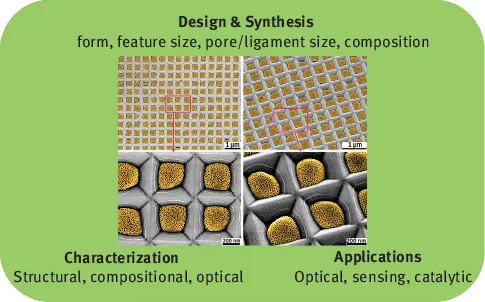
Metallic and bimetallic nanosponges with well-defined size and form have attracted increasing attention due to their unique structural properties and their potential for many applications. In this chapter, the recently developed methods for the synthesis and preparation of metallic and bimetallic nanosponges are presented. These methods can be mainly cataloged in two groups: dealloying-based methods and reduction reaction-based methods. Different topographical reconstruction methods for the investigation of their structural properties are then reviewed briefly. The optical properties of the metallic nanosponges are clearly different from those of the solid counterparts due to the tailored disordered structure. The recent advances in the exploration of the distinct linear and non-linear optical properties of the nanosponges are summarized.
The important advantage of bimetallic alloys, which has already been taken for a long time, is tailoring the desired properties (such as hardness, ductility, strength, weight, corrosion resistance, color, electrical and thermal conductivities, catalytic properties, etc.), by simultaneously tuning their composition and their microstructures/morphologies. The pioneering work on such bimetallic nanostructures and nanoparticles (NPs) was achieved in the 1960s for tailoring the optical and plasmonic properties, and colloidal Au@Ag core/shell NPs have been synthesized using 5.9 nm of Au nuclei [1]. In addition, the marvelous catalytic properties of bimetallic nanoclusters, due to their bi-functional effects, ensemble effect and size effect (for large surface area), have further stimulated the research interest on the synthesis and properties of nanoscale bimetallic structures [2, 3].
Recently, another type of interesting metallic catalysts emerged, namely nanoporous metals, whose large surface area is very profitable for the enhancement of the catalytic performance [4,5,6,7,8]. The 3D bi-continuous ligament/channel structures in such nanoporous metals enable a mass transfer and a charge transfer in a more efficient way as in solid structures during the catalytic reactions. The ligament/pore size of nanoporous metals can scale in a large range from a few nanometers to several hundreds of nanometers, determined by the fabrication conditions. In addition to the catalytic applications, the nanoporous metals can be also used for applications in sensing [5, 6] and actuation [9]. The most important method for the synthesis of the nanoporous metals is dealloying. Alloys with a noble element and another less noble element are often used, and during dealloying the less noble element is removed and the nanoporous structure of the noble element evolves. A very important example for that is nanoporous gold, which can be formed easily from an Au–Ag alloy [10,11,12,13].
In addition, the percolated ligament/channel structures of nanoporous metals allow the deposition of another type of metal, inorganic material or organic material, and nanoporous gold or nanoporous metals-based hybrid materials and nanocomposites have been fabricated. They demonstrated th...
Table of contents
Title Page
Copyright
Contents
1 Synthesis and characterization of size controlled bimetallic nanosponges
2 Controllable design, synthesis and characterization of nanostructured rare earth metal oxides
3 Synthesis and characterization of size controlled alloy nanoparticles
4 On the minimum reactant concentration required to prepare Au/M core-shell nanoparticles by the one-pot microemulsion route
5 Synthesis and characterization of graphene quantum dots
Index
Trusted by 375,005 students
Access to over 1.5 million titles for a fair monthly price.
Study more efficiently using our study tools.
Frequently asked questions
Yes, you can cancel anytime from the Subscription tab in your account settings on the Perlego website. Your subscription will stay active until the end of your current billing period. Learn how to cancel your subscription
No, books cannot be downloaded as external files, such as PDFs, for use outside of Perlego. However, you can download books within the Perlego app for offline reading on mobile or tablet. Learn how to download books offline
Perlego offers two plans: Essential and Complete
Essential is ideal for learners and professionals who enjoy exploring a wide range of subjects. Access the Essential Library with 800,000+ trusted titles and best-sellers across business, personal growth, and the humanities. Includes unlimited reading time and Standard Read Aloud voice.
Complete: Perfect for advanced learners and researchers needing full, unrestricted access. Unlock 1.5M+ books across hundreds of subjects, including academic and specialized titles. The Complete Plan also includes advanced features like Premium Read Aloud and Research Assistant.
Both plans are available with monthly, semester, or annual billing cycles.
We are an online textbook subscription service, where you can get access to an entire online library for less than the price of a single book per month. With over 1.5 million books across 990+ topics, we’ve got you covered! Learn about our mission
Look out for the read-aloud symbol on your next book to see if you can listen to it. The read-aloud tool reads text aloud for you, highlighting the text as it is being read. You can pause it, speed it up and slow it down. Learn more about Read Aloud
Yes! You can use the Perlego app on both iOS and Android devices to read anytime, anywhere — even offline. Perfect for commutes or when you’re on the go. Please note we cannot support devices running on iOS 13 and Android 7 or earlier. Learn more about using the app
Yes, you can access Multifunctional Materials by Challa Kumar in PDF and/or ePUB format, as well as other popular books in Technology & Engineering & Condensed Matter. We have over 1.5 million books available in our catalogue for you to explore.