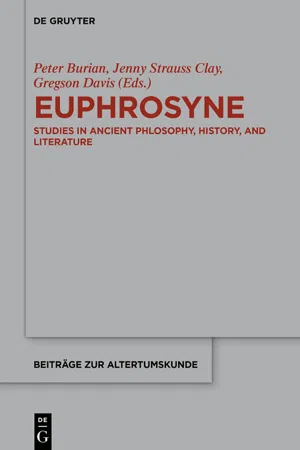
This book collects essays and other contributions by colleagues, students, and friends of the late Diskin Clay, reflecting the unusually broad range of his interests. Clay's work in ancient philosophy, and particularly in Epicurus and Epicureanism and in Plato, is reflected chapters on Epicurean concerns by André Laks, David Sedley and Martin Ferguson Smith, as well as Jed Atkins on Lucretius and Leo Strauss; Michael Erler contributes a chapter on Plato. James Lesher discusses Xenophanes and Sophocles, and Aryeh Kosman contributes a jeu d'esprit on the obscure Pythagorean Ameinias. Greek cultural history finds multidisciplinary treatment in Rebecca Sinos's study of Archilochus' Heros and the Parian Relief, Frank Romer's mythographic essay on Aphrodite's origins and archaic mythopoieia more generally, and Kyriakos Tsantsanoglou's explication of Callimachus's kenning of Mt. Athos as "ox-piercing spit of your mother Arsinoe." More purely literary interests are pursued in chapters on ancient Greek (Joseph Russo on Homer, Dirk Obbink on Sappho), Latin (Jenny Strauss Clay and Gregson Davis on Horace), and post-classical poetry (Helen Hadzichronoglou on Cavafy, John Miller on Robert Pinsky and Ovid). Peter Burian contributes an essay on the possibility and impossibility of translating Aeschylus. In addition to these essays, two original poems (Rosanna Warren and Jeffrey Carson) and two pairs of translations (from Horace by Davis and from Foscolo by Burian) recognize Clay's own activity as poet and translator. The volume begins with an Introduction discussing Clay's life and work, and concludes with a bibliography of Clay's publications.
eBook - ePub
Euphrosyne
Studies in Ancient Philosophy, History, and Literature
- 338 pages
- English
- ePUB (mobile friendly)
- Available on iOS & Android
eBook - ePub
Euphrosyne
Studies in Ancient Philosophy, History, and Literature
About this book
Information
Part I Philosophy
An Empedoclean Allusion in Lucretius (2.1081–3)
David Sedley
Diskin Clay was a treasured friend from our first meeting in 1974 to his death four decades later. That first encounter was at a conference based in the small northern French town of Bruay-en-Artois, a name to which Diskin took a particular fancy, inscribing it in the copy he gave me of his recently published slim volume of verse, Oxyrhynchan Poems. Such were the demands made by his poetic style that to my embarrassment I initially read the index of first lines as being itself one of the poems! Another idiosyncrasy I adored about Diskin was his down-to-earth policy with accents, of which he got along speaking with just two: one for English, and a second one for all the numerous ancient and modern foreign languages he knew. We shared many fond memories, among which he and I used to recall with especial frequency the sense of truant fun we enjoyed when, for one day of the 1995 Symposium Platonicum in Granada, we sneaked off for a trip into the Sierra Nevada, only to end up visiting, of all things, a ham museum.
The personal reminiscences could be continued indefinitely. But after his unique human qualities what I most remember and most miss Diskin for are his brilliant contributions to scholarship across a huge literary and philosophical range. Somewhere in that range lay Empedocles and Lucretius, about whom we both wrote frequently, and whose complex interrelation Diskin illuminated better than anyone else has done. The last time that I saw him in person, at a conference to honor Charles Kahn at Delphi in 2009, Diskin and I resumed our longstanding discussions of those two great philosophical poets, especially in the light of developments emanating from the new Strasbourg papyrus of Empedocles. His chapter, “Empedocles at Panopolis and Delphi,” in the resultant volume (Presocratics and Plato: Festschrift at Delphi in Honor of Charles Kahn, Las Vegas 2012), serves me as my own personal reminder of where Diskin and I found we had got to with our various agreements, disagreements and speculations. I hope that he would have enjoyed extending our discussion further, into the paper that now follows.
Near the end of book 1 (1.951–1051), Lucretius argues for the infinity of the universe, of space, and of body. At a matching point in book 2, again close to the book’s end, he takes up a directly dependent theme, the infinity of worlds (2.1022–1104).
Before examining this passage more closely, we should note a way in which Lucretius here, if only by his silences, adjusts the emphasis that he is likely to have found in his Epicurean source. The part of Epicurus’ On nature which corresponded to this section of the DRN, and which, whether or not it was as I believe it was his direct source,1was at all events his ultimate source, is summarized in his Letter to Herodotus as follows (45):
Also the number of worlds, both of those which are similar to this one and of those which are dissimilar, is infinite. For the atoms, being infinitely many as has just been proved, travel any distance; and the atoms of a suitable nature to be constituents of a world or responsible for its creation have not been exhausted on one world or on any finite number of worlds—neither worlds which are like ours nor worlds of other kinds. Therefore there is nothing to prevent there being an infinite number of worlds.
I note first, in passing, that Epicurus’ emphasis is firmly on the infinite number of worlds, whereas Lucretius chooses to place almost all his own emphasis on the plurality of worlds, with just the occasional indication that their number must in fact be infinite.2 Even to prepare his reader for the amazing idea that there should be any worlds other than our own (2.1044–66), Lucretius finds the need to start with a substantial apologetic preface (2.1023–43), in which he reminds Memmius that everything, however familiar it may be to us now, would amaze us if we encountered it for the first time.
This need to forestall the reader’s disbelief may also account for a further change of emphasis. The atomist tradition had always insisted that other worlds should not be expected all to be like our own, and Epicurus himself, we have seen, puts as much emphasis on the unlike worlds as on the like ones.3 Lucretius, by contrast, speaks throughout as if the other worlds that he is postulating will, like ours, consist of earth, sea, heaven etc., and contain the familiar range of animal species. Thus at 1058–66 he argues that
… this world was a product of nature, and it was the seeds of things themselves that, in clashing by spontaneous accident, after coagulating in manifold ways fruitlessly and to no effect finally joined up in a combination which, suddenly thrown together, could each time become the origin of great things: earth, sea, sky, and the tribe of animals. So again and again you must admit that there exist, elsewhere, other collections of matter of the same kind as this one which the aether holds in its possessive embrace.
And the point is repeated in the immediately ensuing argument (1067–76), where he concludes that, “there are other earths in other regions, and the various races of men and species of animals” (1075–6).4
It is now time to introduce the specific passage on which I have chosen to focus, 2.1077–89.
(A) huc accedit ut in summa res nulla sit una,
unica quae gignatur et unica solaque crescat,
quin aliquoius siet saecli permultaque eodem
sint genere. (B) in primis animalibus indice mente 1080
invenies sic montivagum genus esse ferarum,
sic hominum geminam prolem, sic denique mutas
squamigerum pecudes et corpora cuncta volantum.
(C) quapropter caelum simili ratione fatendumst
terramque et solem, lunam mare cetera quae sunt, 1085
non esse unica, sed numero magis innumerali;
(D) quandoquidem vitae depactus terminus alte
tam manet haec et tam nativo corpore constant
quam genus omne quod his generatimst rebus abundans.
(A) To this is added the fact that in the world no single thing is the only one to be born and the unique and only one to grow, as opposed to belonging to some species with numerous other members of the same kind. (B) Using your mind to show you the way you will find, among animals above all, that this is true of the mountain-wandering race of beasts; true of the twin progeny of mankind; true moreover of the silent flocks of scale-bearers and all the living things that fly. (C) Therefore you must similarly admit that the sky, earth, sun, moon, sea and so on are not unique, but rather in number beyond number,5 (D) given that a deep-set limit of life just as much awaits them, and that they are constituted by a body just as subject to birth, as every species that is for this reason abundant according to its kind.
The argument has the following broad structure:
- 1077–80. Nothing comes into being and grows as the sole member of its kind.
- Animal species are an example of this.
- 1084–6. Hence we must infer that sky, earth, sun, moon, sea, etc. are likewise each of them just one among innumerable specimens of the same kind.
- 1087–9. For each of them is just as much subject to birth and death as any familiar species with multiple members.
Here steps A and B are straightforward. The inference to C is less so: just as every individual animal is merely one member of a species, the inference seems to run, so too each of the apparently singular parts of our world—sky, earth, sun, moon, sea, etc.—can be assumed to be merely one member of a kind. The missing further step has to be that, since by analogy with animals there are innumerable additional world-components (sky, earth, sun etc.) beyond those constituting our world, there must also be additional worlds, namely the worlds constituted by those components.
At this stage, we should pause to note the curiously circuitous route taken by the argument. What, we may ask, is gained by first inferring analogically from the multiplicity of members in each animal species to the multiplicity of world parts, then, by a further part-to-whole inference, proceeding from the multiplicity of world parts to the multiplicity of the worlds themselves? What was gained by not simply relying on an analogical inference from the multiplicity of members of animal species to the multiplicity of worlds, as if worlds themselves constituted a further species? Note at least the following implication of Lucretius’ chosen strategy here. Since the existence of other worlds is inferred from the expectation that there are multiple skies, earths, oceans, suns and moons, the underlying assumption is that the other worlds, viewed as wholes, are going to be very much like our own. This conforms to the pattern I have already noted, one that distinguishes Lucretius’ own emphases from those visible in the Greek Epicurean texts.
The final step, D, is still more curious. In order to confirm his intermediate premise (C), regarding the multiplicity of world components such as sky and earth, Lucretius in D points out something else that world-components have in common with indiv...
Table of contents
- Title Page
- Copyright
- Contents
- Introduction
- Part I Philosophy
- Part II Archaeology, Topography, Epigraphy
- Part III Poetry: Interpretation
- Part IV Poems (original and translation)
- The Publications of Diskin Clay
Trusted by 375,005 students
Access to over 1.5 million titles for a fair monthly price.
Study more efficiently using our study tools.
Frequently asked questions
Yes, you can cancel anytime from the Subscription tab in your account settings on the Perlego website. Your subscription will stay active until the end of your current billing period. Learn how to cancel your subscription
No, books cannot be downloaded as external files, such as PDFs, for use outside of Perlego. However, you can download books within the Perlego app for offline reading on mobile or tablet. Learn how to download books offline
Perlego offers two plans: Essential and Complete
- Essential is ideal for learners and professionals who enjoy exploring a wide range of subjects. Access the Essential Library with 800,000+ trusted titles and best-sellers across business, personal growth, and the humanities. Includes unlimited reading time and Standard Read Aloud voice.
- Complete: Perfect for advanced learners and researchers needing full, unrestricted access. Unlock 1.5M+ books across hundreds of subjects, including academic and specialized titles. The Complete Plan also includes advanced features like Premium Read Aloud and Research Assistant.
We are an online textbook subscription service, where you can get access to an entire online library for less than the price of a single book per month. With over 1.5 million books across 990+ topics, we’ve got you covered! Learn about our mission
Look out for the read-aloud symbol on your next book to see if you can listen to it. The read-aloud tool reads text aloud for you, highlighting the text as it is being read. You can pause it, speed it up and slow it down. Learn more about Read Aloud
Yes! You can use the Perlego app on both iOS and Android devices to read anytime, anywhere — even offline. Perfect for commutes or when you’re on the go.
Please note we cannot support devices running on iOS 13 and Android 7 or earlier. Learn more about using the app
Please note we cannot support devices running on iOS 13 and Android 7 or earlier. Learn more about using the app
Yes, you can access Euphrosyne by Peter Burian, Jenny Strauss Clay, Gregson Davis, Peter Burian,Jenny Strauss Clay,Gregson Davis in PDF and/or ePUB format, as well as other popular books in Literature & Ancient & Classical Literary Criticism. We have over 1.5 million books available in our catalogue for you to explore.